Active reading was never about highlighting: how AI reading assistants get it right (and wrong)
Updated · 12 min read
Listen to this post
Contents
- A highlight is a decision, not a result
- AI gets it wrong when every line looks important
- Help belongs beside the difficult passage
- A mark should keep your reason with the words
- Structure makes return possible
- Active reading includes the right to leave things unmarked
- A more honest measure of a reading tool
- Frequently asked questions
- Is highlighting useless?
- Should a reading assistant highlight passages for me?
- What makes an explanation trustworthy while reading?
- What should a note on a highlight say?
- References
Read. Notice. Return.
A marked passage is not the same as an understood one. It is a place to begin.
That distinction matters as AI reading assistants become better at selecting, explaining, and condensing text. They can make difficult material easier to enter. They can also make the gestures of reading feel complete before the thinking has begun.
Active reading was never about coloring more lines. It was about making choices: what matters here, what does it mean, where does the argument turn, and why might I need this again?
In short: a highlight records where you looked, not what you understood. A reading assistant helps when it keeps explanations beside the passage and leaves the choice of what to mark, and why, with you.
A highlight is a decision, not a result
Highlighting has a sensible appeal. A sentence seems important, so you mark it. Later, the mark offers a route back.
But a highlight alone cannot tell you whether you understood the sentence, how it supports the author's claim, or why you chose it. It preserves a location. It does not preserve the reader's reasoning.
Research on study strategies offers a useful, measured warning. In their review of ten learning techniques, Dunlosky and colleagues rated highlighting and underlining as low utility overall. Their abstract puts the point plainly: "Most students report rereading and highlighting, yet these techniques do not consistently boost students' performance, so other techniques should be used in their place (e.g., practice testing instead of rereading)." (Dunlosky et al., 2013) The same review gave its highest rating to practice testing, the approach Roediger and Karpicke found improved retention after two days and a week compared with restudying (Roediger and Karpicke, 2006).
That finding is not a verdict against every highlight. It is a reason to ask what the act of marking is doing. Is it helping a reader select and organize an idea, or simply making a page look studied?
Miyatsu, Nguyen, and McDaniel take a useful next step (Miyatsu et al., 2018). Rather than dismissing the study habits students prefer, highlighting among them, they look at where each one goes wrong and set out tips for using it better. Their framing is about implementation: the same habit can help or not depending on how it is done.
A practical version of that idea is to hold the pen on the first pass. Read a section through, then decide what deserves a mark. A mark chosen after you have seen where the argument goes is more likely to reflect a decision than a reflex.
The question, then, is not whether highlighting is good or bad in itself. It is whether the act of marking is connected to the act of thinking, and whether the tool helps you make a thoughtful mark and gives you a reason to return.
A highlight is a signal. Understanding is the work around it.
AI gets it wrong when every line looks important
An AI assistant can scan a long paper and highlight terms, claims, definitions, and apparent conclusions. Sometimes this is useful. When a PDF is dense or unfamiliar, a few signposts can help you find your bearings.
But if the system highlights everything it judges to be important, it removes the reader's most valuable decision: choosing what deserves attention for this reading. The result may be a page covered in signals, each of them competing for the same glance.
The problem is not simply quantity. It is authority. An automatic mark can look like a settled answer about what matters. Yet a claim that is central to the author may be peripheral to your question. A caveat that seems small to a general-purpose model may be the detail your project depends on.
An AI reading assistant should therefore offer marks as suggestions, not judgments on your behalf. It can point to a definition or show where a claim appears. You should be able to ignore the suggestion, keep it, question it, or add a note about why it matters.
That is a different idea of what a mark is for. Not a machine that covers the page with important-looking passages, but a reading space that helps you stay with the source and keeps your choices attached to it. For the practical side of choosing what to mark, see a PDF highlighting strategy.
AI can point. The reader still decides.
Help belongs beside the difficult passage
A reader meets difficulty locally. One paragraph resists. A term has a specialized meaning. A sentence depends on a distinction that becomes clear only in the next few lines.
The easy move is to leave the document, paste the phrase into a chat window, and read an answer there. That answer may be useful. But now the explanation and the passage are separated. You have to remember where the answer fits and check whether it matches the author's use of the words.
An assistant that explains a selected passage beside the text preserves that check. You can compare the explanation with the sentences around it, then decide whether it holds. The assistant supports the reading; it does not finish the argument for you.
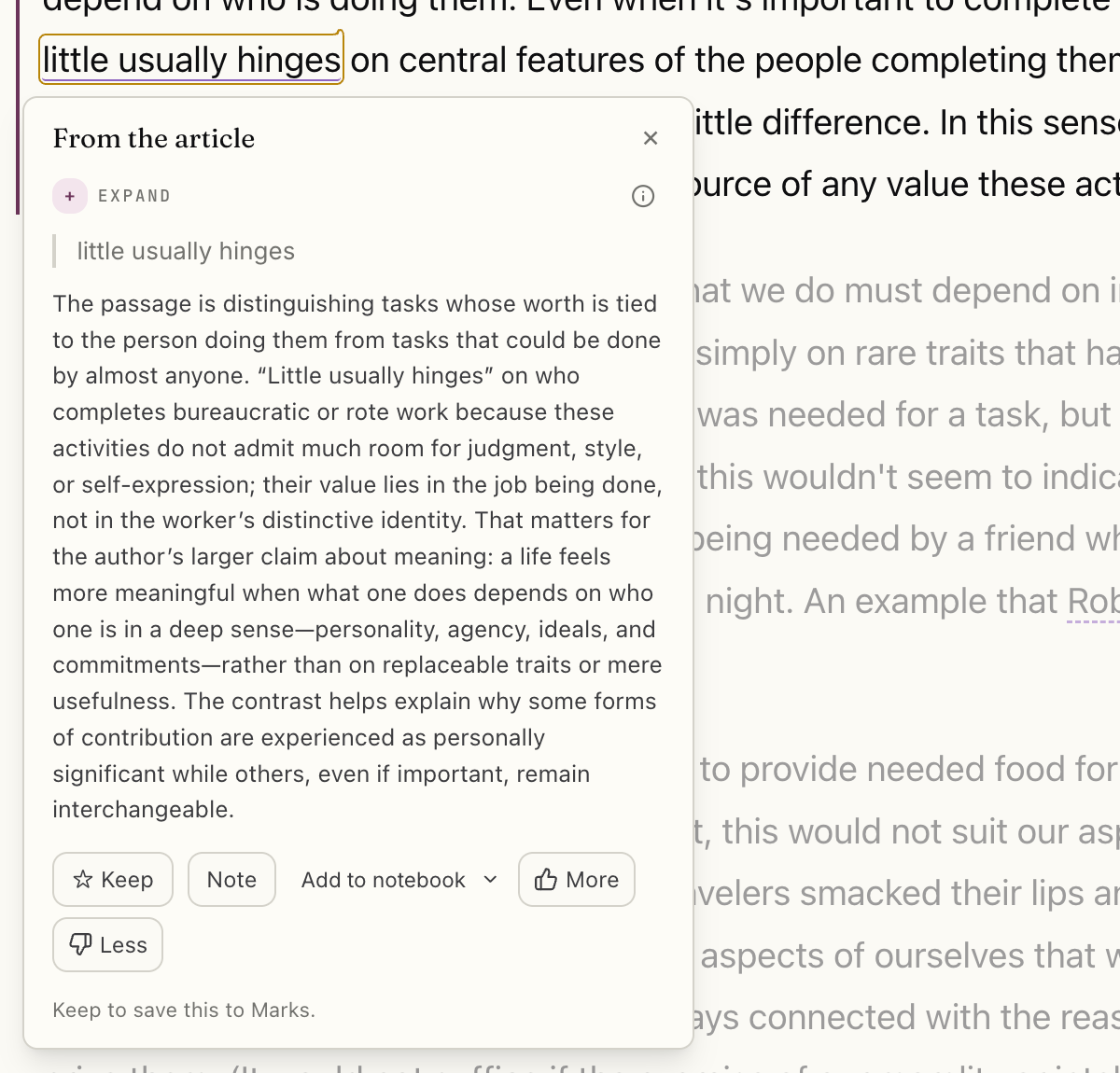
This is one difference between an AI assistant built for reading and one built mainly for answers. The first keeps the source present. The second may give you a fluent account of an excerpt while leaving the larger structure out of sight.
A summary still has a place. It can orient you before you commit to a long article, help you re-enter a source you have already read, or let you decide whether a paper belongs on your list. But a summary is not proof that you followed the reasoning, noticed the qualification, or understood why the evidence supports the conclusion. Reading comprehension asks for that closer work: resolve the hard passage, check the explanation in context, and continue with the source. If you do lean on a summary, seven questions to ask before you trust one is a useful check.
An answer may help you re-enter. It cannot stand in for the passage.
A mark should keep your reason with the words
A quotation lifted into a notes app often loses the context that gave it meaning. The few words you copied may be accurate, but the turn before them or the qualification after them may be gone.
A better mark remains connected to the passage and to the reader's note. "Important" is a useful label. "Important because it contradicts the earlier assumption" is more useful still. "Confusing" can be a record of unfinished work, not a failure. "Disagree" keeps a question open. "Use later" gives a passage a future without pretending the reason is already clear.
In Omphalis, highlights are anchored to their words and nearby text. You can add a note, apply a tag (Important, Confusing, Disagree, or Use later) and return through a Marks list. That means the saved item can carry both the author's passage and the reader's response.
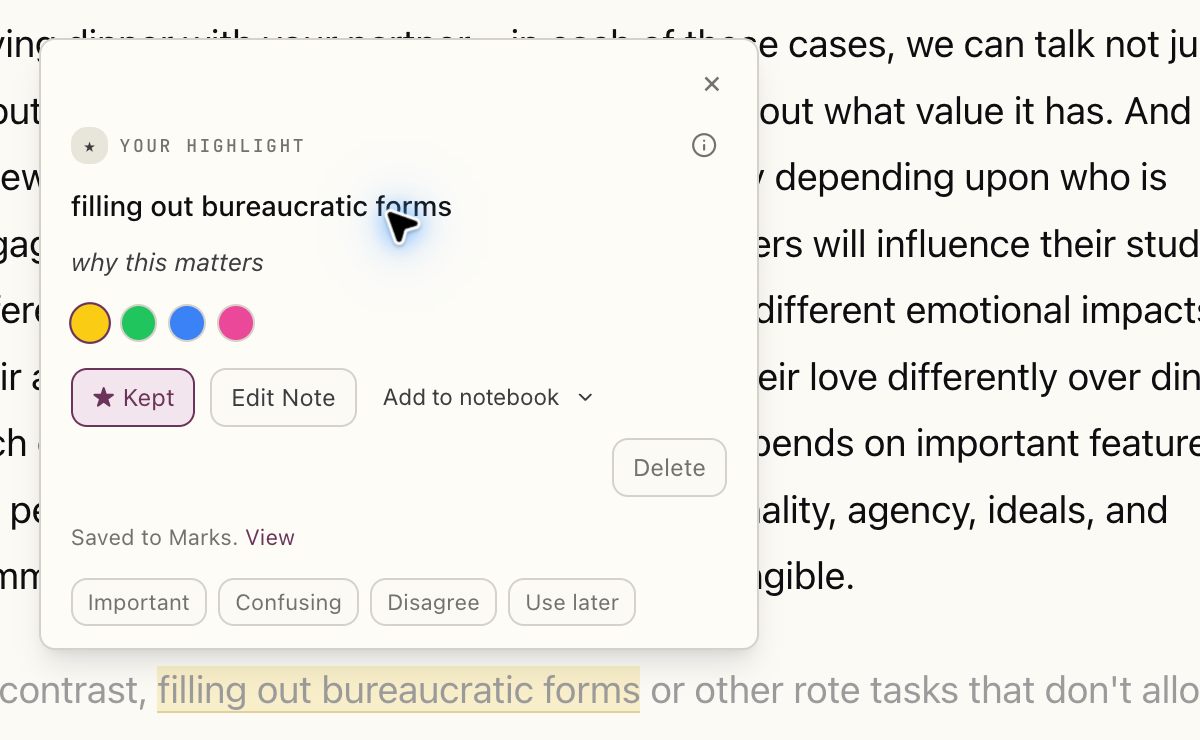
This is a small design choice with a larger consequence. When a note stays beside its source, your interpretation does not have to compete with a generic AI summary for status. The system can help organize what you kept. But the significance of that mark belongs to the person who made it.
This is also where a knowledge extraction tool needs a more careful definition. Extracting information is not only pulling out candidate facts or producing a condensed account. It can mean helping a reader preserve the passages, questions, and connections they chose to keep. Extraction should make material usable without pretending that the extracted pieces are the whole argument.
Keep the passage. Keep the reason.
Structure makes return possible
Reading a long source is not just moving from sentence to sentence. It is following a shape: a question, a claim, evidence, a limitation, perhaps a turn that changes what came before.
A list of highlights can help you revisit individual passages. It cannot, by itself, show how those passages relate. If every marked sentence arrives as an isolated extract, a central qualification may appear no different from a useful example.
That is why an active reading assistant should help readers see structure as well as selected words. A cleaned reading page, a section map, and marks that lead back to the original passage offer different kinds of orientation. None replaces careful reading. Together, they make it easier to see where you are and where you might return.
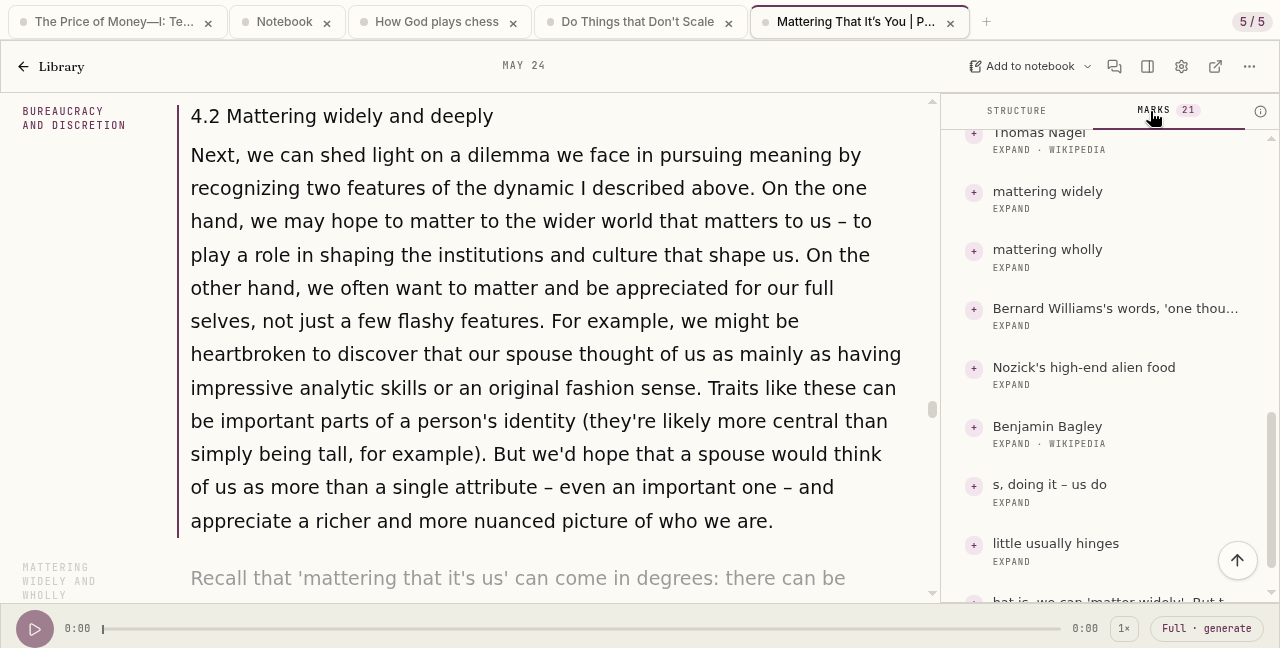
For a researcher returning to a paper days later, the most useful path may not lead to the abstract. It may lead to a marked result, the caveat beside it, and a note that says what still needs checking. For someone reading a long essay, the path may lead to the passage where the author changes direction.
Those are not generic summaries. They are traces of a person's attention.
Active reading includes the right to leave things unmarked
There is a quiet pressure in digital reading tools to capture everything: every insight, every definition, every sentence worth saving. But a reading practice that keeps every possible thing can leave the reader with another archive to sort through.
Not all useful reading produces a note. Sometimes you understand a difficult paragraph and move on. Sometimes you decide a detail is not relevant. Sometimes the best thing to keep is a question you cannot yet answer.
An assistant should make those choices easier, not automate them away. It should be able to surface a passage, clarify a term, and help you return to the author's words. It should not insist that every reading moment become an annotation or that every annotation become a lasting insight.
That boundary is important because AI can make information look settled. A tidy summary, confidently worded, may create the feeling of comprehension without showing which parts of the source support it. A system that keeps the source visible and makes its explanations checkable gives you room to notice an error, a missing qualification, or a different interpretation.
The point is not to distrust every generated explanation. It is to keep the conditions for judgment in view.
Assistance should preserve the reader's agency, not imitate it.
A more honest measure of a reading tool
It is tempting to judge an AI reading assistant by how much it can produce: summaries, highlighted passages, answers, notes. Those capabilities can be useful. But output volume is a poor measure of whether a reader stayed engaged with the source.
A better test is quieter. Can you see the argument's structure? Can you get help with a difficult sentence without losing your place? Can you keep your note beside the passage that prompted it? Can you return later and recover not just the quote, but the context and your reason for saving it?
The research on highlighting does not establish that AI annotations improve comprehension. Nor does it show that a tool with better marks will automatically create better reading. It does offer a useful constraint: selection matters, and implementation matters. A mark may help when it reflects the reader's thought. A system that produces marks in place of thought risks confusing visibility with understanding.
That is why active reading was never about highlighting alone. It is about following, selecting, questioning, and returning. AI can support those movements when it keeps explanations close to their sources and treats your marks as meaningful data. It gets in the way when it decorates the page, replaces the reading with a summary, or mistakes its own selection for yours.
To see how this feels, open a sample source in the Omphalis demo. Start with one passage that slows you down and read the explanation beside it. When you want to do the same with a piece of your own and keep the note, save it to read later and add a note only where there is something you want to carry forward.
A way back is useful. The meaning remains yours.
Frequently asked questions
Is highlighting useless?
No. Dunlosky and colleagues rated it low utility because it does not consistently improve performance, not because it never helps. A mark chosen for a reason, with a note about that reason, gives you something to return to and test yourself on. The comparison is laid out in active reading vs highlighting.
Should a reading assistant highlight passages for me?
Suggestions can help you find your bearings in an unfamiliar document. They work best when you can ignore, keep or question each one, so the decision about what matters stays yours.
What makes an explanation trustworthy while reading?
Being able to check it against the passage. An explanation that opens beside the sentence lets you compare it with the surrounding text before you accept it.
What should a note on a highlight say?
Why you marked it: the claim it supports, the question it raises, or where you disagree. One sentence is enough if it would still make sense to you a month later.
References
- Dunlosky, J., Rawson, K. A., Marsh, E. J., Nathan, M. J., & Willingham, D. T. (2013). "Improving students' learning with effective learning techniques." Psychological Science in the Public Interest, 14(1), 4 to 58. PubMed
- Miyatsu, T., Nguyen, K., & McDaniel, M. A. (2018). "Five popular study strategies: their pitfalls and optimal implementations." Perspectives on Psychological Science, 13(3), 390 to 407. PubMed
- Roediger, H. L., & Karpicke, J. D. (2006). "Test-enhanced learning: taking memory tests improves long-term retention." Psychological Science, 17(3), 249 to 255. PubMed