Omphalis vs MarginNote

MarginNote turns excerpts into mind maps and flashcards. Omphalis helps you get through the source.

MarginNote 4 is a reading and study app for iPhone, iPad, and Mac. Highlight a PDF or EPUB and each excerpt becomes one card: a highlight on the page, a node in a mind map you can also read as an outline, and a flashcard reviewed on a spaced-repetition schedule. It also takes web pages and video, and it works offline. Omphalis has no mind maps and no flashcards. If building a mind map or reviewing flashcards from a textbook is the job, stay with MarginNote.

Omphalis is for a different job: getting through dense sources and returning to them, across formats. PDFs and papers, articles, podcasts, and YouTube talks open as one cleaned reading page with a section map. Explanations open beside a hard passage, marks with notes reopen that passage in the source, Listen narrates the text, and Ask answers with citations you can follow back.

Start free

New accounts get a 30-day trial of every feature, no card needed. After that, Free stays free.

Disclosure: this comparison is written by Omphalis about its own product, so it is not a neutral review. We are not paid by MarginNote or by anyone else to be compared favourably, this page carries no affiliate links, and every claim about MarginNote is checked against their own public documentation. Read the full disclosures, and tell us if something here has gone out of date.

Checked September 29, 2026 against MarginNote's homepage, features page, assistant features page, pricing page, research workflow page, What's New page and Anki comparison page. Our suggestions about fit are our judgment.

Start with the task you have in mind

Turn a textbook into a mind map and flashcards

In MarginNote

Highlight a passage and MarginNote makes it a card automatically. That one card is a highlight on the page, a node in the mind map, and a flashcard in review. Arrange cards in ten mind-map styles (tree, fishbone, timeline, concept map, matrix and more), read the same map as an outline, and review on an FSRS spaced-repetition schedule. Anki decks import and export both ways.

In Omphalis

Omphalis does not do this. It has no mind maps, no flashcards, and no review schedule, and its section map shows the parts of a source rather than a structure you build from excerpts. If the textbook has to become a map and a deck, keep MarginNote. What Omphalis keeps is the mark itself: a highlight on the passage, a note about why it stopped you, and a tag such as Confusing.

Come back to a highlight with the text around it

In MarginNote

Every card is pinned to the page it came from, and from any card one click opens the PDF at that page and highlight. Title Link goes a step further: each card's title becomes a keyword, so when a concept from your past notes appears in a new document, it lights up on the new page as an automatic backlink. Wiki-style card links and global search keep an old highlight findable.

In Omphalis

The mark stays on the passage in the cleaned reading page rather than moving into a card. The Marks rail lists your marks beside the open source, and in the Library Marks list, selecting a mark shows it in context, and Open article returns you to that passage with the sentences around it still in view. The note you left says why it mattered.

Work through a dense PDF you have to understand

In MarginNote

Annotate the PDF itself, with OCR for equations, tables, and handwriting (advanced OCR is part of Max), or long-press anywhere on the page to open room for an Extended Note. A Study Set keeps a course's PDFs, EPUBs, lecture video, and lecture audio together. Since version 4.2, language-model features let you ask about a selected passage, generate a table of contents for a PDF that has none, write chapter summaries, and draft quiz questions. Each suggestion can be accepted, edited, or rejected, and these features draw on credits: each App Store plan starts with 500, and Max adds 500 a month (for the first three years on Max Lifetime).

In Omphalis

Open the PDF or paper, or an article, podcast episode, or YouTube talk, as one cleaned reading page with a section map, so you can see the shape of a long piece and jump to a part. Chapters appear only when the source declares them, as a PDF outline does; Omphalis does not generate them. Open an explanation (Source, Define, or Expand) beside a hard passage, or select your own phrase and choose Learn more; explanations are few by design. Choose Listen to hear it read aloud. Ask a question and follow its citations back to the passage. The reading page shows extracted text, so keep the original PDF for figures, tables, equations, and layout. PDFs are read on paid plans and during the 30-day trial.

Where a mark takes you back

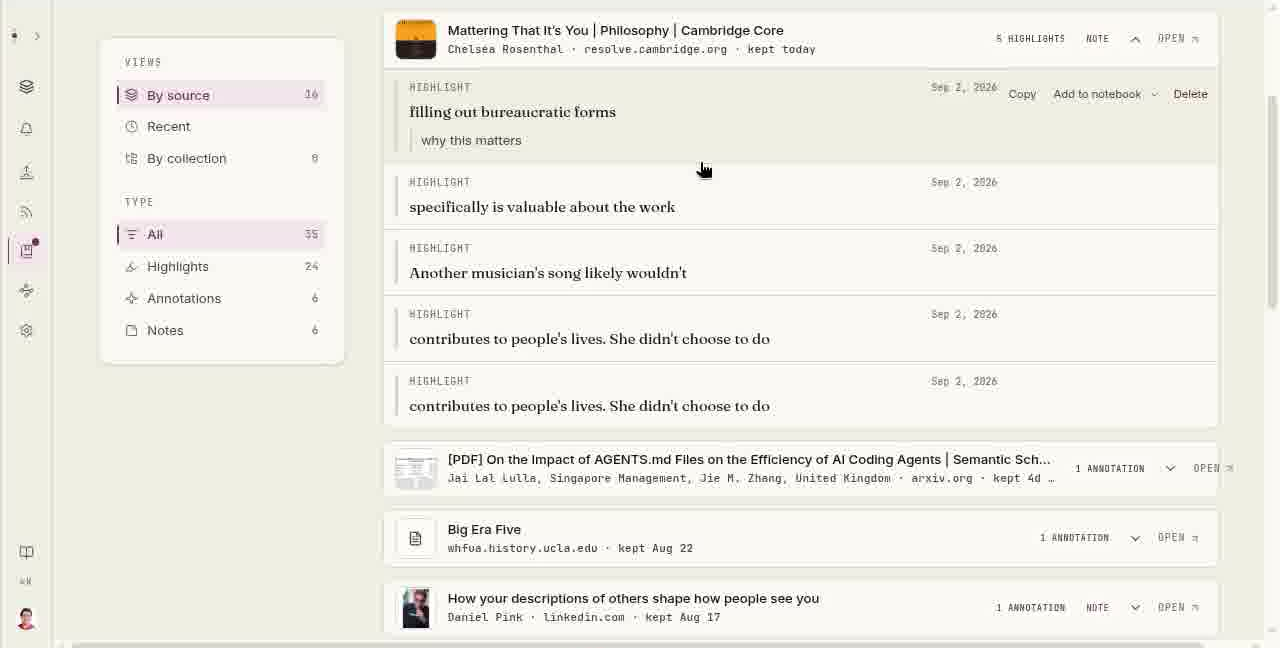
MarginNote moves an excerpt into a card you can arrange and review. An Omphalis mark stays a way back into the source. This is the Library Marks list, grouped by source: five highlights kept from an article, one with a note beneath it, and Open beside each source to go back into it.

The library Marks list grouped by source, with five highlights from Mattering That It’s You, one carrying a note, and Open beside each source
Marks collected in the library, grouped by source. Select a mark to see it in context and open the source at that passage.

Select the image to see the detail.

Which would I try?

MarginNote, for maps and flashcards

Keep MarginNote if a textbook has to become a mind map, an outline, and a deck you review on a schedule, or if you write by hand on an iPad as you read. One card serving as a highlight, a map node, and a flashcard is a real design, and Omphalis has nothing like it. MarginNote also works offline and brings Anki decks in and out.

Visit MarginNote →

Omphalis, for getting through the source

Try Omphalis with one dense paper, report, podcast, or talk you have to understand and will need again. Read the cleaned page, open an explanation beside the passage that stops you, leave a note, and reopen it later from Marks. It runs in the browser and on iOS and Android.

See the Omphalis reading workflow →

The two can sit side by side: keep your maps and decks in MarginNote, and read the papers, articles, and talks you need to understand closely in Omphalis. Open the same hard section in both and see which one gets you through it.

Also compare Omphalis with Pocket, Omnivore, Instapaper, Matter, Glasp, Readwise, Heptabase, NotebookLM, Snipd, LiquidText, Elicit, Mindgrasp or Eightify.

Before you choose

Is Omphalis a MarginNote alternative?

Only for part of what MarginNote does. If you use MarginNote to build mind maps and review flashcards from a textbook, Omphalis is not an alternative: it has no mind maps, no flashcards, and no spaced review. If you mainly use MarginNote to read dense PDFs and come back to your highlights, Omphalis is worth trying. It reads PDFs and papers, articles, podcasts, and YouTube talks as one cleaned page with a section map, with explanations beside hard passages, marks with notes that reopen the passage, Listen, and Ask with citations.

Which highlight apps keep the surrounding text?

Both of these do, in different ways. In MarginNote every highlight becomes a card pinned to its page, one click opens the PDF at that page and highlight, and MarginNote says the surrounding material is one tap away during review. In Omphalis the mark stays on the passage in the cleaned reading page; the Marks rail and the Library Marks list reopen that passage with the sentences around it in view, and a note can record why it stopped you.

What is a good study app for dense PDFs?

It depends on how you study. If you learn by turning a textbook into cards, maps, and scheduled review (MarginNote describes medical school, law school, and professional exams among its uses), MarginNote is built for that on iPhone, iPad, and Mac. If you learn by getting through the argument of a dense paper or report and returning to the hard parts, Omphalis gives you a section map, explanations beside the passage, marks with notes, narration you can listen to, and Ask with citations. Omphalis shows extracted text, so keep the original PDF for figures, tables, and equations.

Does Omphalis make flashcards or mind maps?

No. Omphalis has no flashcards, no spaced review, and no mind maps. Its section map shows the parts of a long piece so you can move through it; it is not a map you build from your excerpts. If you want those study tools, MarginNote has them, and it imports and exports Anki decks.

Does Omphalis run on the same devices as MarginNote?

Not the same way. MarginNote 4 is sold through the App Store for iPhone, iPad, and Mac, with a separate Mac-only download, and says it has no Windows client. Its App Store plans are listed in US dollars at $12.99 once for Pro (iPhone and iPad only), $16.99 a year for Max, or $51.99 once for Max Lifetime; Max adds the Mac, and App Store prices vary by region. Omphalis is a web app with iOS and Android apps and a browser extension; there is no desktop app. Omphalis Free is $0 and Pro is $9 a month or $90 a year, with a 30-day trial and no card. PDFs are read on paid plans and during the trial. Prices checked September 29, 2026.
Written by Last updated