Reading comprehension
Explain a hard paragraph without leaving the document.
Bring the article, paper, or PDF you are working through. Select the span that will not click, open an explanation beside it in Omphalis, and check that gloss against the author’s next sentence. Then write down what you now understand, on the passage.
Explaining the hard span in place is how you understand a source while you read it. A shorter account of the piece can help you decide whether it belongs on the list, but it does not finish the paragraph in front of you.
Start free
30-day trial, no card required. Includes 600 comprehension units, 200 Ask voice minutes and 15 assistant answers a day. After that, Free stays free. See plan allowances.
See it on a real piece first →
Updated
What happens when you keep rereading one paragraph?
You know the feeling. The same sentence, again, and no new grip on it. The next move is often to copy the paragraph into another window. The answer comes back fluent. Your place in the argument is gone, and the sentence after the hard one is still unread.
Leaving the document breaks the check that makes a gloss useful. You need the author’s wording in view while you read the explanation, so you can see whether the gloss matches this use of the words. Chelsea Rosenthal’s Mattering That It’s You is the example below. The phrase “little usually hinges” is doing specific work in her argument about meaningful work. The explanation opens on that phrase, inside the essay.
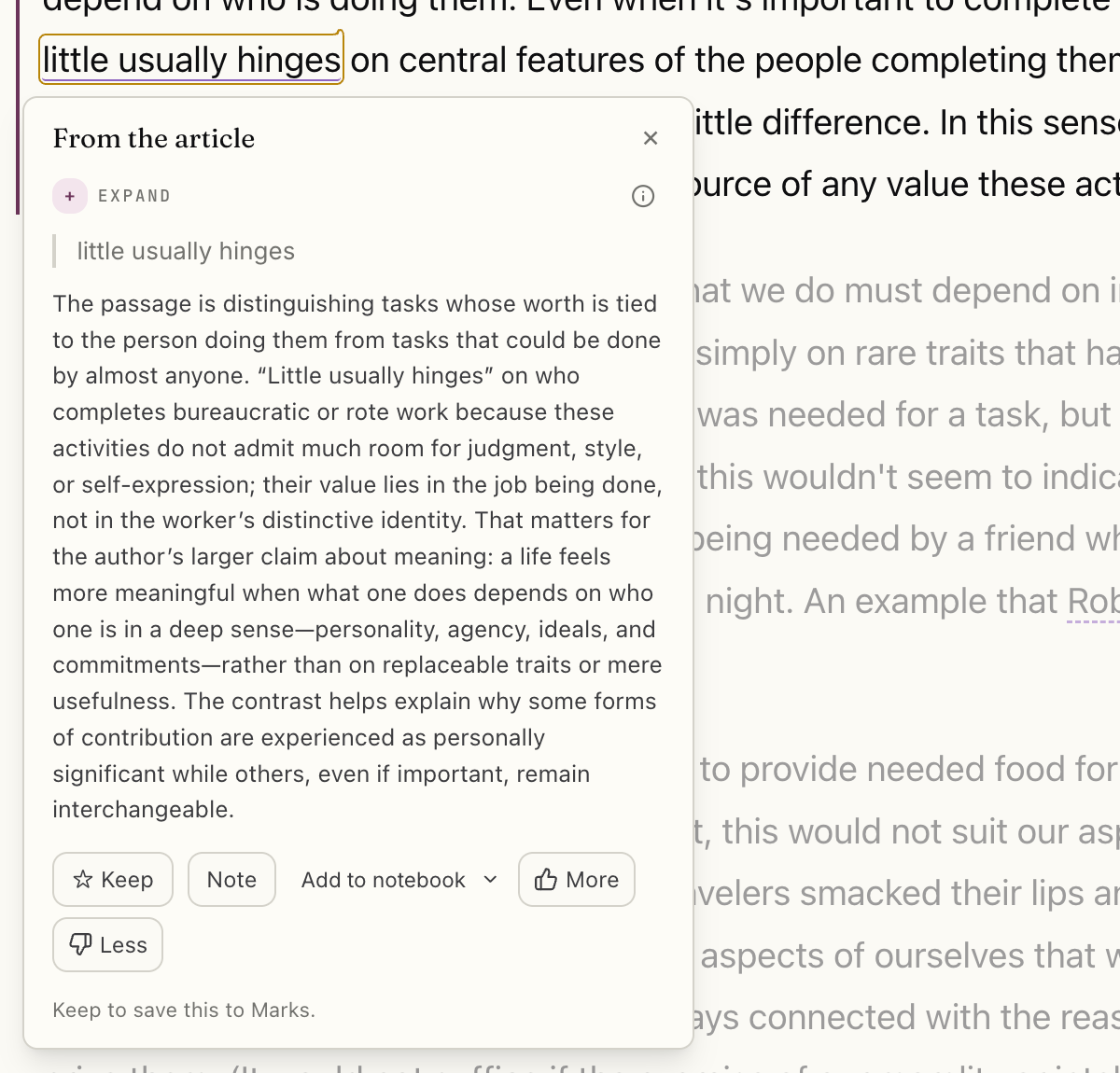
Select the image to see the detail.
The margin, in this sense, is the place the help belongs. The quiet comeback of the margin is the longer note on why a mark beside the text outlasts a detached extract.
What does understanding a source while you read involve?
A tidy summary is good at one thing: orientation. After you have read a fluent gist, you can often say what the piece is about. You still may not be able to explain the turn in the method, the caveat that limits the result, or why you saved it. That gap shows up later, when you try to use the source in your own work.
Understanding while you read includes four things a gist does not guarantee. You can see the shape of the argument. You can resolve a local difficulty in place. You can leave a mark that records your reason, not only the author’s sentence. You can return to that mark on a later day. Omphalis is for that recurring work with sources that matter.
A summary is still the right first move when you are triaging a stack, re-entering a piece you have already read carefully, or deciding whether a source belongs on the list at all. Use it for that, then read the ones you intend to finish. A summary of a paper is not the reading, and what summaries do to deep reading is the research-facing version of the same point. The case for comprehension is ours.
What should an explanation beside the passage do?
Select the hard span. Open the explanation beside it. Compare it with the surrounding sentences. Add your own note. Keep reading. The help is local, and the document remains the thing you are finishing.
Ground the gloss in this passage
A dictionary sense is not enough when the author is using a phrase to carry a distinction. In Rosenthal’s essay, “little usually hinges” separates tasks whose worth is tied to the person doing them from tasks almost anyone could complete. The explanation in the card is about that use. On a PDF, the same pattern is an explanation opened on a term in the paper, which is what reading a PDF in Omphalis is for.
Leave the judgment with you
Assistance clarifies the formulation but does not decide whether you agree, or whether the evidence holds. After you understand the sentence, the useful record is your own: a note on what it means for your work, what you doubt, or what you want to check. Tag the passage Confusing when the reason you marked it was that it would not yield. The card below is that mark on a Paul Graham essay: the explanation is kept, Confusing is one of the tags, and the passage is saved to Marks.
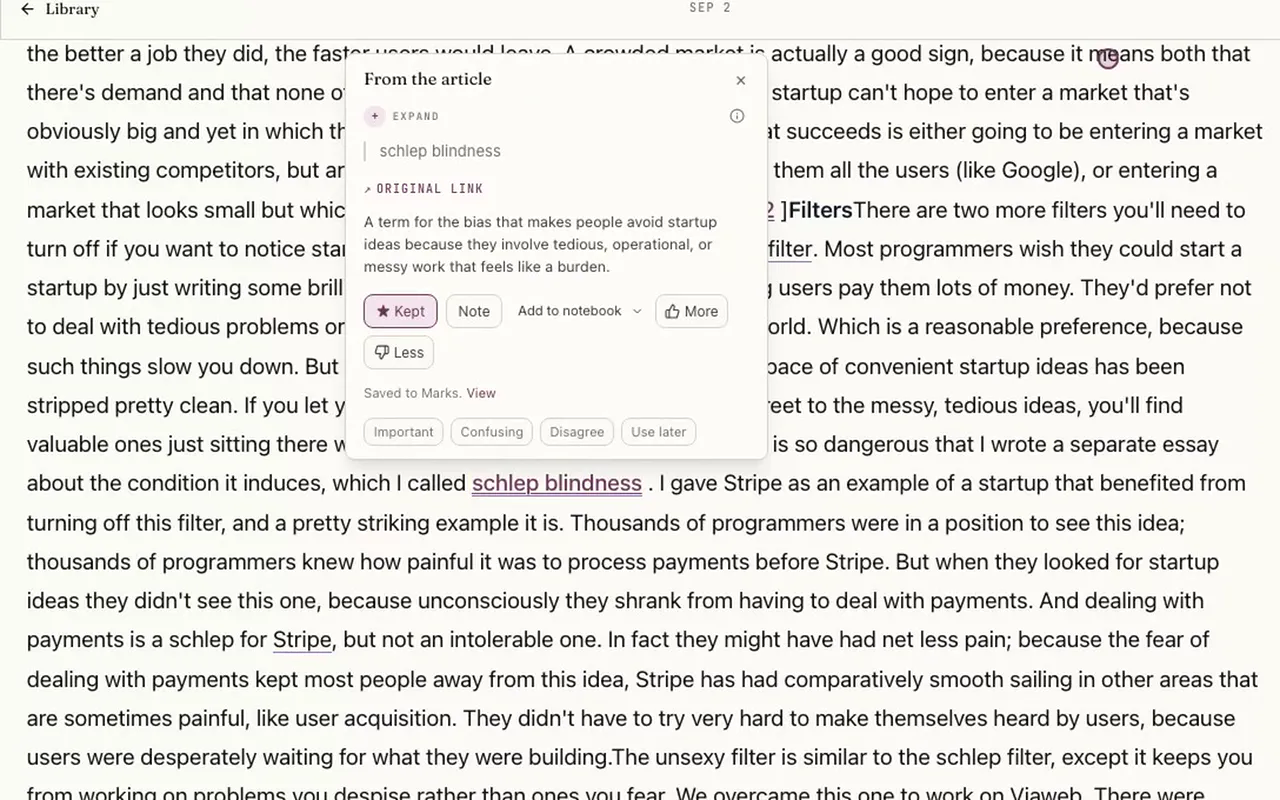
Select the image to see the detail.
When is a separate notebook the right tool?
In-place explanation is the wrong hero when the task is a set of sources. NotebookLM is excellent at questions across uploads, study guides, briefings, and a spoken overview of the set. In-place explainers on the web and in PDF apps answer a closer question: help on a selection while the page is open. Excerpt workspaces such as LiquidText answer yet another: pull passages out and rearrange them.
Keep the study notebook when multi-source artifacts are the primary need. The comparison is on Omphalis and NotebookLM. Use an in-document explanation when you have one hard source you intend to finish, and you need to check the gloss against the next sentence immediately. One hard source and an immediate check is the ordinary case for professionals mid-read on a paper, a report, or a long essay.
How should help work without becoming the reader?
Map the sections so you can see what is ahead. Explain a stuck span beside the text, and only there. Keep notes on the passage. Leave the caveats in the source, where you can read them. The reader of record is still you.
A practical loop on one source looks like this. Orient with the section list. Read. Mark the turns and the confusing spots. Open a local explanation only where you are stuck. Close the piece by saying the claim in your own words. Return later through a mark, with the passage still attached.
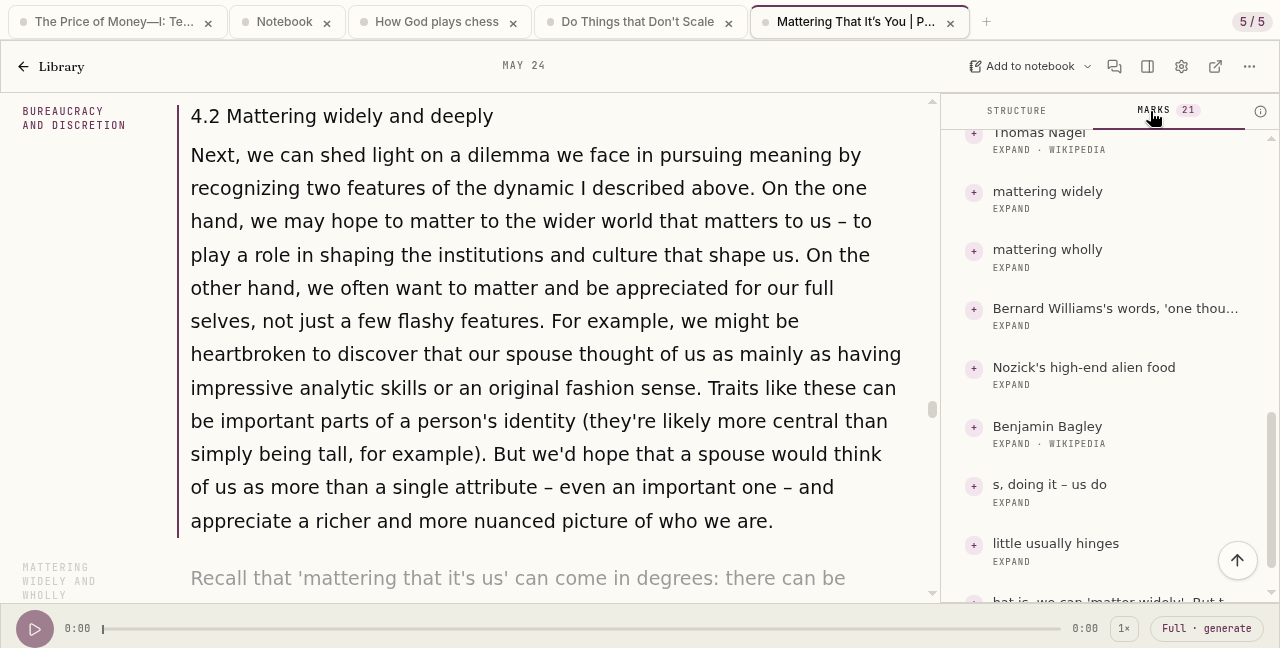
Select the image to see the detail.
The same return works on a PDF you are finishing. Reading a PDF without losing the plot walks through that case. The product page for the file itself is mark a confusing PDF passage and return.
How does Omphalis explain a hard passage in place?
Open the source. The reading view keeps the text and its sections together. An explanation opens on a difficult phrase inside the piece, as with “little usually hinges” above. A highlight and a note stay attached to that passage. You can ask about the source without abandoning the page, and you can put the note in a notebook with related sources when the work spans more than one.
Who is in-place explanation for?
Professionals and careful readers finishing articles, papers, and PDFs they saved because they mattered. The moment is the sentence that will not click, one window away from pasting it somewhere else. The fit is help in place, on a source you mean to complete and return to.
Who should keep a study notebook or a pure annotation app?
People whose primary job is multi-source study material, or visual ink on the original page. Pair Omphalis with those tools, or stay with them, when that is the task. The page you are on is for understanding the passage while it is still the document.
What else should you know about explaining a passage in place?
- How do you explain a paragraph without leaving the document?
- Select the sentence or span that will not click, open a grounded explanation beside it, and compare the gloss with the surrounding text before you move on. Keep a short note in your own words on that passage. Omphalis opens that explanation on the source you are reading, so you stay inside the document.
- How is an explanation beside the passage different from a summary of the selection?
- A summary of the selection compresses what the span says. An explanation beside the passage helps you enter a difficult formulation so you can keep reading the author’s argument. Compression can feel like finishing. A gloss you can check against the next sentence makes that sentence easier to follow.
- How do you understand a dense source while reading, instead of replacing it with a summary?
- Keep the document open. Use a map of its sections, resolve hard paragraphs beside the text, and leave marks that record why a passage mattered. A summary can help you decide whether to read. Understanding comes from following the argument, the evidence, and the limits yourself. Omphalis is built for that work on articles, PDFs, and talks you saved because they mattered.
- When is Omphalis a fit, and when should you keep a study notebook?
- Use Omphalis when the job is finishing and understanding one hard article, paper, or PDF, with help that stays next to the passage. Keep a notebook such as NotebookLM when questions across many uploads, briefings, or a spoken overview of the set are the primary need. You can pair them; a study notebook and help beside one passage are not the same task.
- Is this only for students?
- No. Omphalis is for adults doing professional reading: researchers, analysts, founders, pastors, and writers working through articles, papers, and PDFs they chose because the source matters. The explanation and the note sit beside that material.
- Does the explanation replace reading the passage?
- No. The explanation clarifies a stuck span so you can return to the author’s words and continue. You still decide whether you agree, and whether the evidence holds. Your highlights and notes stay attached to their passages, including when you add them to a notebook alongside related sources.
Try it on a passage that slows you down.
Read the explanation beside the source, return to the author’s words, and add a note in your own words.
Start free
30-day trial, no card required. Includes 600 comprehension units, 200 Ask voice minutes and 15 assistant answers a day. After that, Free stays free. See plan allowances.
Written by Omphalis teamLast updated