Across sources
I've read several sources, but I'm struggling to put the ideas together.
The articles, the papers, the episode, and the talk are already in front of you. The draft is still one source, then the next. Omphalis is a workspace for understanding. Build understanding from the sources that matter to you. On this page, that work is to investigate a topic across sources.
Bring articles, PDFs, podcasts, and video and YouTube links into a notebook. Ask one question across them. Read an answer that says what each source contributes, and open the numbered citation to the source it cites. Keep your note with the material, then come back to the passage with the text around it.
Start free
30-day trial, no card required. Includes 200 voice minutes, 200 PDF pages and 15 assistant answers a day. After that, Free stays free. See plan allowances.
See the reader on a real piece first →
Updated
What does summarizing each source in turn leave you with?
A paragraph on the first source, then a paragraph on the second, then a paragraph on the third. You can say what each one is about. You still cannot say how they answer the question you sat down to ask, or which passage you would open again when you write.
On September 27, 2026, Dr. Whitney Kosters described "anyone who keeps ending up with an essay that feels like Source A, followed by Source B, and then Source C." That is a description of the problem. It is not a review of Omphalis.
A summary of one source is still the right first move when you are deciding whether it belongs in the set. Once it does, the next move is a question the set can answer together. A literature review that does not turn into a pile of tabs is the longer note on that sequence. When the job is one difficult paper, start with reading the paper with help beside it.
How do you ask one question across your sources?
Put the sources in a notebook and ask one question there. The answer says what each source contributes, and its numbered markers open the source they cite, so you can check the point against that source. In the question, type @ to pull in a particular item, a mark, or something you asked before. Ask is where that works, including while you are reading one source.
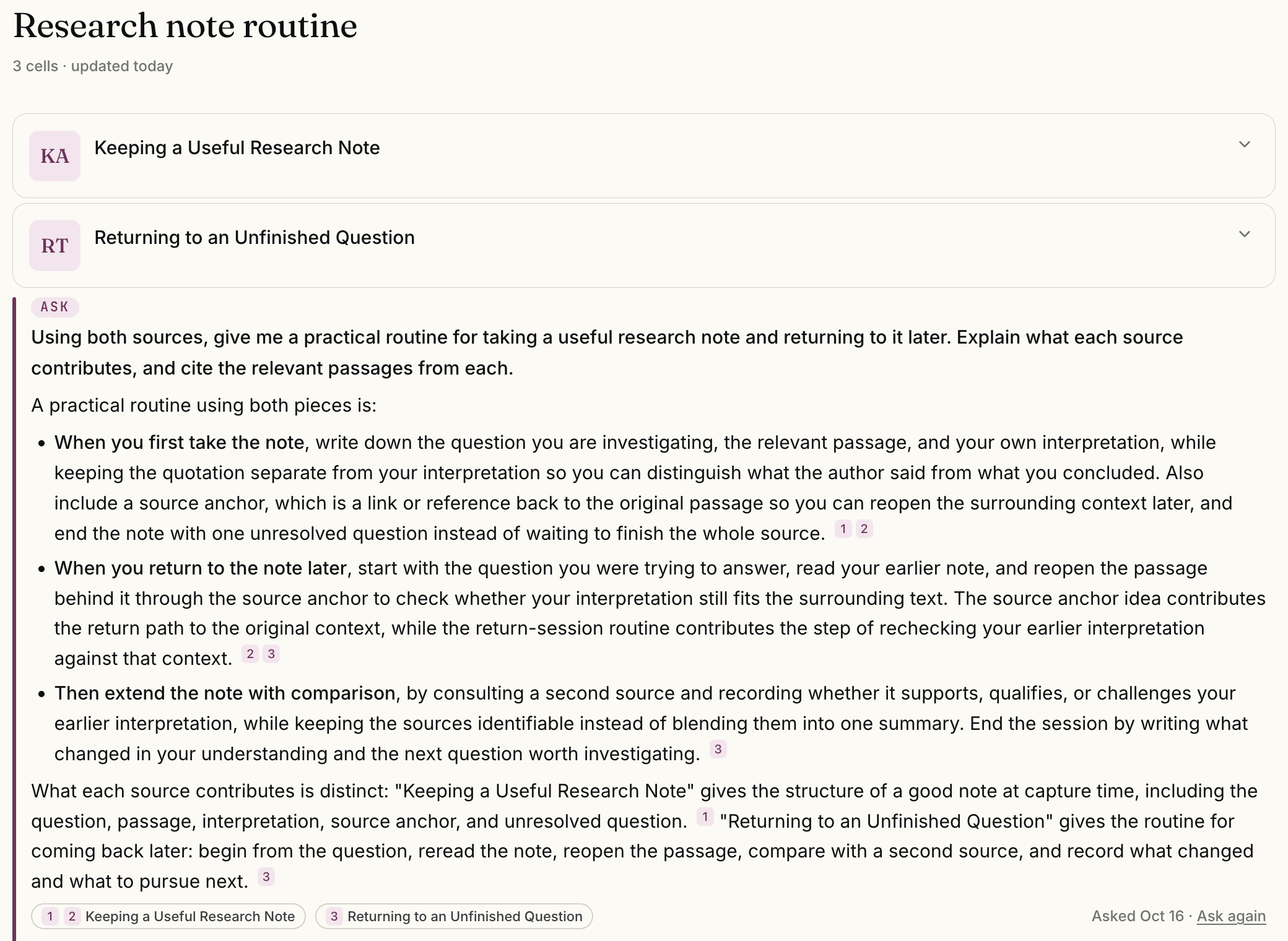
The still below is the homepage demonstration. Two short pieces, Keeping a Useful Research Note and Returning to an Unfinished Question, sit in one notebook. The question asked what each source contributes. Sample material created for this demonstration.
How do you keep the answer with the material?
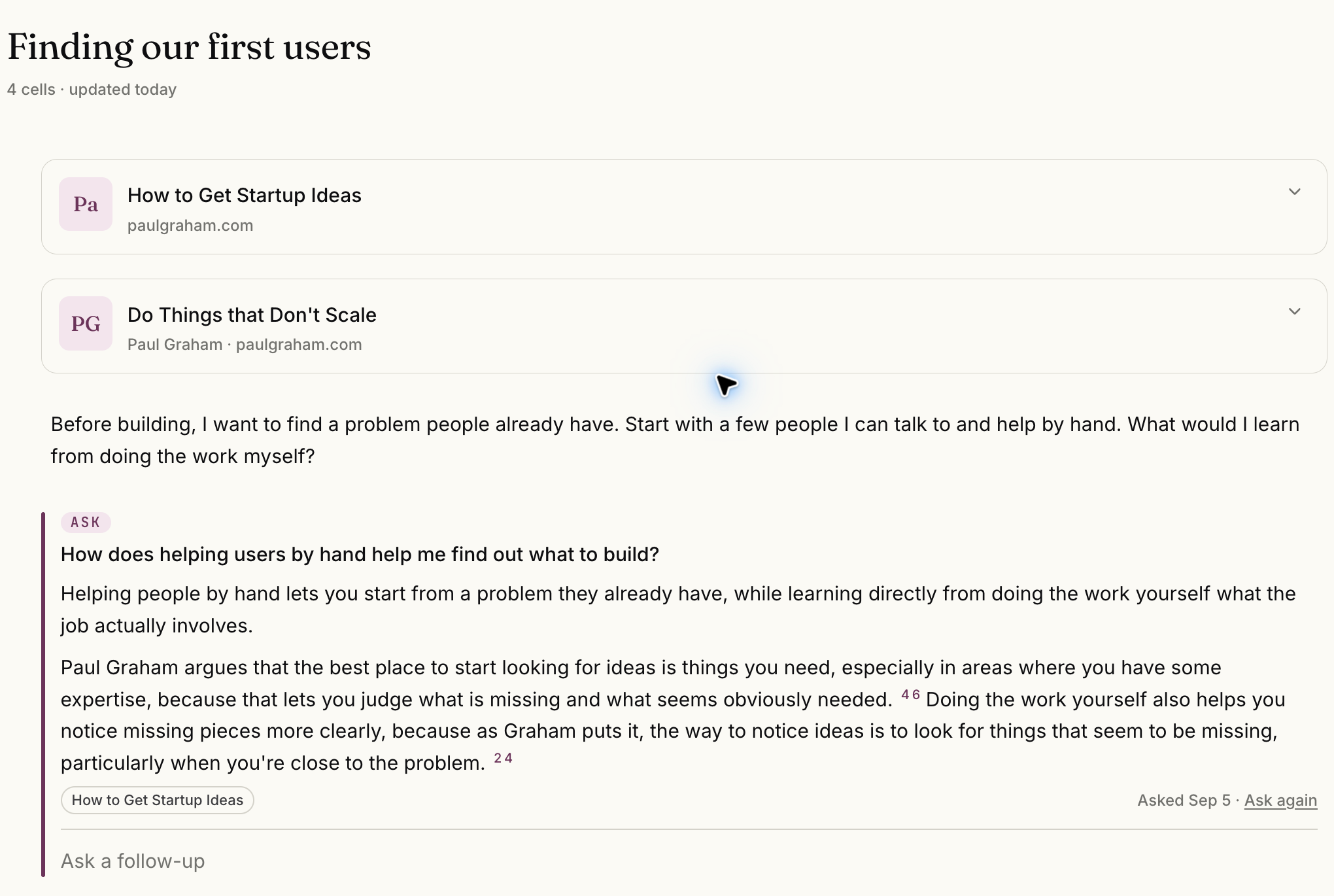
A notebook holds source cards, your own notes, and Ask answers. The question stays with the material, so the next sitting starts from the sources and the answer, not from a separate notes file. This capture is two Paul Graham essays, a working note, and an Ask answer. The answer shown cites How to Get Startup Ideas.
Select the image to see the detail.
How do you come back to a passage later?
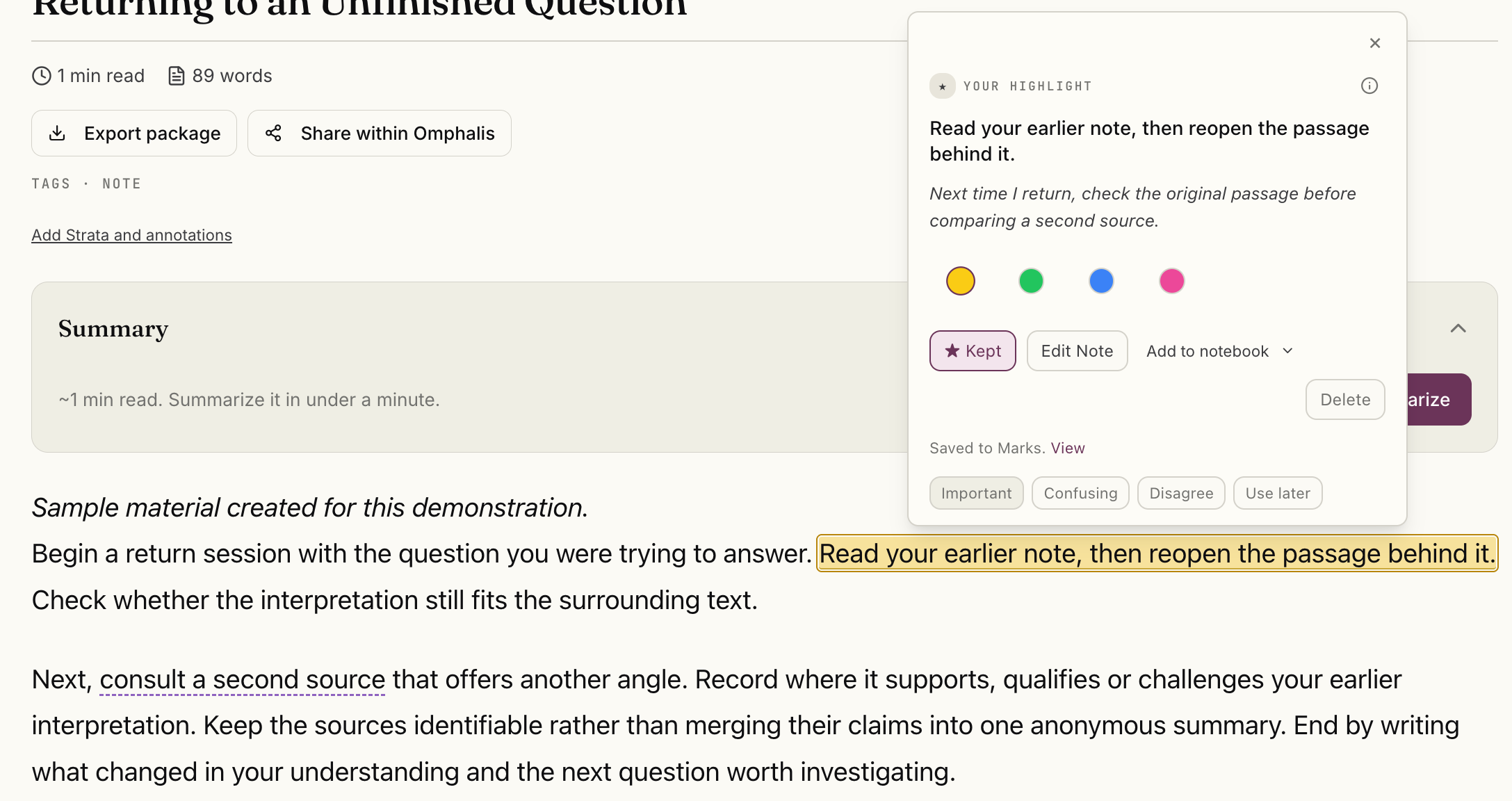
Highlight the line you want to use and write what you mean to do next. The note stays with the highlight, and Marks opens the piece at that passage, with the text around it. That is the way back when the draft is weeks away. Highlights and notes reopen the passage. On paid plans, Connections can bring an earlier marked passage alongside something you save later. Open both sources and decide whether the connection is useful.
In October 2026, a question on r/GradSchool asked "How do you map out connections between different sources so you can easily reference them months later when writing?" The note on the passage is the part of that you can reopen. The quote describes the problem. It is not a review of Omphalis.
Who is this for?
What does a researcher do with several papers?
You have read the set and the review is still a stack of summaries. Put the papers in a notebook, ask the question the review has to answer, and keep the note on the passage you would cite. One paper you are still getting through belongs on research papers.
What does a course student do with a set of readings?
A week of readings can be an article, a PDF, and a talk. Ask one question across them before the seminar, and leave a note on the line you want to raise. The citation opens the source, so you can check the line before you say it.
What does a writer do when the draft is still one source at a time?
Ask what each source contributes to the point you are making, then write from that answer and the notes you kept. The draft can start from the relationship, and the passages stay attached when you come back to revise.
What else should you know about putting sources together?
- How do you ask one question across several sources?
- Put the sources in a notebook and ask there. The answer draws on the sources in that notebook and cites the passages it used. In the question, type @ to pull in a particular item, a mark, or something you asked before. The demonstration on this page asks what each source contributes, and each numbered marker opens the source it cites.
- What does a notebook keep?
- Source cards, your own notes, and Ask answers, so the question stays with the material you were working on. You can come back to the notebook and read the answer next to the sources it used.
- How do you return to a passage later?
- Highlight the line and write what you mean to do next. The note stays with the highlight, and opening the mark takes you back to that passage with the text around it. On paid plans, Connections can bring an earlier marked passage alongside something you save later. Open both sources and decide whether the connection is useful.
- What can you bring in?
- Articles, PDFs, podcasts, and video and YouTube links. A PDF is read during the 30-day trial and on paid plans, within the trial's 200 PDF pages. On Free, a PDF is kept with its name and page count, and its text is not extracted into the reading view.
- Is the answer a summary of each source in turn?
- The job on this page is one question across the sources you chose. The answer says what each source contributes, and you open the citation to check it. A summary of one source is a different task. When you are finishing a single paper, start on the research papers page.
Bring the sources you are trying to put together.
Ask one question across them, open the citations, and keep the note with the passage you will need later.
Start free
30-day trial, no card required. Includes 200 voice minutes, 200 PDF pages and 15 assistant answers a day. After that, Free stays free. See plan allowances.
Written by Omphalis teamLast updated