Omphalis is a workspace for understanding. Read the sources you choose, open explanations in context and inspect cited answers. Keep your interpretation on the passage, then bring related sources and marks into a notebook for a question you can continue later.
What is the short answer?
Compare Gemini Notebook for source questions, notes and generated study outputs with Omphalis for source reading, contextual explanations, cited questions and your own synthesis in a notebook. Both can support understanding across sources; the useful test is how you read, write and return to the evidence.
There's a free plan. 30-day trial, no card required. Includes 600 comprehension units, 200 Ask voice minutes and 15 assistant answers a day. After that, Free stays free. See plan allowances.
Disclosure: this comparison is written by Omphalis about its own product, so it is not a neutral review. We are not paid by NotebookLM or by anyone else to be compared favourably, this page carries no affiliate links, and every claim about NotebookLM is checked against their own public documentation. Read the full disclosures, and tell us if something here has gone out of date.
Notes and source workflows checked October 29, 2026 against Google's product guide and notes documentation. The linked September announcement describes rollout timing, not proof of availability in every account. Our suggestions about fit are our judgment, not a hands-on accuracy benchmark.
Updated
What should you keep after an answer?
Keep the claim, the evidence behind it and your interpretation. In either product, open the citations and inspect the surrounding qualifications. An overview can orient you, but it is not proof that every detail your question depends on survived. A personal note records what you checked and what remains unresolved.
How do you work through a difficult source in Omphalis?
Open the source as a reading page
A PDF opens as extracted text with a section map. An article opens as a cleaned page. A podcast or a YouTube talk opens as a transcript with timestamps, and a podcast adds speaker labels once the transcript is ready. Keep the original PDF for figures, tables, equations, and any layout that carries meaning. PDF reading, YouTube transcripts, and podcast transcripts are the same reading page. Listen reads the text aloud. It is not the original hosts' audio.
Open an explanation at the passage that stops you
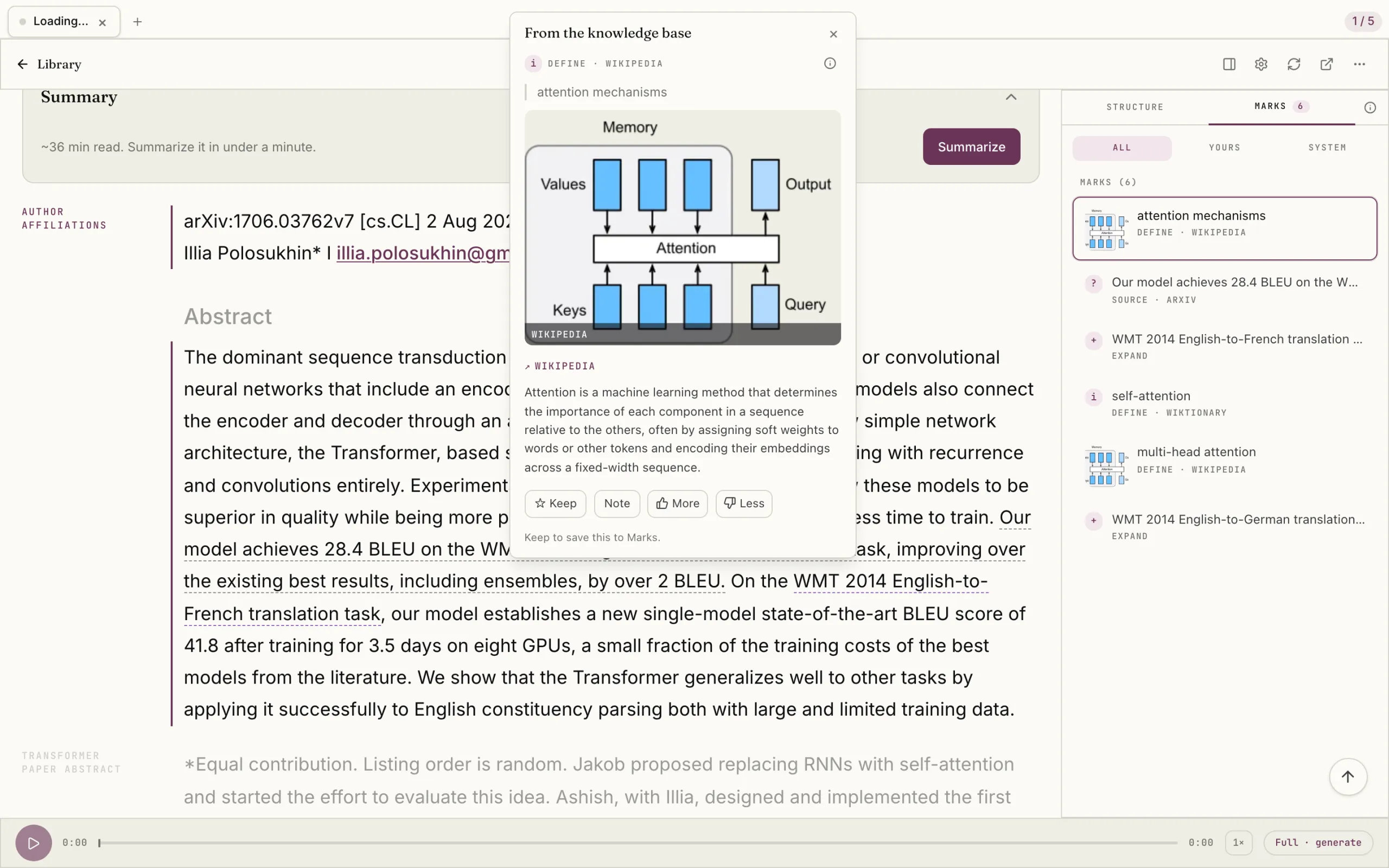
Select the sentence. Open Source, Define, or Expand beside it. Read the explanation next to the passage, close it, and keep going. The still below is Attention Is All You Need, with an explanation of attention mechanisms beside the abstract. Research papers is the same pattern on a paper you have not finished.
A real product capture: Attention Is All You Need, with an explanation of attention mechanisms beside the abstract.
Select the image to see the detail.
Leave your note on the passage
Highlight the line and write why it mattered. The note stays on that highlight. Opening the mark later returns you to the passage with the text around it. Highlights and notes are how you come back.
Ask when you choose to, and check the citation
Ask about the source you have open, or across a notebook when the question needs more than one piece. In the question, type @ to pull in an item or notebook, a Space, a Collection, or the Omphalis guide. The answer cites the passages it used, and the numbered markers open them. Ask is that step. When the job is what several sources say about one question, use compare what your sources say.
Continue the question across sources
Put a paper, an article and a talk into an Omphalis notebook with the marks you kept. Ask how each bears on the question, check the cited passages and write your own account. Return later to revise that account with the sources still at hand. Google also supports questions across selected sources and notes; compare the reading and writing sequence rather than treating multi-source work as unique to either product.
Google's September update describes additional study and spoken workflows with staged rollout details. Check your account and client.
How do the two compare?
Gemini Notebook and Omphalis for a difficult source
Task
Gemini Notebook
Omphalis
What you get from a source
Overviews and study material from the set: study guides, briefings, mind maps, and Audio Overviews. Google's guide describes these as approachable formats made from your sources. See the NotebookLM guide.
Readable source text, contextual explanations, cited questions and your own passage notes, gathered with selected sources in a notebook.
When a passage stops you
You chat with the notebook. The guide says those answers are grounded in your sources, with clear in-line citations. The September 15, 2026 post adds spoken conversations in the mobile apps, also grounded in your sources. See the September 15, 2026 post.
Open Source, Define or Expand beside the passage, ask a follow-up and inspect the cited text. Keep your interpretation on the passage, then use it in a notebook.
Your notes
Notes you create appear in the Sources panel alongside the sources you uploaded. They can be used for questions and for study material, and chat can cite a passage in the note. See the Notes documentation.
The note stays on the highlight. Opening the mark later returns you to that passage with the text around it.
Ask cites the passages it used. Numbered markers open the passage the answer used.
Study outputs
Study guides, briefings, mind maps, quizzes, flashcards, and Audio Overviews. The September 15, 2026 post adds more quiz formats, interactive learning overviews, and short video overviews of about 60 seconds, on the rollout schedule in that post. See the September 15, 2026 post.
Cited questions, source-linked notes, notebooks and narration of source text. Course builder can produce study material from a long saved document on paid plans or the trial; Omphalis is not a specialist spaced-repetition system or an Audio Overview generator.
Formats
You can upload PDFs, websites, YouTube videos, audio files, Google Docs, or Google Slides. See the NotebookLM guide.
A PDF, an article, a podcast transcript, or a YouTube transcript opens as a reading page, with timestamps when the source has them. A PDF is extracted text with a section map, so keep the original for figures, tables, and equations. PDFs are read during the trial and on every plan above Free, from your units. On Free a PDF is kept with its name and page count but not read.
Audio Overviews, in Deep Dive, Brief, Critique, and Debate formats, are described in the Audio Overview documentation.
Who should stay with Gemini Notebook?
Stay if overviews, study guides, mind maps, quizzes, flashcards, or Audio Overviews from a set of sources are the job you wanted. If you want a spoken overview of ten sources before a meeting, that is its job. Gemini Notebook is a strong tool for making study material and overviews from a set of sources, and Omphalis does not replace it. Visit NotebookLM.
Who might try Omphalis?
Try a question involving two sources. Read a claim, inspect a cited answer, keep your own note and return to it later. For a direct comparison, see Omphalis vs NotebookLM.
There's a free plan. 30-day trial, no card required. Includes 600 comprehension units, 200 Ask voice minutes and 15 assistant answers a day. After that, Free stays free. See plan allowances.
Yes. Both support source questions and personal notes. Try Omphalis for a workflow that joins reading, contextual explanations, cited answers and passage notes with your own writing across selected sources in a notebook. Compare that with Gemini Notebook’s source notebooks and generated study outputs.
Is there a NotebookLM alternative for reading a PDF with notes beside the text?
Yes. In Omphalis a PDF opens as a reading page with a section map. Select a passage to open an explanation beside it, highlight it and write your note on that passage, and the mark reopens the page there later. Ask answers with numbered citations that open the passage they used. The reading page is extracted text, so keep the original PDF for figures, tables and equations. PDFs are read during the trial and on every plan above Free. NotebookLM also keeps notes and answers with citations; the page on reading a PDF shows the Omphalis workflow step by step.
Is this also a Gemini Notebook alternative?
Yes. Google renamed NotebookLM to Gemini Notebook in July 2026, and it is the same product. Everything on this page applies under either name.
Does Omphalis summarize my sources?
Omphalis includes summaries and questions alongside source reading. Inspect the cited passages and keep your own interpretation in a notebook. Course builder is available for long saved documents on paid plans or the trial; it is not a replacement for a specialist scheduled-review system.
Can I ask questions across several sources?
Yes, in a notebook, when you choose to. Type @ to pull in an item or notebook, a Space, a Collection, or the Omphalis guide. The answer says what each source contributes, and its numbered markers open the passage it used. The page for that job is compare what your sources say.
Do both products keep personal notes?
Yes. Google’s notes documentation describes notes as sources for questions and study outputs, with citations into the notes. Omphalis keeps personal notes on source passages and gathers sources, marks and writing in notebooks. Try reopening and exporting your own sample; neither product’s feature list proves migration fidelity.