Omphalis vs Perplexity
Perplexity vs Omphalis: keep Perplexity for finding sources, work through the ones that matter in Omphalis
If you need answers from the open web, keep Perplexity. Omphalis does not search the web. Perplexity goes out, reads widely, and comes back with an answer that cites where each claim came from. Pro adds deep research, a choice of models, and search across the web, your files, and your apps. If finding sources or a quick cited answer is the work, stay with Perplexity.
Some people searching for a Perplexity alternative have a different problem. The sources are already chosen: five papers for a review, a week of readings, two talks and an article on one decision. What is missing is knowing what each of them says on the question, where they disagree, and which passage to open again. Omphalis is a workspace for understanding. It helps you build understanding from the sources that matter to you, with one question asked across them, an explanation beside the hard passage, and a mark that reopens it later.
Start free
30-day trial, no card required. Includes 600 comprehension units, 200 Ask voice minutes and 15 assistant answers a day. After that, Free stays free. See plan allowances.
Disclosure: this comparison is written by Omphalis about its own product, so it is not a neutral review. We are not paid by Perplexity or by anyone else to be compared favourably, this page carries no affiliate links, and every claim about Perplexity is checked against their own public documentation. Read the full disclosures, and tell us if something here has gone out of date.
Checked October 20, 2026 against Perplexity's pricing page, Projects help page, file uploads help page, and Learn Mode help page. Our suggestions about fit are our judgment.
Updated
What does Perplexity do well, and when should you stay?
Perplexity is built to answer a question with citations in every answer, so you can see where a claim came from. The free plan covers limited daily use. Pro raises the limits and adds deep research, a choice of models, and search across the web, files, and connected apps. Projects, which Perplexity used to call Spaces, keep searches, tasks, files, and instructions together so you and your collaborators can return to the same work, and a Project can hold up to 5,000 files. Learn Mode explains an answer step by step and can turn course material into flashcards and quizzes. Stay with Perplexity when the job is finding sources, getting a fresh answer about the world, or a research brief built from the open web.
What are the two jobs behind a Perplexity alternative?
The first job is another answer engine for the web. Omphalis is not one, and this page will not pretend otherwise. Ask in Omphalis answers from what you keep: the item you are reading, the Space you are in, all your Spaces, or the Omphalis guide. The second job starts after the searching is done. You have the sources, and a good answer about them is not the same as understanding them. You still need to know what each one contributes, read the paragraph that carries the argument, and come back to it next week. This page is for that second job.
How do Perplexity and Omphalis compare?
| Compared on | Perplexity | Omphalis |
|---|---|---|
| Built for | Answers with citations, from the web and from your files and connected apps. Perplexity describes Pro as built for serious work. | Working through the sources you chose: one question asked across them, an explanation beside the hard passage, and marks that reopen it. |
| Searches the web | Yes. Searching the web is the core of the product, and every answer carries inline citations. | No. Ask answers from the item you are reading, the Space you are in, all your Spaces, or the Omphalis guide. Omphalis works from the sources you bring in. |
| Keeping sources together | Projects, formerly Spaces, keep searches, tasks, files, instructions, and connected tools in one place. A Project holds up to 5,000 files. | A notebook holds source cards, your own notes, and Ask answers, so the question stays with the material you were working on. |
| Formats | Text files, PDFs, images, audio, and video can be uploaded. Speech in audio and video is transcribed. | Articles, PDFs, podcasts, and video and YouTube links, each opened as a page you can read, mark, and listen to. |
| Long files | Perplexity says that for a long upload it will extract the most important parts to answer your query. | The whole source opens in front of you. A PDF becomes extracted text with a section map, so keep the original for figures and tables. |
| One question across sources | A cited answer drawn from the web, your files, or both. | An answer that says what each source contributes. Each numbered citation opens the passage it came from, with the text around it. |
| Help with a hard passage | Learn Mode explains an answer step by step and can make flashcards and quizzes from material you upload. | Open an explanation beside the passage that stopped you. The passage stays on the page, and you keep reading from there. |
| Marks and return | Threads and Project files you can come back to. | A mark with a note and a tag such as Confusing or Use later. Opening it later returns you to that passage in the source. |
| Price | Free is $0. Pro is $17 a month and Max is $167 a month, each when billed annually, on Perplexity's pricing page. | Free is $0. Pro is $9 a month or $90 a year. PDFs are read on paid plans and during the trial. On Free a PDF is kept and is not read. |
What does one question across several sources look like in each?
Say you are deciding how to approach customer research and you have two essays, an interview transcript, and a recorded talk. In Perplexity you can add the files to a Project, ask your question, and read a cited answer, with the web available if you want more. In Omphalis you gather the same sources and a note of your own in a notebook and ask there. The answer says what each source contributes to the question, and each numbered marker opens the source at the passage it used, with the sentences around it. You mark the line you will build on, write why it matters, and tag it Use later. When you come back, the notebook still holds the sources, your note, and the answer, so the next sitting starts where the last one stopped.
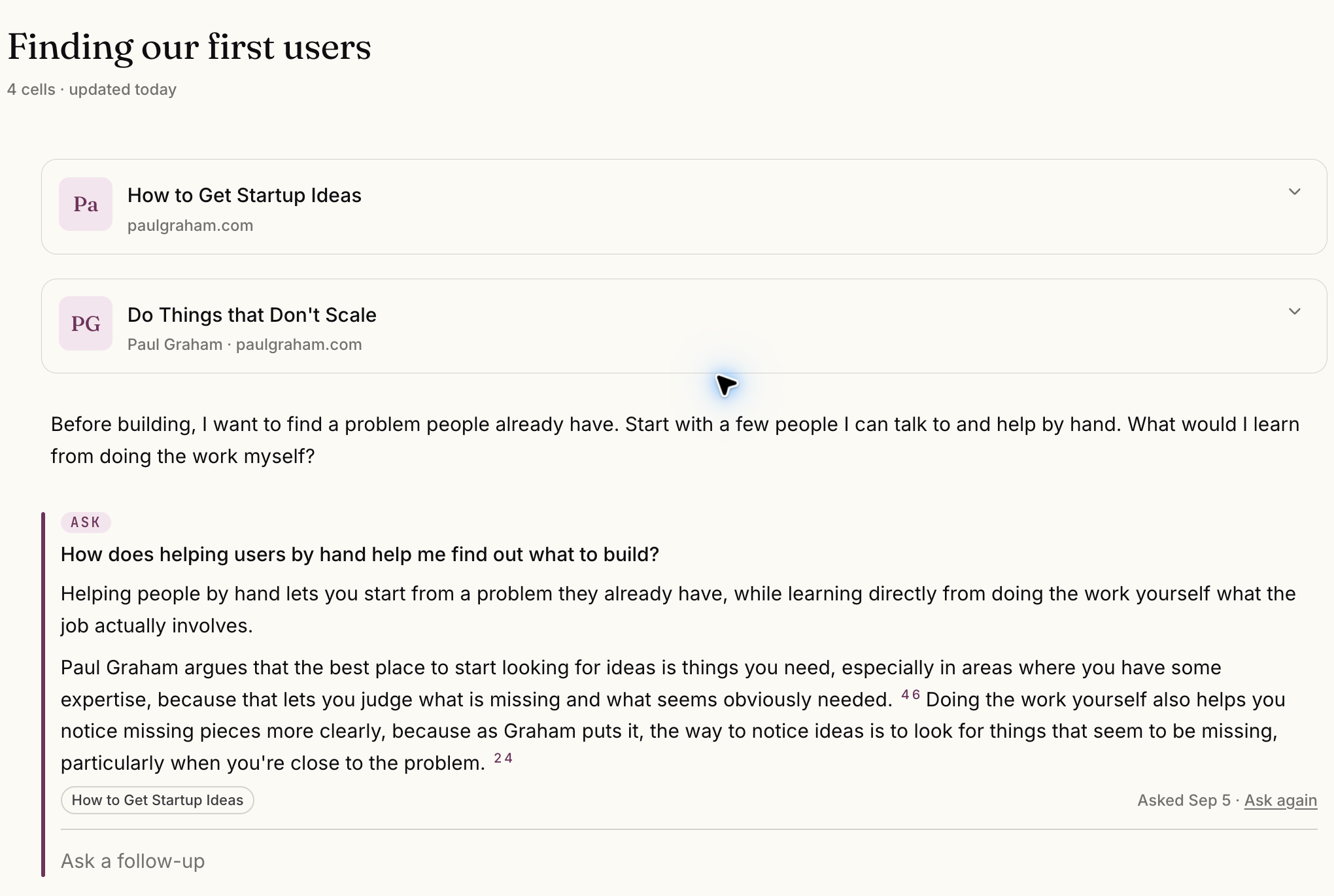
Select the image to see the detail.
Perplexity, NotebookLM, or Elicit?
People weighing Perplexity often look at NotebookLM and Elicit too. Choose Perplexity for answers from the web. NotebookLM grounds its answers in the sources you upload to a notebook. Elicit searches and screens the research literature. Omphalis is for working through the sources you chose and coming back to the hard parts. If your sources live as linked notes and cards on a whiteboard, see Heptabase as well.
How do you use Perplexity and Omphalis together?
Use Perplexity to find candidates: the papers, articles, and talks worth your time. Save the ones that matter into Omphalis as links, PDFs, or YouTube videos. Read each one with an explanation open beside the paragraph that assumes something you have not met, and mark what stays unclear. Then ask your question across all of them and see what each source adds. When you write, open the citations and check the line before you use it. The page on comparing what your sources say walks through the cross-source step.
Who should pick which?
When should you stay with Perplexity only?
Stay for quick answers with citations, fresh results from the web, market and news questions, and research briefs drawn from sources you have not found yet.
Visit PerplexityWhen should you add Omphalis?
Add it when you have a defined set of sources, you need to know what each one says, you get stuck on a hard section in one of them, or you come back to the same question over weeks.
See the Omphalis web appWhat do Perplexity and Omphalis cost?
Perplexity Free is $0. Pro is $17 a month and Max is $167 a month, each when billed annually, on Perplexity's pricing in US dollars. Omphalis Free is $0. Pro is $9 a month or $90 a year. PDFs are read on paid plans and during the trial. On Free a PDF is kept and is not read.
30-day trial, no card required. Includes 600 comprehension units, 200 Ask voice minutes and 15 assistant answers a day.
The trial does not add web search. Ask answers from what you keep in Omphalis on every plan. Plan details are on pricing.
A good Perplexity alternative for the sources you already chose
If you want another answer engine for the web, compare other search tools. Omphalis does not search the web. If you already have the papers, articles, PDFs, or talks, Omphalis lets you ask one question across them, see what each one contributes, open each citation to its passage, and keep marks with notes that bring you back to the hard parts.
Also compare Omphalis with Pocket, Omnivore, Instapaper, Matter, Glasp, Readwise, Heptabase, NotebookLM, Snipd, LiquidText, MarginNote, Elicit, Zotero, Adobe Acrobat, Goodnotes, Mindgrasp, Eightify or Recall.
Before you choose
Is Omphalis a Perplexity replacement?
Not for searching the web. Perplexity goes out to the web and comes back with a cited answer, and Omphalis does not do that. If you already have the sources, Omphalis is a workspace for understanding them: you ask one question across them, read what each one contributes, and open each citation to the passage it came from. Many people keep both.
Does Omphalis search the web when I ask a question?
No. Ask offers four places to answer from: the item you are reading, the Space you are in, all your Spaces, or the Omphalis guide. None of them is the web. Omphalis works from the sources you bring in, and every claim in an answer carries the passage it used.
What happened to Perplexity Spaces?
Perplexity now calls them Projects. Its help center describes a Project as a persistent, shareable workspace that keeps searches, tasks, files, instructions, and connected tools in one hub, with up to 5,000 files per Project.
Can I ask one question across PDFs, articles, and YouTube talks in Omphalis?
Yes. Gather the sources and your own notes in a notebook and ask there. The answer says what each source contributes, and each numbered citation opens that source at the passage it used. PDFs are read during the trial and on every plan above Free.
Perplexity, NotebookLM, or Omphalis?
Perplexity answers from the web and keeps files in Projects. NotebookLM grounds its answers in the sources you upload to a notebook. Omphalis is for working through the sources you chose, seeing what each one says on your question, and coming back to the hard parts. The NotebookLM comparison goes further.
Written by Omphalis teamLast updated