I saved this because it mattered. Now I can't find the passage or remember why.
A full library does not fix that by itself. You kept the article, the PDF, the episode, or the video because one passage mattered. The useful test is whether you can reopen the passage and your own note together.
Recall combines saving, notes, summaries, questions and a knowledge graph. Its pricing page says you can save articles, YouTube videos, podcasts, PDFs, and notes, then summarize them, organize them, and chat with them or with the open web. Free includes 10 summaries per month and unlimited notes. Those are substantive ways to study and connect sources. This Recall is the product at recall.it. It is not Microsoft Recall, and it is not Recall.ai. Recall's FAQ says the same.
Omphalis is a workspace for understanding. Bring articles, PDFs, podcasts and video/YouTube together, work through a difficult idea, and keep the question and the note beside the source. Come back and build on them. There's a free plan.
30-day trial, no card required. Includes 600 comprehension units, 200 Ask voice minutes and 15 assistant answers a day. After that, Free stays free. See plan allowances.
Disclosure: this comparison is written by Omphalis about its own product, so it is not a neutral review. We are not paid by Recall or by anyone else to be compared favourably, this page carries no affiliate links, and every claim about Recall is checked against their own public documentation. Read the full disclosures, and tell us if something here has gone out of date.
Documentation checked October 17, 2026; pricing rechecked October 29, 2026 against Recall's pricing page, FAQ, documentation. Our suggestions about fit are our judgment.
Updated
How do Recall and Omphalis compare?
Recall and Omphalis compared on saves, passages, summaries, and price
Compared on
Recall
Omphalis
Working across selected sources
Recall combines your notes with saved content, library/web chat and a knowledge graph. Paid plans add automatic organization and spaced-repetition quizzes.
Gather selected sources, passage notes and your own writing in a notebook. Ask across that material, inspect citations and return to the evidence later.
What you can save
Articles, YouTube videos, podcasts, PDFs, and your own notes. The FAQ says summaries work best on YouTube videos up to 10 hours, PDFs up to 300 pages, articles, Google Docs, blogs, and recipes. The docs also list TikTok.
Articles, PDFs, podcasts and video/YouTube in one library. A PDF opens as a cleaned reading page. A supported episode or YouTube talk opens as a transcript with timestamps once it is ready.
Finding the passage again
The full content is stored, and you can highlight inside the Recall Notebook. Related cards are linked, and Plus resurfaces connections while you browse. Test the passage return and export path on the source formats you use.
A highlight stays on the passage, with your note beside it. Opening the mark takes you back to that passage, with the text around it.
Summaries, quizzes, and chat
Plus summarizes, chats with your library or the open web or both, and quizzes you on a spaced-repetition schedule. Free includes 10 summaries per month.
An explanation opens beside a hard passage. Ask cites the passages it used. You can gather selected sources and marks into a notebook, ask cited questions and keep your own interpretation.
Price
Free is $0, with no card: 10 summaries per month, unlimited saves, and unlimited notes. Plus is $10 a month billed yearly, or $12 billed monthly. Max is $38 a month billed yearly, or $48 billed monthly. Paid plans can be refunded within 30 days. That is a refund, not a no-card trial.
There's a free plan, and paid plans from $9 a month, with a 30-day trial, no card required (600 comprehension units, 200 Ask voice minutes and 15 assistant answers a day).
Start with the task you have in mind
What do you do with something you saved and cannot find?
In Recall
Recall stores the full piece, so the card is still in the library. Its documentation describes it as a read-it-later home for articles, PDFs, Google Docs, YouTube, podcasts, and TikTok. A saved summary is tagged, linked to related cards, and editable in the Recall Notebook, where you can highlight text. The thing you come back to is the card and its connections.
Omphalis is a workspace for understanding. Bring the article, PDF, podcast, or video/YouTube in, highlight the passage that mattered, and leave the reason beside it. The Marks list reopens that passage with the text around it, so the sentence and the reason are the same place.
What do you do when the idea is difficult?
In Recall
On Plus, Recall summarizes the piece, lets you chat with what you saved, with the open web, or with both, and can quiz you on a spaced-repetition schedule. Its documentation describes chat with one saved source. The pricing page, rechecked October 29, 2026, describes chat across the library and the open web. Both are on Recall's own pages.
Open an explanation beside the passage that stopped you, or ask a question and follow the citation back to that passage. The question and the note stay beside the source. You can come back later and build on them. Omphalis does not replace Recall’s specialist scheduled-review system; its course builder supports long saved documents on paid plans or the trial.
What do you do when you want a summary, a quiz, or a graph of the whole library?
In Recall
This is Recall's home ground. Plus adds unlimited summaries for typical use, automatic tags, a knowledge graph, Augmented Browsing while you browse, Listen Mode for the summary, quizzes, and a bulk import of up to 1,000 bookmarks or 10,000 Markdown notes. Max adds a choice of model and bulk actions on up to 100 items. The pricing page says the free tier includes 10 summaries per month.
Omphalis does not quiz you on a schedule, and it does not hand you a summary to listen to instead of the source. Choose selected articles, PDFs, podcasts and video/YouTube for a question, explain passages in context and inspect cited answers. Keep your synthesis in a notebook with your own notes and return to the supporting sources.
What does coming back to the passage look like?
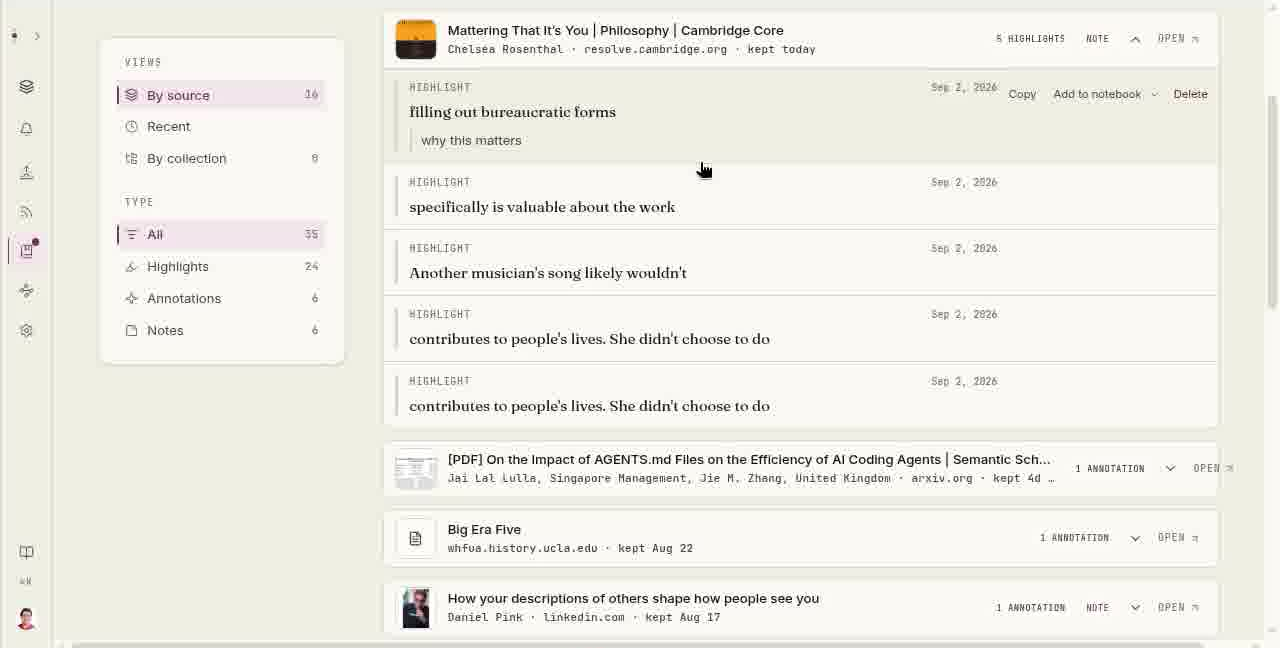
The mark is the passage, and the note is why you kept it. This capture is an article in Omphalis: a highlight with its note, and Open beside the source.
The Marks page: a highlight with its note, and Open on the source so you can return to that passage.
Select the image to see the detail.
When is Recall the better fit?
Recall, for the summary and the graph
Stay with Recall if you want a summary before you spend the hour, a quiz on a schedule, automatic tags, and lines drawn between everything you have saved. Stay if TikTok, Google Docs, or a thousand old bookmarks are the library. Stay if you want to listen to the summary, or chat with the whole collection and the open web. Omphalis brings in articles, PDFs, podcasts and video/YouTube, and is not trying to replace the summary or the graph.
Try Omphalis with a question involving an article, a paper or a talk. Read a claim, inspect a cited answer and keep why it matters beside the passage. Bring the sources and marks into a notebook, write your interpretation and reopen the evidence in a later session.
Choose Recall when its graph and scheduled review fit your work. Choose Omphalis when reading, source-linked notes and your own synthesis in a notebook are the workflow you want to continue. Both support questions and notes; keeping both is optional.
For one job, yes. If you saved something because a passage mattered and now you cannot find that passage or remember why, Omphalis is a workspace for understanding: articles, PDFs, podcasts and video/YouTube together, a hard idea worked through beside the source, and a note you can reopen. Recall is the better fit when you want summaries, quizzes, automatic tags, and a graph of everything you saved, including TikTok.
How much do Recall and Omphalis cost?
Recall's pricing page lists Free at $0 with 10 summaries per month, Plus at $10 a month billed yearly or $12 billed monthly, and Max at $38 a month billed yearly or $48 billed monthly. Paid Recall plans include a 30-day refund if you email support@recall.it. Omphalis: there's a free plan, and a 30-day trial, no card required, with 600 comprehension units, 200 Ask voice minutes and 15 assistant answers a day. Paid Omphalis plans start at $9 a month. Documentation checked October 17, 2026; pricing rechecked October 29, 2026.
Does Recall keep the original, or only a summary?
Both, by its own docs. Recall stores the full content and says you can use it as a read-it-later home. It also writes a summary you can edit, listen to, tag, and quiz yourself on. You can highlight in the Recall Notebook. Export from Settings is a zip of Markdown files. Omphalis keeps the note on the passage in the source and reopens that passage.
When should I stay with Recall?
Stay if the job is a large library you want summarized, tagged, and quizzed, or if TikTok and Google Docs are most of what you save. Stay if you want chat across that whole library and the open web, a bulk import of old bookmarks, or Listen Mode on the summary. Omphalis brings in articles, PDFs, podcasts and video/YouTube, and does not replace that. This Recall is also not Microsoft Recall, and not Recall.ai. Recall's own FAQ says so.
Is there a free plan?
Yes. There's a free plan. The 30-day trial, no card required, includes 600 comprehension units, 200 Ask voice minutes and 15 assistant answers a day. After that, Free stays free. On Free, a PDF is kept with its name and page count, and its text is not extracted into the reading view. PDFs are read during the trial and on every plan above Free, from your units.