Seven Questions to Ask Before You Trust an AI Summary
Updated · 13 min read
Listen to this post
Contents
- 1. What question is the summary answering?
- 2. What structure did it flatten?
- 3. What evidence supports its claims?
- 4. What did it omit?
- 5. Can you trace claims back to the source?
- 6. Does it preserve uncertainty and disagreement?
- 7. Can you return to the important passages?
- A better way to use AI summaries
- From summary to understanding
- Sources and further reading
Pause. Trace. Return.
An AI summary can be fluent, accurate in parts, and still untrustworthy as a guide to understanding.
That is not a contradiction. A summary is a reduction. It takes a long source and selects what appears to be its most important material. The selection may be useful. It may also quietly remove the structure, evidence, uncertainty, and disagreement that gave the original material its meaning.
This is why a summary should usually be treated as an orientation layer, not as a replacement for reading, listening, or watching the source itself.
The question is not whether AI summaries are useful. They can be. The better question is whether a particular summary is reliable enough for the decision you are about to make.
Research by the BBC and the European Broadcasting Union, summarized in a 2025 BBC and Ipsos report on AI assistants for news, found that 45% of responses from leading AI assistants contained at least one significant error. Sourcing was the single biggest cause. As one participant in the Ipsos research put it:
“When you use AI putting your trust in it to give you the correct information, not opinions which are debateable.”
The finding is specific to news answers. It does not tell us that every summary is unreliable. It does tell us that polished language and familiar citations are not enough.
Before you rely on an AI summary of a paper, report, book, transcript, or long article, ask seven questions.
1. What question is the summary answering?
Every summary answers a question, even when that question is left unstated.
“Summarize this paper” may produce an account of the abstract and conclusion. “Explain the main argument” may focus on the author’s thesis. “Give me the practical implications” may leave out the methodology entirely.
These are different summaries of the same source.
Start by identifying the purpose:
- Are you deciding whether to read the source?
- Are you trying to remember what you read last month?
- Are you looking for evidence for a specific claim?
- Are you comparing two positions?
- Are you preparing for an exam, meeting, or research discussion?
A summary designed for quick orientation is not automatically suitable for making a technical judgment.
The first question is therefore not “Is this summary accurate?” It is “Accurate for what?”
A useful summary can still be the wrong tool for the task.
This matters because selection always follows intent. If you ask for “the main takeaway,” the system may reasonably prioritize the conclusion. If your real need is to understand whether the conclusion follows from the evidence, that answer may be incomplete without the methods, assumptions, and limitations.
Write down the question before you read the answer.
That small act gives you something to compare against. You can notice what the summary is trying to do, and what it was never asked to do.
2. What structure did it flatten?
Long-form content is not only a collection of facts. It has a shape.
A research paper moves from question to method to result to interpretation. An essay may introduce a claim, qualify it, answer an objection, and then change direction. A podcast may move through examples, stories, disagreements, and a final synthesis.
A short summary often turns these different moments into a level list.
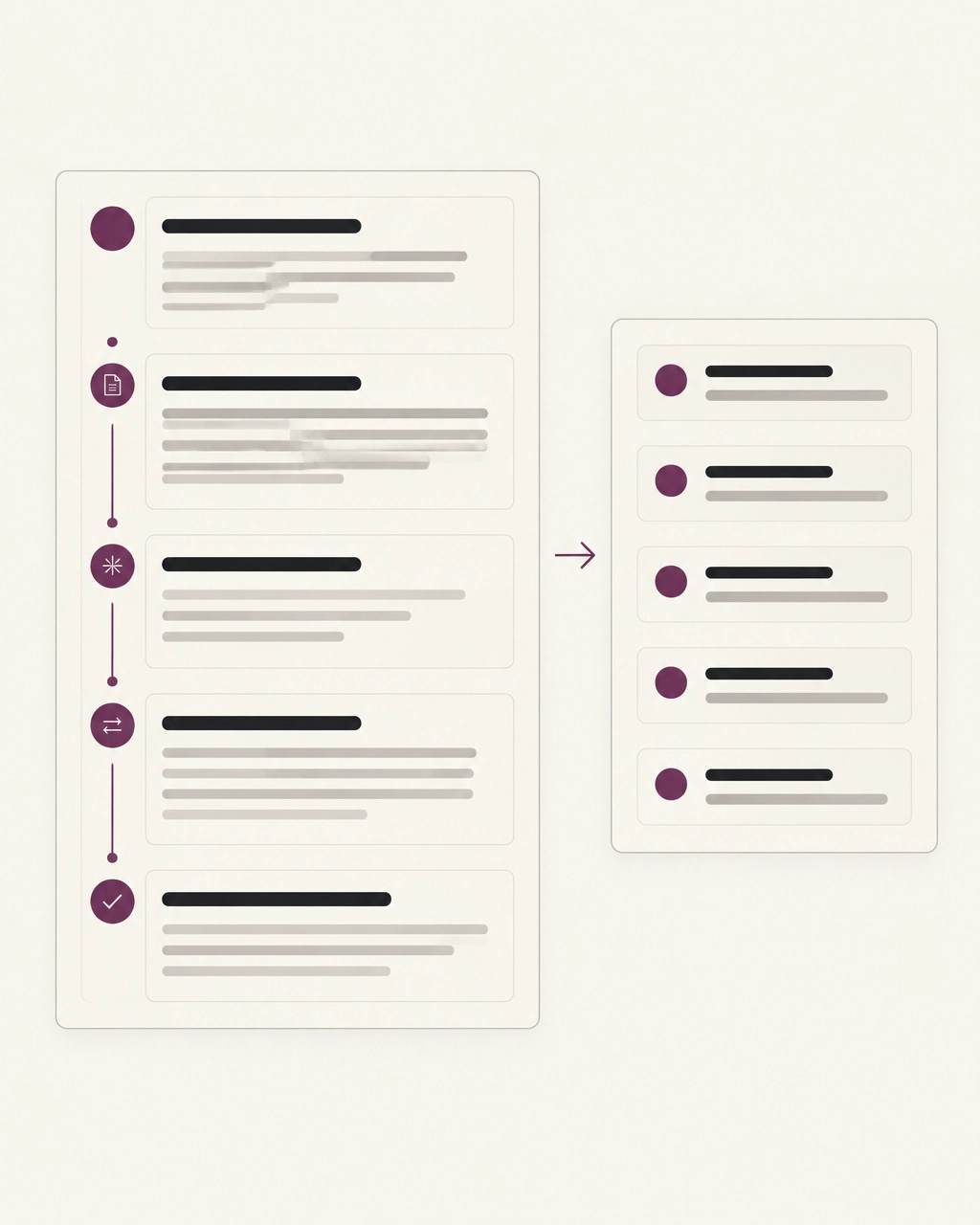
Look for the parts that tell you how the source works:
- What is the central claim?
- Which points support it?
- Where does the argument turn?
- Which evidence is direct, and which is interpreted?
- Is a limitation part of the main point or a footnote?
- Does the author distinguish observation from explanation?
A list of conclusions can be factually correct while still hiding the relationships between them.
This is one reason a summary may create a feeling of understanding before understanding has actually formed. You recognize the phrases. You can repeat the conclusion. But you may not know what depends on what.
The Omphalis case for comprehension draws on Walter Kintsch’s model of discourse comprehension to describe this distinction through three layers: the words on the page, the claims those words express, and the deeper mental model a reader builds about how the material fits together.
A summary can help with the first two. The third still belongs to the reader.
When evaluating a document analysis AI tool, ask whether it shows structure or only reduces content. Does it help you see sections, argument turns, dense moments, and evidence? Or does it simply return a smaller block of prose?
A shorter version is not necessarily a clearer map.
3. What evidence supports its claims?
A summary becomes more trustworthy when its important claims can be traced to the source.
This does not require every sentence to carry a citation. It does require a practical path back to the evidence.
For each consequential claim, ask:
- Which paragraph supports it?
- Is the claim stated directly, or inferred?
- Does the source provide data, an example, a quotation, or only an interpretation?
- Are numbers, dates, names, and comparisons reproduced correctly?
- Does the cited passage support the whole claim or only part of it?
A citation can create the appearance of care without providing real support. A link may lead to the right paper but not to the passage that justifies the summary’s wording.
In the BBC and Ipsos research, 76% of UK adults said a sourcing or attribution error would have a major impact on their trust in an AI summary. That response makes sense. A misplaced source does more than add a minor blemish. It changes who appears to have said something, measured something, or endorsed a conclusion.
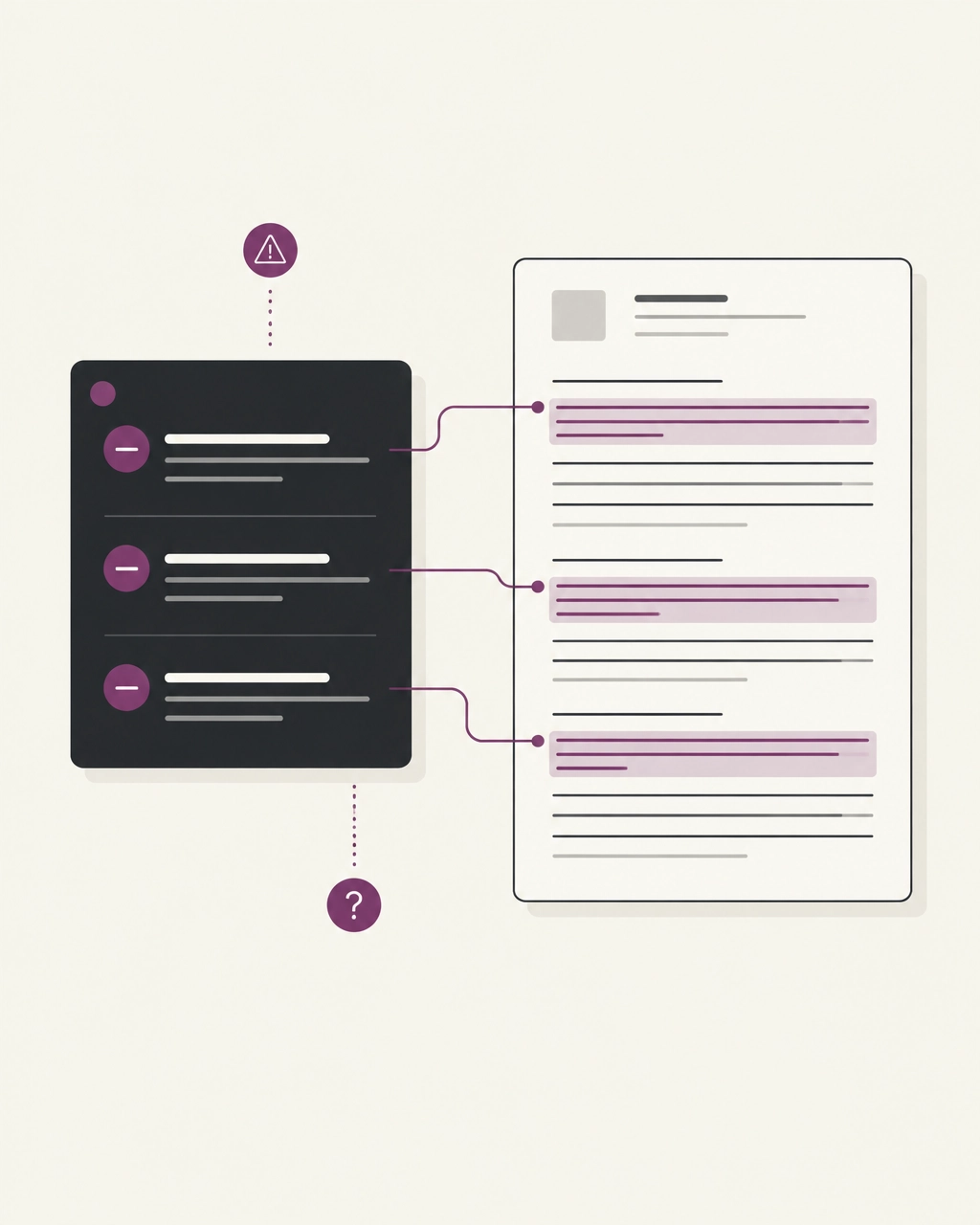
Try tracing three important claims before trusting the rest.
If the process is easy, the summary is giving you a useful verification path. If it is difficult or impossible, treat the answer as provisional.
This is a central distinction for an AI research tool: the tool should help you move between a claim and its context. It should not ask you to accept an interpretation simply because it sounds coherent.
Fluency is not evidence.
4. What did it omit?
Every summary leaves things out. The important question is whether it makes those omissions visible.
Ask what is missing from the answer:
- The research method?
- The size or nature of the sample?
- A definition?
- A counterargument?
- An exception?
- The author’s uncertainty?
- The conditions under which the finding applies?
- The difference between what was measured and what was concluded?
Omission is not always a flaw. A short summary has to leave things out. If you are deciding whether to spend an hour with a long report, a selective overview may be exactly what you need.
The risk appears when omission is silent.
A summary that says “the study shows” may have removed the fact that the study examined a narrow population. A summary that says “experts agree” may have omitted disagreement. A summary that describes a policy as effective may have left out the timeframe, comparison group, or unresolved result.
A useful habit is to ask the system directly:
What important context, evidence, limitations, or opposing views are not included here?
Then check the answer against the original structure. Look at the contents page, section headings, figures, footnotes, and discussion. The omitted material often lives there.
The Eindhoven University of Technology guidance on AI-generated summaries makes a related point: generating a summary can remove the work of selecting and organizing information for yourself. That work is not merely administrative. It is part of learning.
A summary should reduce the cost of entering a source, not hide the cost of understanding it.
5. Can you trace claims back to the source?
Evidence and traceability are related, but they are not identical.
Evidence asks whether a claim is supported. Traceability asks whether you can find that support without losing your place.
This distinction matters in real work. A researcher may need to check a definition two weeks later. A student may need to revisit the passage behind a note. A policy professional may need to show a colleague exactly where a conclusion came from.
Traceability gives the summary a route back.
Look for:
- Page numbers or section names.
- Paragraph-level links.
- Timestamps for audio and video.
- Visible source titles and authors.
- Quotations that can be checked in context.
- Clear separation between source claims and AI-generated interpretation.
A good interface makes this movement ordinary. You read a claim, open the supporting passage, inspect the surrounding context, and return to your place.
That is different from opening a second tab and trying to remember which sentence produced which conclusion.
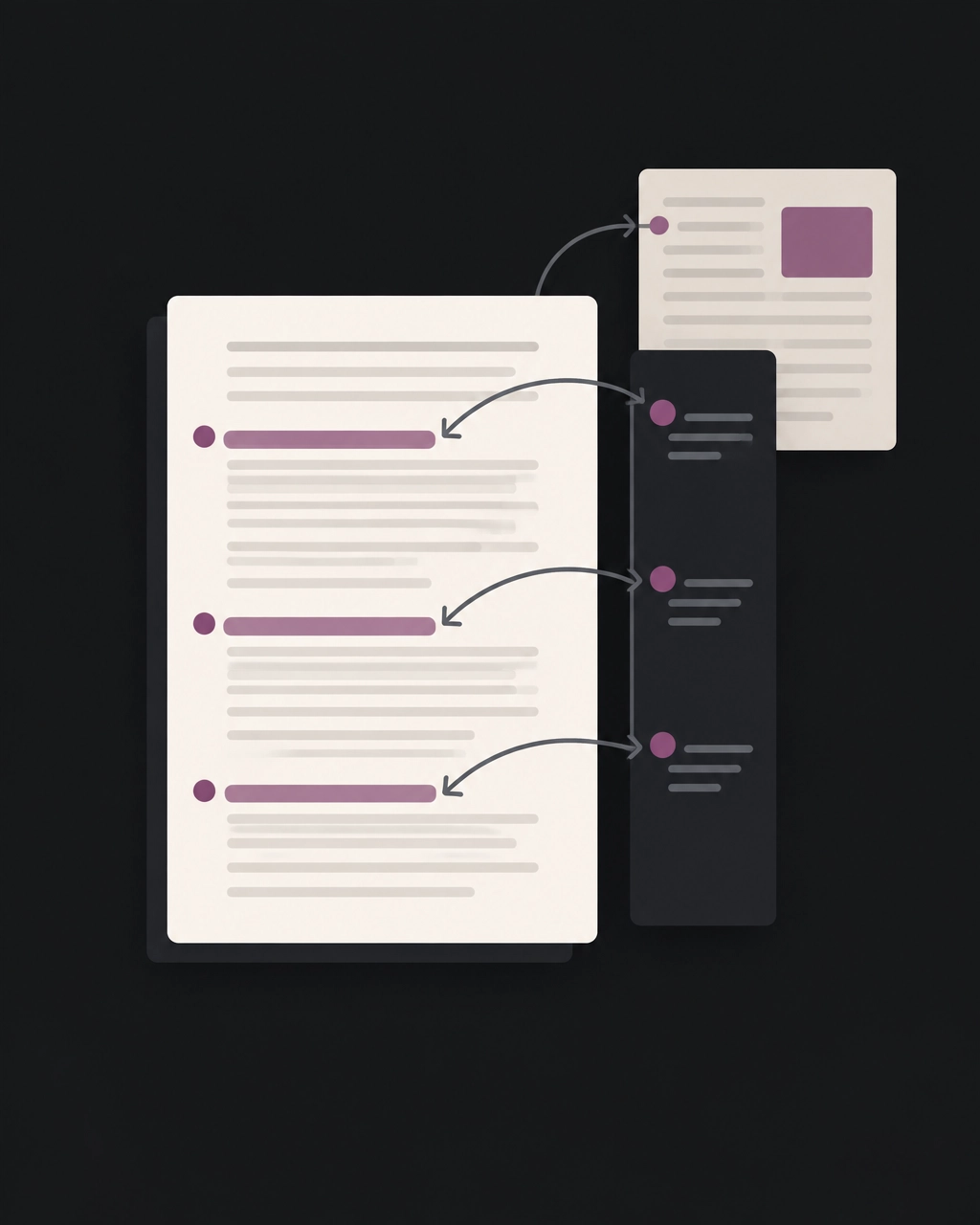
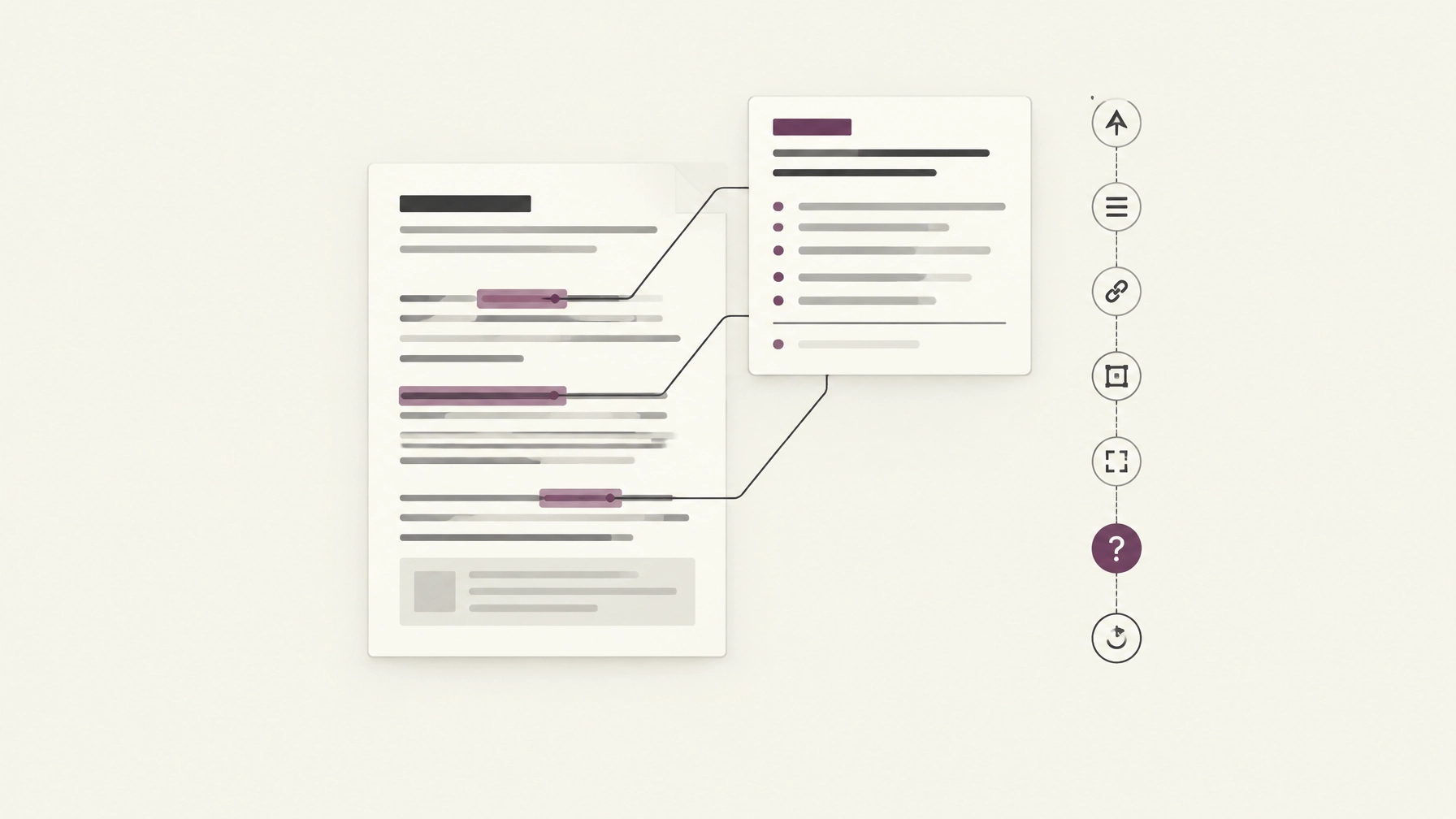
The Omphalis highlights and notes workflow is built around this kind of return. A mark stays attached to the passage that prompted it, with the surrounding text still available. The point is not to collect isolated quotations. It is to preserve the route back to the source.
This is where a content understanding platform should do more than summarize. It should help you navigate from overview to passage, from passage to note, and from note back to the larger argument.
A summary without a way back is a dead end.
6. Does it preserve uncertainty and disagreement?
Careful sources rarely speak with complete certainty.
They use phrases such as “may,” “suggests,” “in this sample,” “under these conditions,” and “the evidence remains mixed.” These are not decorative qualifications. They define the limits of a claim.
AI summaries can smooth those limits away.
A 2025 study by Uwe Peters and Benjamin Chin-Yee compared 4,900 summaries from 10 language models with the scientific texts they summarized. Most models produced broader generalizations than the originals, even when prompted for accuracy, and model summaries overgeneralized more often than human-written ones. The exact rates vary by model, task, and evaluation method, so the result should not be treated as a universal measure of every system. The broader concern is more stable: confident language can make a conditional conclusion sound universal.
Ask:
- Does the summary preserve the source’s level of confidence?
- Does it distinguish evidence from interpretation?
- Does it represent competing views fairly?
- Does it identify unresolved questions?
- Does it make a correlation sound like a cause?
- Does it turn a possibility into a recommendation?
Notice the verbs.
“Shows” is stronger than “suggests.”
“Proves” is stronger than “supports.”
“Experts agree” is stronger than “several researchers argue.”
These differences matter most when the source is contested, technical, or incomplete.
A trustworthy summary should preserve disagreement rather than tidy it away. It should also make its own status clear. Is a sentence directly supported by the source? Is it a synthesis across sections? Is it an interpretation added by the system?
You do not need an answer that sounds certain.
You need an answer whose certainty is proportionate to the evidence.
7. Can you return to the important passages?
The final question is practical and personal:
Will this summary help you return?
For information-heavy work, understanding is rarely completed in one pass. You encounter a paper, mark a passage, leave a question, compare it with something else, and come back later. Meaning changes as new material enters the picture.
A summary that helps only in the moment may be useful for triage. A summary that supports return becomes part of a durable reading practice.
Ask:
- Can you save the passages that mattered?
- Can you add your own note about why they mattered?
- Can you find them again in the source?
- Can you connect them with marks from other documents?
- Can you revisit the surrounding argument rather than only the extracted sentence?
Your own mark is important here. The system may identify a possible theme or suggest a connection. But your note records your judgment: this is why I want to keep it.
That distinction protects your ownership of meaning.
The summary can orient you. The source can challenge you. Your mark can preserve what you noticed.
This is also why a reading environment can be more useful than a summary box. In Omphalis, you can read articles, PDFs, podcast transcripts, and videos with structure, explanations, highlights, and notes beside the material. The aim is not to eliminate engagement. It is to make difficult material easier to enter and easier to return to.
A summary should open a path.
It should not close the book for you.
A better way to use AI summaries
The safest place for an AI summary is near the beginning of your workflow.
Use it to:
- Decide whether a source deserves your time.
- Identify unfamiliar terms and sections.
- Find possible entry points into a long document.
- Form questions before reading closely.
- Locate passages you want to verify.
- Compare the broad shape of several sources.
- Prepare for a return to material you have already read.
Then move into the source.
Read the method. Listen to the exchange. Inspect the example. Notice the qualification. Mark the passage that changes your view.
For high-stakes decisions (academic claims, medical information, legal questions, financial analysis, or policy recommendations) do not treat a summary as the sole basis for action. Verify important claims against the original source and, where appropriate, against authoritative secondary material.
The goal is not suspicion for its own sake.
It is proportion.
A short overview may be enough to decide whether to continue. It is rarely enough to carry the full weight of understanding.
From summary to understanding
A summary can help you orient yourself. It can make a difficult document easier to enter. It can surface names, themes, sections, and possible questions.
But comprehension is more than receiving a compressed answer.
It is seeing how the parts fit. It is knowing what supports a claim, what limits it, and where the author remains uncertain. It is keeping a path back to the passage that changed your mind.
Use the summary.
Check the structure.
Trace the evidence.
Keep your own marks.
In short, a summary gives you a way in. Understanding requires a way back.
Sources and further reading
- BBC and Ipsos, Audience Use and Perceptions of AI Assistants for News
- Eindhoven University of Technology, Are AI-generated summaries suitable for studying and research?
- Kintsch, “The Role of Knowledge in Discourse Comprehension: A Construction-Integration Model”
- Peters and Chin-Yee, “Generalization Bias in Large Language Model Summarization of Scientific Research”
- The Omphalis case for comprehension
- Read research papers with help beside the source
- Keep highlights attached to their passages