The Read-Write Inversion: When Generating Got Cheap and Reading Got Expensive
Updated · 13 min read
Listen to this post
Contents
- 1. What changed when text got cheap to produce?
- 2. Who pays the hidden bill of cheap generation?
- 3. What can a summary do, and what can it not do?
- 4. Why is deep reading a structural activity?
- 5. Why is the cost of reading worth paying?
- 6. Which three decisions make a better reading practice?
- First, what deserves a full read?
- Second, what are you reading for?
- Third, how should you mark as you go?
- 7. How should tooling support the reader?
- 8. Why is return part of understanding?
- 9. What does the inversion ask of us?
Choose. Read. Keep.
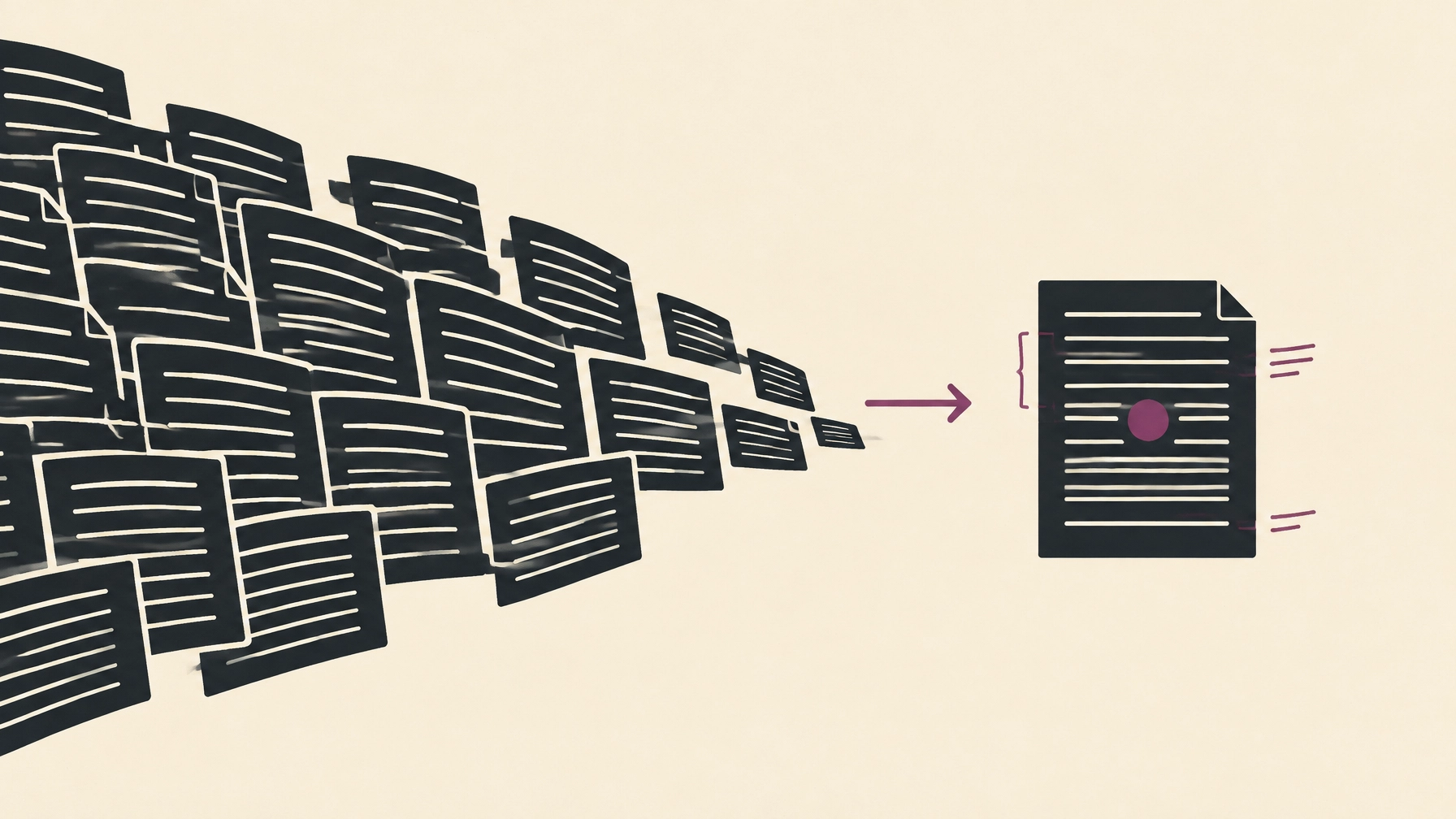
For most of history, producing text was expensive and reading was comparatively cheap.
Writing required time, training, materials, and revision. A report took days. A book took months or years. Even a short memo carried a cost, so people had reasons to make it shorter, clearer, and worth receiving.
That relationship has changed.
Generation is now fast, abundant, and often nearly free. A prompt can produce a report, an outline, a summary, a proposal, or five alternative versions of the same message before a reader has decided which one deserves attention.
The bottleneck moved.
It used to sit at writing. It now sits at attention, comprehension, and judgment.
This is the read-write inversion. The cost of producing a document collapsed, while the human capacity to read it carefully remained almost exactly where it was.
1. What changed when text got cheap to produce?
Generative AI did not only make writing faster. It changed the economic logic around writing.
When producing a document took effort, volume was naturally limited. Writers had to choose what to include. Editors had to decide what was worth polishing. Teams had to ask whether another memo, update, or analysis was necessary.
Cheap generation weakens those constraints.
A manager can ask for three versions of a strategy memo. A researcher can turn rough notes into a polished literature review. A consultant can produce a client-ready outline before the underlying evidence has been fully examined. A team can summarize every meeting, every call, and every document simply because the system makes doing so easy.
This is not necessarily careless behavior. Cheap production creates rational incentives to produce more.
A 2023 experiment by Shakked Noy and Whitney Zhang, published in Science, illustrates the change. In a study of 453 college-educated professionals completing occupation-specific writing tasks, access to ChatGPT reduced average completion time and improved the quality ratings of the submitted work.
The authors report:
"The average time taken decreased by 40% and output quality rose by 18%."
That is a meaningful productivity gain. It also tells us only half of the story.
The experiment focused on writing tasks that were relatively clear and self-contained. The tasks did not require precise factual accuracy or deep context-specific knowledge. The researchers were measuring the production of text, not the downstream work of evaluating what that text claimed.
That work still has to happen.
A document generated in seconds may require an hour to check. A polished argument may still rest on weak evidence. A fluent explanation may leave out the qualification that changes the conclusion.
Output went up.
The reader's workload went up with it.
2. Who pays the hidden bill of cheap generation?
The hidden cost of cheap generation is not always visible to the person creating the document.
It appears later as more material to evaluate, more claims to verify, more versions to compare, and more documents that sound authoritative while demanding careful inspection.
The modern knowledge worker was already operating inside an environment of excess communication. Microsoft's 2025 Work Trend Index, based on aggregated and anonymized Microsoft 365 signals, reported that average workers received 117 emails daily and that some users were interrupted by meetings, messages, or email approximately every two minutes during core working hours.
The report's interruption figure requires care. It reflects the top 20 percent of users by ping volume, and the telemetry excludes education and European Union tenants. It should not be treated as a universal description of work.
Still, the direction is clear. People are not waiting for more material to process. They are already triaging a continuous stream of it.
AI enters that stream as a supply shock.
"Employees are interrupted every two minutes during core work hours."
That is how Microsoft summarizes one part of its telemetry. The exact number matters less than the structure it reveals. The workday is already organized around interruption, scanning, and rapid judgment.
Now add nearly frictionless generation.
More reports arrive. More summaries circulate. More options are proposed. More pages become plausible enough to require review.
The system may save time at the point of creation while moving the labor to someone else's inbox.
3. What can a summary do, and what can it not do?
Summarization is useful.
A summary can help you decide whether a paper, transcript, or report deserves a full reading. It can make a difficult document easier to enter. It can help you recover the general topic of something you encountered months ago.
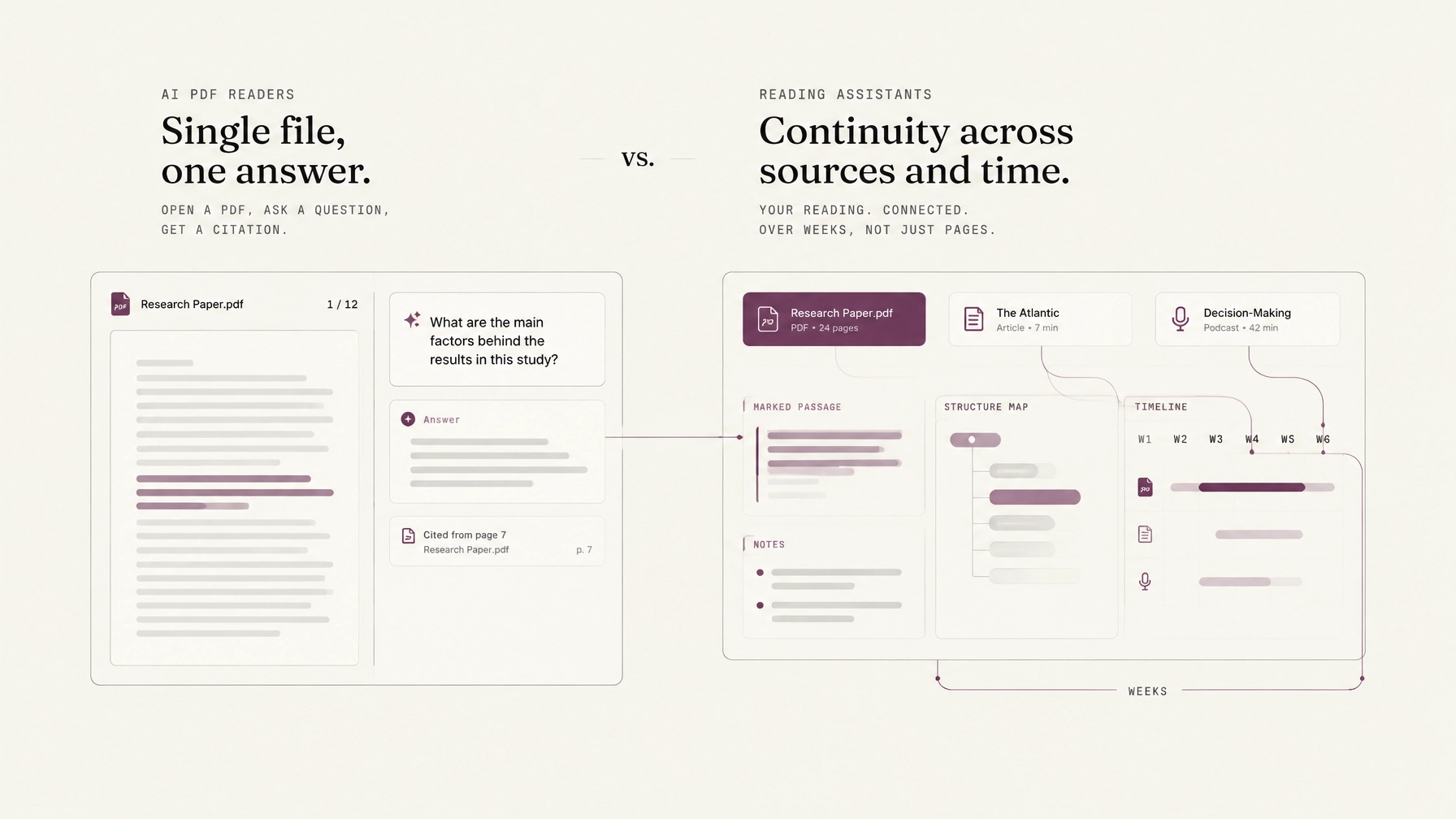
But a summary addresses the entry cost of a document. (We wrote seven questions to ask before you trust an AI summary for the moment you decide whether to rely on one.) It does not transfer the structural understanding that lets you evaluate, quote, reuse, or disagree with it.
This distinction matters.
A summary can tell you what the author appears to say. It may even describe the main argument accurately. But it usually cannot give you the full position of each claim inside the argument:
- What does this claim depend on?
- Where does the reasoning turn?
- Which example is carrying the weight?
- What evidence is missing?
- What does the author assume the reader already accepts?
- Which sentence limits the claim made several paragraphs earlier?
These are positional questions.
They depend on where an idea sits, what surrounds it, and how it connects to the rest of the document. They are not answered simply by reducing the number of words.
Compression can make a document more familiar. Familiarity can feel like understanding.
The two are not the same.
A short summary may tell you enough to decide not to read. That is valuable. But if you saved the document because it matters to your work, a summary may provide the wrong kind of completion. It can let you feel finished before you have built anything durable from the source.
Not a replacement for reading.
A way into it.
4. Why is deep reading a structural activity?
Understanding a document deeply is not the same as retaining every sentence.
A careful reader does something more specific. They build a working model of the document as they move through it.
They notice the opening question. They follow the evidence. They recognize when the author shifts from description to interpretation. They see where a definition narrows the argument, where an exception weakens it, and where the conclusion reaches beyond what the evidence can support.
The words matter. So does their arrangement.
Cognitive psychologist Walter Kintsch's construction-integration model describes comprehension as more than the retention of literal wording. A reader builds the words, the claims behind the words, and a broader mental model of what the text means in context.
A summary can support the first layer. It may describe the claims.
The deeper model still has to be built by the reader.
This is why the most important questions about a document are rarely first-order questions such as, "What did the author say?"
They are usually second- and third-order questions:
- What follows from this?
- What would have to be true for this argument to hold?
- How does this connect to what I already know?
- Does this change a decision, a project, or an earlier belief?
- What would I need to revisit before relying on it?
These questions require movement through the document and back into your own context.
A case for comprehension is therefore not an argument against summaries. It is an argument against confusing summaries with the finished work of understanding.
5. Why is the cost of reading worth paying?
Careful reading takes time because it does more than receive information.
It gives information a place.
You read a paper and notice that its strongest conclusion rests on a narrow sample. You listen to an interview and mark the moment when the guest changes the definition of the problem. You study a report and realize that the recommendation depends on an assumption that was never tested.
These observations are not decorative details. They determine how the material can be used.
The cost of reading deeply includes:
- Entering the document: Finding the question, the shape, and the sections that deserve your first attention.
- Following the structure: Noticing how claims build, turn, qualify, or conflict with one another.
- Testing the position: Asking what the evidence supports, what it leaves open, and what the author does not address.
- Connecting the material: Relating the source to prior knowledge, current work, and other documents.
- Leaving a durable trace: Marking what mattered in a way that still makes sense when you return later.
This is not a cost to eliminate entirely.
It is the work that turns information into something you can carry.
6. Which three decisions make a better reading practice?
The practical response to the read-write inversion is not to read everything more slowly.
It is to become more deliberate about what receives a full read.
First, what deserves a full read?
Not every document deserves equal attention.
A generated briefing may be enough for orientation. A primary research paper may deserve a full reading because you expect to cite or challenge it. A podcast transcript may contain one section relevant to a question you are pursuing.
Choose the level of engagement before the document chooses it for you.
Ask: What would make this worth my time?
Second, what are you reading for?
Reading changes when the purpose is clear.
You may be looking for evidence, a definition, a counterargument, a method, a historical example, or a connection to something you already believe.
The purpose creates a path through the material. Without one, every paragraph competes equally for attention.
Third, how should you mark as you go?
A mark should preserve more than a sentence.
It should preserve why the sentence mattered.
A bare highlight can show that you stopped somewhere. A note can say what you noticed, questioned, or want to use. That small addition makes the return possible.
The difference is modest but important. A future version of you does not need to reconstruct the entire moment from a colored line. The passage and your reason for keeping it remain together.
7. How should tooling support the reader?
The useful role of an AI productivity app is not to declare a document finished.
It is to help someone enter the document, see its shape, keep what they noticed, and return to it.
That requires a different design emphasis from the one that treats reading as a prelude to extraction.
A useful reading environment can help you:
- move through a long article, PDF, podcast, or video transcript;
- see where the dense sections and argument turns are;
- clarify a difficult term without losing the surrounding passage;
- attach a note to a specific paragraph or timestamp;
- return to a mark with the source still in view;
- connect an insight to something you marked elsewhere.
This is where a knowledge extraction tool can either help or quietly get in the way.
If extraction means stripping away context and returning a clean card, the result may be easy to collect but difficult to use. If extraction preserves position, structure, and the reader's own interpretation, it becomes part of a longer process of understanding.
The distinction is between taking information out and making meaning portable.
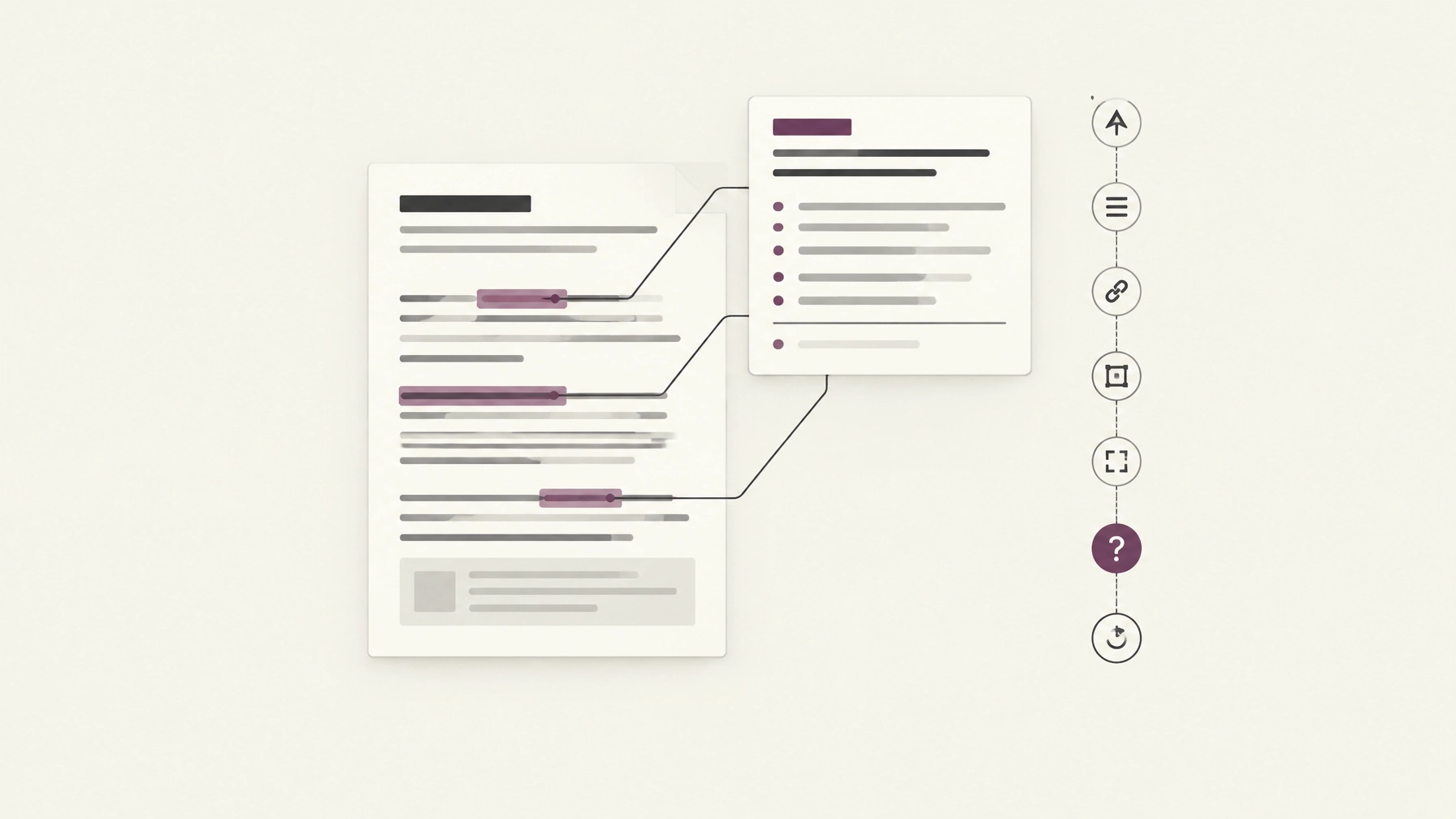
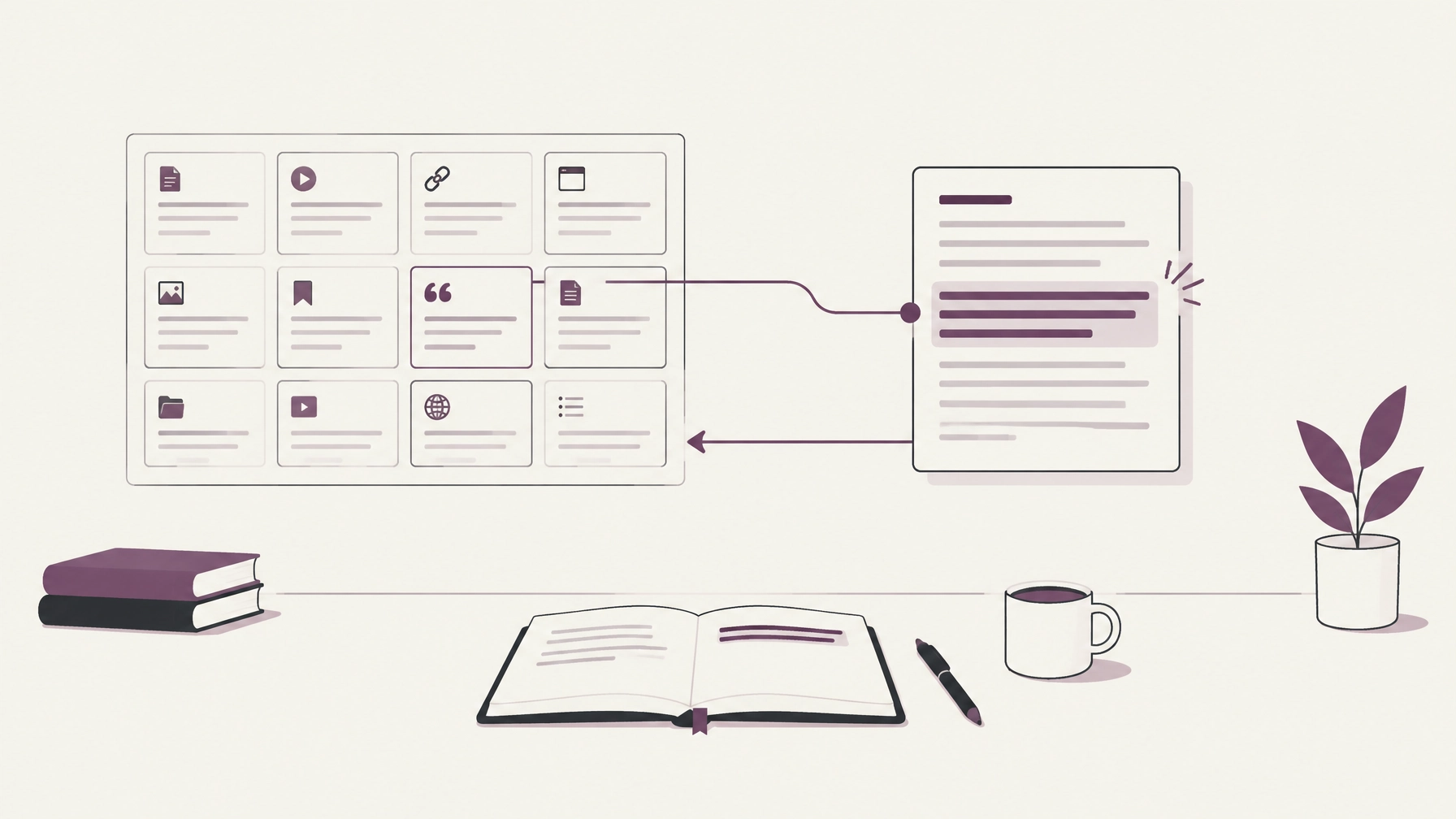
Omphalis is built around the second idea. Its highlights and notes remain attached to the passage that prompted them. A mark can carry a short explanation, a question, or a tag such as Important, Confusing, Disagree, or Use later.
That does not replace judgment.
It gives judgment somewhere to remain.
8. Why is return part of understanding?
A document does not become useful simply because you finished it once.
Some material needs a second entrance.
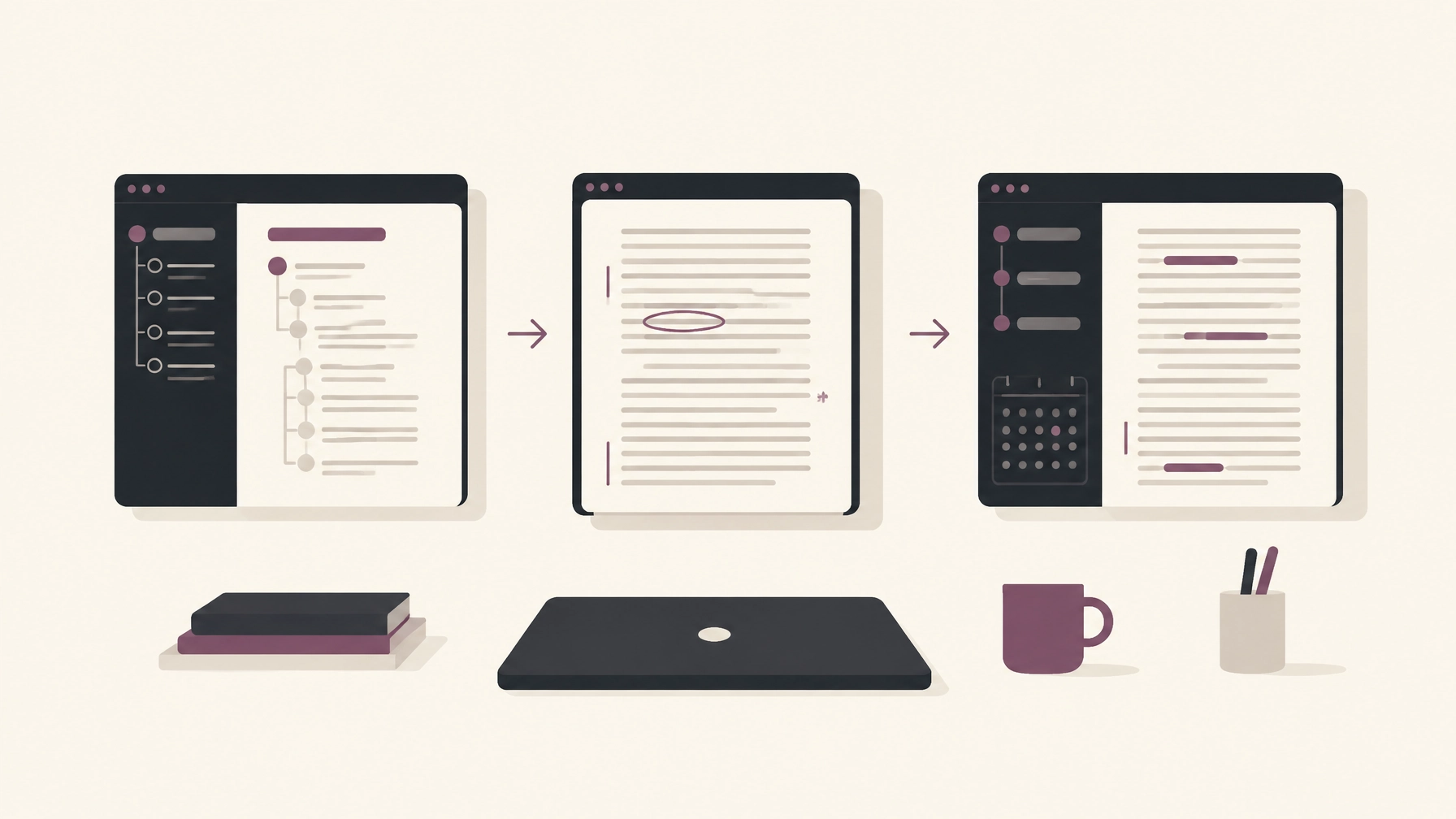
You return when the project changes. You return when another source contradicts the first. You return when a term you passed over becomes central to a new question. You return because memory preserved the outline but lost the conditions that made the claim meaningful.
This is why context matters.
A quote copied into a separate list may be accurate and still be difficult to interpret later. The sentences around it may have carried the qualification. The section heading may have changed its force. Your own note may be the only remaining record of what you were trying to understand.
A returnable mark keeps these things close enough to check. That is the case for annotation that survives the article it came from, and for knowing when rereading is worth the time.
The purpose is not to build a larger pile of saved material. It is to make fewer pieces more usable over time.
A library of unexamined highlights is accumulation.
A library of marked, questioned, and revisited passages can become a map.
9. What does the inversion ask of us?
The read-write inversion changes the meaning of productivity.
It is no longer enough to ask how quickly a team can create a document. We also need to ask:
- Who has to read it?
- What kind of verification does it require?
- What evidence can the reader inspect?
- What happens when the document is wrong?
- Will the important reasoning still be available a month later?
A generated document should be easy to audit, not merely easy to accept.
That means clear sources, visible uncertainty, traceable claims, and enough structure for a reader to understand how the conclusion was reached. It also means reducing unnecessary output. The fact that a system can produce another page does not mean another page will help.
More text is not automatically more knowledge.
More summaries are not automatically more understanding.
More output is not automatically more progress.
The role of an AI system in this environment should remain modest and useful. It can surface structure. It can make a difficult passage easier to enter. It can help you find a previous mark or notice a possible connection.
It should not claim ownership of what matters.
That remains with the reader.
In short: generation got cheap. Understanding did not.
The scarce skill is no longer producing text.
It is deciding what deserves your reading, understanding what the source actually does, testing what it claims, and keeping what you understood in a form you can return to.
The future will contain more documents than any person can read carefully. That is not a reason to abandon careful reading. It is a reason to choose it more consciously.
Triage the material.
Enter with a purpose.
Mark what stopped you.
Return when the context changes.
A document is not finished when it has been generated, summarized, or saved.
It becomes useful when something you understood from it remains available to you.
Start with one piece you expect to matter later. Read it in context. Keep the passage. Add the reason. Leave a way back.
Not a pile.
A path.