Knowledge Retention From Reading: What Works
Updated · 14 min read
Listen to this post
Contents
- TL;DR
- Table of Contents
- Why you forget what you read
- A two-minute test to find your weak link
- Read so there is something to remember
- Preview with a purpose
- Turn headings into questions
- Annotate more than you highlight
- Handle long and dense texts in passes
- Test yourself instead of rereading
- Space your reviews
- Where it breaks down in practice
- How Omphalis supports the loop
- Our view on retention
- Start with your next reading
- FAQ
- How can I retain more of what I read?
- Is highlighting a good way to remember?
- How often should I review what I've read?
- How should I handle a very long book or paper?
- Sources
- Recommended
You retain more of what you read when you stop treating reading as one pass and start treating it as recurring work: read with a question, write notes tied to the exact passage, then come back and test yourself on a schedule. Rereading and highlighting feel productive but do little. Recall and spacing do the work. Omphalis is built around that loop, with help on the passage you are stuck on, notes beside it, and answers from your own sources that show where they came from.
TL;DR
- Forgetting is normal and fast. Fluent reading creates a false feeling of knowing, so effort at the time of reading and soon after matters most.
- Replace heavy highlighting and rereading with previewing, marginal notes in your own words, and questions built from headings.
- Test yourself instead of rereading. In one study, students tested three times recalled 21 percent more a week later than students who studied four times.
- Space your reviews over days and weeks. Two or three well-timed encounters are enough.
- Keep notes attached to the passage they came from, so each review can send you back to the source.
Table of Contents
- Why you forget what you read
- A two-minute test to find your weak link
- Read so there is something to remember
- Handle long and dense texts in passes
- Test yourself instead of rereading
- Space your reviews
- Where it breaks down in practice
- How Omphalis supports the loop
- Our view on retention
- Start with your next reading
- FAQ
- Sources
Why you forget what you read
Most people who read a lot know the experience: you finish a chapter, feel good, and a week later you can't say what it argued. That is not a personal failing. Faria Sana, a psychology professor at Athabasca University, describes a false feeling of fluency: the words flow in, seem to be organizing themselves in your head, and don't stick unless you concentrate and use memory strategies. The same article notes that forgetting is steepest in the first 24 hours after learning.
Oregon State's academic success team makes the same point practically: we forget much of what we read within minutes unless we actively recall it right away.
Two more causes are worth knowing. Cognitive psychologist Sean Kang says one prominent theory is interference: information from other books gets in the way when you try to retrieve a memory. He also says that when we expect something to be stored externally, such as on a computer, we may not encode it carefully, because working memory is limited.
That second point matters for anyone who saves a lot. A library of 800 saved articles can lower the stakes of remembering any one of them. Saving is not reading, and reading is not remembering. Attention selects, comprehension builds meaning, encoding stores it, and retrieval makes it reachable. A weak link at any stage looks the same from the outside: "I read that, but I can't remember it."
A two-minute test to find your weak link
Before you change your habits, find out what is failing. Read one short section, cover it, and ask yourself two questions: what is the main claim, and what evidence supports it? This is the diagnostic psychologist Angela Bogdanova suggests to separate not understanding the material from not being able to retrieve what you did understand.
If you can't state the claim at all, the problem is comprehension. Slow down, find the passage that lost you, and get it explained. If you could follow it as you read but the answer vanishes when the page closes, the problem is retrieval, and the fix is practice at retrieving. Closing the page removes the wording, sequence and formatting that made the passage feel familiar, which is why recognition is easy and recall is hard.
Read so there is something to remember
Retention begins before you remember anything. The university guidance on this is consistent.
Preview with a purpose
Cornell's Learning Strategies Center teaches three P's: decide the Purpose (an exam, a seminar discussion, a paper, a decision at work), Preview with that purpose in mind by scanning headings, graphs and the table of contents, and make a Plan for how you will use what you learn. Oregon State suggests spending five to ten minutes on this preview. Knowing what you are hunting for changes what you notice.
Turn headings into questions
Stanford's teaching center recommends the SQ3R method: Survey the chapter, turn headings into Questions, Read for meaning, Recite answers out loud in your own words, and Review your notes often. Indiana University's SQ5R version adds Record and Reflect, and explains why it works: reciting in complete sentences helps encode information and creates retrieval cues, and connecting ideas to your own experience makes later recall easier.
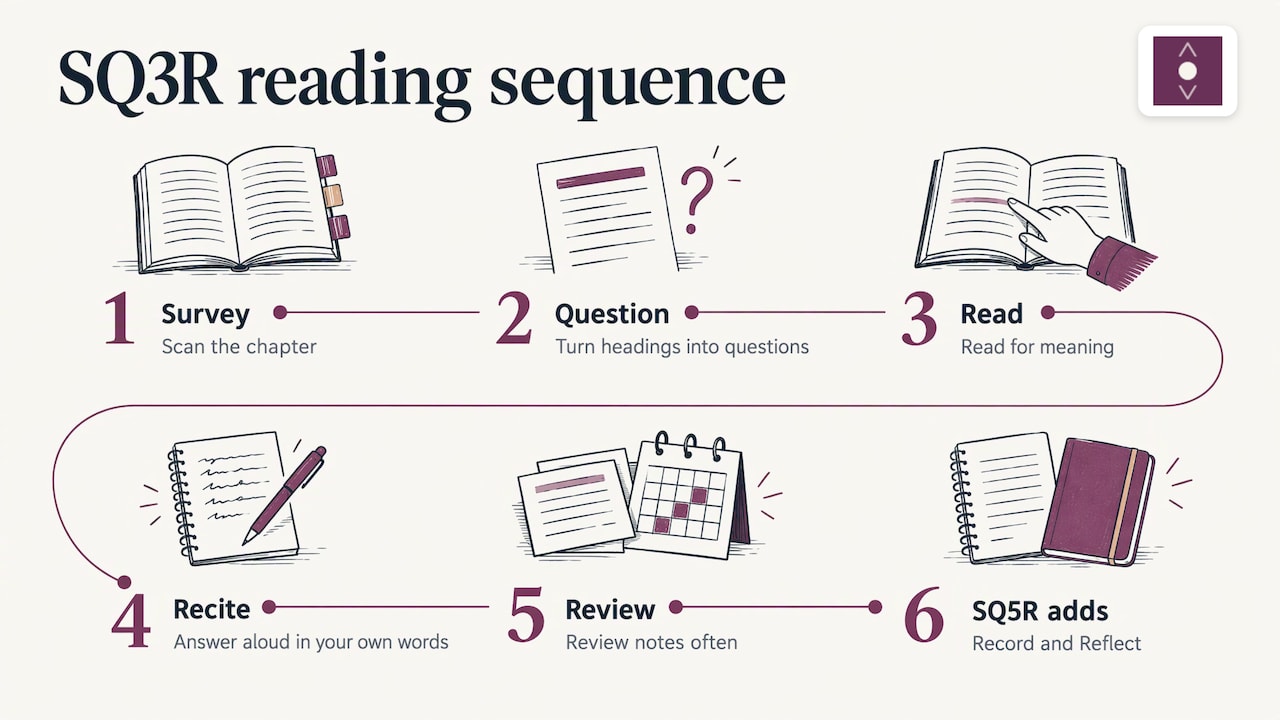
The habit underneath all of these is the same: you arrive at each section with a question, so reading becomes a search for an answer. We cover that in more depth in our guides on question-driven reading and active reading questions to ask before, during and after.
Annotate more than you highlight
UCF's study skills guide says several key studies show highlighting is largely ineffective and can create a false sense of mastery, and that rereading whole chapters before a test has very low benefits. Princeton's guidance points the same way: replace highlighting with marginal notes and a dialogue with the author, mark the thesis, and make outlines or flow charts.
Harvard Library's reading guide, by librarian Susan Gilroy, gives a fuller set of six habits: preview, annotate with your own symbol system, summarize and analyze in your own words, look for repetitions and patterns, contextualize, and compare and contrast readings. A highlight says "this seemed important." A margin note says why, and that sentence is the part you are likely to remember.
Handle long and dense texts in passes
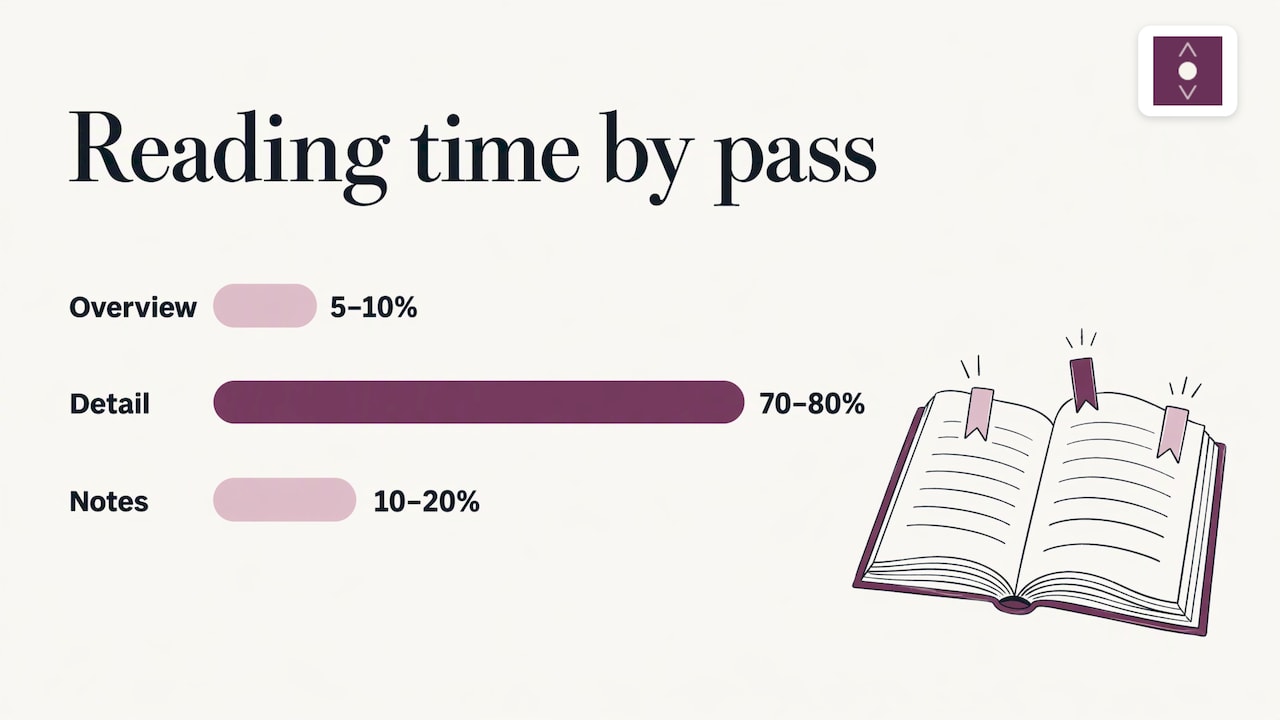
If a book or a long paper overwhelms you, stop reading it straight through. Paul N. Edwards of the University of Michigan School of Information recommends three passes for non-fiction:
| Pass | Share of your reading time | What you do |
|---|---|---|
| Overview | 5 to 10% | Get the structure and the argument's shape |
| Detail | 70 to 80% | Read closely, with marginal notes |
| Notes | 10 to 20% | Record arguments, evidence and conclusions in your own words |
He suggests aiming for one to three pages of notes per 100 pages of text, starting each note with a page number so you can find the passage again, and keeping notes somewhere you can easily locate them. He also advises short sessions of one to two hours, because comprehension and retention drop off sharply after about an hour.
That page-number advice is the quiet key. A note you can't trace back to its passage is a claim you can't check, and one you will hesitate to use in a paper, a sermon, an episode or a memo.
Test yourself instead of rereading
This is where the strongest evidence sits. Roediger and McDermott reviewed the research in a 2018 article: students who studied a passage once and then took three tests recalled 21 percent more a week later than students who studied it four times. The tested group forgot about 14 percent, while the restudy group forgot nearly half. Even tests without feedback produced large gains, and feedback would have made them larger.
In practice, retrieval means closing the text and:
- Writing the main claim and its evidence from memory.
- Answering the questions you made from the headings.
- Explaining the idea aloud as if to a colleague. Princeton notes that teaching is an effective way to learn and moves information from short-term toward long-term memory.
- Making flashcards for facts, terms and definitions, as Dartmouth's academic success guide recommends.
If you read for an exam with defined content, such as a licensing test, question banks give you ready-made retrieval practice. Practice tests for exam prep are one way to do that for professional exams.
For your own reading, the best questions are the ones you wrote. Our walkthrough of turning highlights into flashcards shows how a marked passage becomes a prompt you can answer later.
Space your reviews
Testing once is good. Testing on a schedule is better. Carnegie Mellon's Eberly Center explains that spaced practice, revisiting material with gaps of days, weeks or months, beats massed practice for long-term retention. Two or three well-spaced encounters are enough, and a workable gap is roughly 10 to 20 percent of how long you want to remember the material, favoring active re-exposure over passive rereading. UCF adds that studying across several days, with sleep in between, stores knowledge far better than cramming.
A simple version:
- Within a day: close the text and write three to five lines from memory.
- After about a week: answer your own questions without looking.
- After a month or so: review only what you missed, and combine several weeks of notes into one review sheet or concept map, as Dartmouth's guide suggests, rather than rereading.
If you need to remember something for a year, a gap of a month or two is about right by the 10 to 20 percent guideline. If it is for an exam in three weeks, gaps of a few days work.
Where it breaks down in practice
The methods above are well supported. The trouble is logistics. Your highlights live in one app, your notes in another, your PDFs in a folder, the podcast you wanted to remember in a third place. When notes are detached from the passage, you can't tell what the source actually said, and the review step quietly stops happening.
Three habits fix most of it:
- Keep everything in one place you return to. Retention is a recurring job, so the system must make coming back cheap.
- Keep the way back to the source. Every note, answer and flashcard should lead to the passage it came from.
- Ask questions of what you saved, not of the internet at large. Recall needs your material, and answers that show their origin let you verify instead of trust.
How Omphalis supports the loop
Omphalis is a workspace for understanding, built for recurring work with the sources that matter to you. You can save web articles, pasted text, PDF, EPUB and DOCX files, podcasts, YouTube videos and voice notes, follow feeds and newsletters, and import from Zotero, Google Drive, Kindle and other tools.
Then the habits above map to features:
- Preview and read: a clean reading view with a way back to the original, and a choice of how far each save goes: Clean, Structure or Full.
- Get unstuck: ask for help on the exact passage you are stuck on, which is the comprehension fix from the diagnostic above.
- Annotate: highlights and notes sit beside the passage, so your margin sentence stays attached to the text that prompted it.
- Recall and review: ask questions of your own sources and get answers that show where they came from. Comparisons, Notebooks, research reports and citation export carry the work into writing.
For how this fits together as a method, see our guides to structured reading methods and reading comprehension strategies for adults. Students working with papers will find the PDF highlighting strategy useful, and if you write as well as read, there is a piece on keeping your own writing and other people's reading in one place.
Our view on retention
We built Omphalis on a simple belief: understanding is not a summary you read once. It is something you build from the sources that matter to you, and then return to.
The research says retention comes from effort at the moment of reading and from coming back later. A summary hands you a conclusion without either. That is why we keep you in the source: help on the exact passage, notes beside it, and answers that show where they came from.
This is recurring work, so we designed for the second and third visit, not only the first. Your highlights and notes stay tied to the text, so a month later you can see what you marked and why, and go straight back to the original.
For seminars, labs and reading groups, Workspaces share sources, reading lists and margins, while leaders never see members' private marks or personal Libraries. Shared reading deepens memory, and private thinking stays private.
Omphalis Team
Start with your next reading
You don't need to rebuild your whole system. Pick the next article, paper or podcast you care about and run the loop once: preview, margin notes, recall within a day, review in a week.
Omphalis has a Free plan with 40 comprehension units a month, and a 14-day trial with no card required. Paid personal plans start at $4 a month for Lite, with Pro at $9 a month ($90 a year), where PDF reading starts. Premium is $19 a month and Scholar $39 a month. See all plans on the pricing page.

If you read together, Workspaces offer a Semester pass at $25 per student for a four-month term, plus Starter, Plus and Institute plans for ongoing groups. Details are on the Workspaces page.
FAQ
How can I retain more of what I read?
Preview the text with a purpose, read with questions made from the headings, and write margin notes in your own words. Then close the text and recall the main claim and evidence within a day. Retrieval practice and spaced review do more for long-term memory than rereading.
Is highlighting a good way to remember?
On its own, no. UCF's study skills guide cites several studies finding highlighting largely ineffective and prone to creating a false sense of mastery. Use it sparingly and pair each mark with a note saying why it matters. Notes attached to the passage give you something to recall and something to check.
How often should I review what I've read?
Two or three well-spaced encounters are enough, according to Carnegie Mellon's Eberly Center. A good gap is about 10 to 20 percent of how long you want to remember the material. For example, review after a day, a week and a month, and focus on what you missed.
How should I handle a very long book or paper?
Read it in passes rather than straight through: a short overview, a detailed read, then a notes pass in your own words. Keep sessions to one or two hours, since comprehension and retention fall off sharply after about an hour. Start each note with a page number so you can find the passage again.
Sources
- Guided Reading Processes You Should Try, Oregon State University
- Reading Strategies, Harvard Library
- 3 P's for Effective Reading, Cornell Learning Strategies Center
- 101 Tips for Study Skills, UCF
- Why We Forget Most of the Books We Read, The Atlantic
- Why do we forget books we've read?, The Guardian
- Why Can't I Remember What I Just Read?, Angela Bogdanova
- Active Reading Strategies, Princeton Principedia
- The SQ3R Method, Stanford Center for Teaching and Learning
- Reading, writing, taking notes, Indiana University
- How to Read a Book, Paul N. Edwards, University of Michigan
- Remembering What We Learn, PMC
- Spaced Practice, Eberly Center, Carnegie Mellon University