Keeping your own writing and other people's reading in one place
September 22, 2026 · 13 min read
Listen to this post
Contents
- Introduction
- 1. Personal manuscript, public reading: create a single source of truth
- 2. Tagging the moment: markable highlights across content
- 3. The Map View: visualizing connections between your writing and others'
- 4. Contextual annotations: preserving meaning, not just quotes
- 5. Personal repository hygiene: organizing for longevity
- 6. Cross-format synthesis: from note to narrative
- 7. Collaboration without chaos: reading for teams
- FAQ
- Should your notes live with the things you read?
- How do you connect your own thinking to what you have saved?
- How do I start without overhauling my current workflow?
- Can I keep private notes separate from shared material?
- How do I stop the organization from drifting over time?
- Conclusion
- References
TL;DR
- Omphalis offers a unified space to ingest, annotate, and connect personal writing with curated reading, preserving provenance and authorial intent across formats.
- Key practices include consistent naming, tagging, and versioning, plus cross-format synthesis and a visual Map View to trace ideas and their relationships.
- Collaboration is supported with privacy controls and attribution, enabling teams to share highlights without exposing private notes or compromising authorship.
- Regular maintenance routines (audits, cadence for ingestion, naming and tag vocabulary reviews) prevent drift and sustain long-term usefulness.
Introduction
You read with intention. You write with purpose. When those activities share a single, structured space, you keep track of ideas without losing context. A unified space helps you retain authorial voice, connect insights across formats, and act on what you learn.
In short, your notes belong in the same place as the things you read, because the link between a note and the passage that provoked it is most of its value and the first thing a split workflow loses.
In practice, you gain a continuous thread from source to note to narrative. Your highlights, annotations, and drafts stay linked to the exact passages that sparked them. This continuity makes it easier to revisit ideas, verify interpretations, and build on what you read.
The alternative is well documented. Bernstein, Van Kleek, Karger, and schraefel studied the small pieces of information that escape the tools meant to hold them, ending up in mail to self, loose files, and paper, precisely because no single tool fit the moment of capture. A personal knowledge library only works if capture and reading happen in the same place.
Omphalis provides a clean, mapped reading experience that preserves meaning across content types. Our approach centers on understanding, not just extraction, so you retain noteworthy moments and tie them to your own writing.
- Ingest diverse formats into one workspace, from articles to videos, without losing context
- Mark and cross-link moments to reveal deeper themes
- Visualize ideas in a knowledge map that travels with your writing
1. Personal manuscript, public reading: create a single source of truth
You gather writing, notes, transcripts, and media into a single repository without breaking the thread of your argument. Each format arrives with its original structure preserved, allowing you to compare how a point appears across sources. This consolidation reduces duplication and keeps your research path visible.
Use a consistent ingest pipeline that captures metadata, timestamps, and source identifiers. When you import an article, a podcast transcript, a voice note from a walk, or the meeting notes you typed afterwards, attach contextual cues like author, date, and relevance tags. A personal knowledge library is only as retrievable as the metadata you put into it.
Your voice stays intact as content moves from note to narrative. Preserve original quotations with provenance and keep interpretive notes tethered to the exact passages that inspired them. This alignment supports faithful re-expression in your own writing, minimizing paraphrase drift.
Keeping the source attached is not just bookkeeping. Britt and Aglinskas found that readers taught to attend to where a document came from used that information far better when reconciling several accounts of the same events. Provenance is what lets you tell two sources apart later.
Document edits, rephrasings, and synthesis steps. A transparent trail helps you defend interpretations and reuse insights without reworking the same material from scratch. Omphalis keeps your manuscript and its sources in sync, so each idea remains anchored to where it came from.
2. Tagging the moment: markable highlights across content
You read and listen across formats, and tagging helps you lock in the exact moment that matters. Tags should reflect purpose, not just topics, so they guide later retrieval and synthesis. Use a consistent tag vocabulary to avoid drift over time.
Purpose matters because the mark on its own does little. Reviewing ten study techniques, Dunlosky and colleagues rated highlighting and underlining low utility when used alone, not because marking is useless but because it stops short of the work that makes material stick. A tag that records why a passage matters is the cheapest way to add that step.
Capture highlights with precise pointers: a quote, a timestamp, a concept, or a question raised by the creator. Preserve the original context so you can reassess later without rechecking the source. This discipline speeds up recall and supports accurate re-expression in your writing.
Links between highlights create thematic threads that span formats. When you tag a passage in an article and connect it to a podcast moment, you expose a recurring motif or a contradictory stance. Those connections enrich your understanding and sharpen your own narrative voice.
Aim for linked clusters rather than isolated notes. Group related highlights into thematic bundles, then map how they interact. This cross-pollination shows you not just what was said, but how ideas converge or diverge across media.
3. The Map View: visualizing connections between your writing and others'
The map view renders your reading network as a living graph. Each node captures a concept, a passage, or an idea from a source, while edges show relationships such as contrast, support, or progression. This visualization helps you trace how your thinking aligns with or diverges from external voices.
The idea is older than the software. In 1945 Vannevar Bush described a desk that would let a reader join two items permanently into an associative trail and recall the whole trail later, on the grounds that the mind works by association and filing cabinets do not.
Begin with a seed concept from material you care about. As you introduce related notes, the graph grows into clusters around themes, methods, and questions. The result is a tangible map that guides your next steps.
Formats stay linked to their origins in the map. A transcript node points to the exact timestamp, while an article node retains its author and publication date. Provenance travels with the connections, so you retain context as you explore.
Apply visual filters to compare formats, or switch to a literature-first view to trace how ideas migrate from reading to writing. The map becomes a navigable landscape where context remains intact.
4. Contextual annotations: preserving meaning, not just quotes
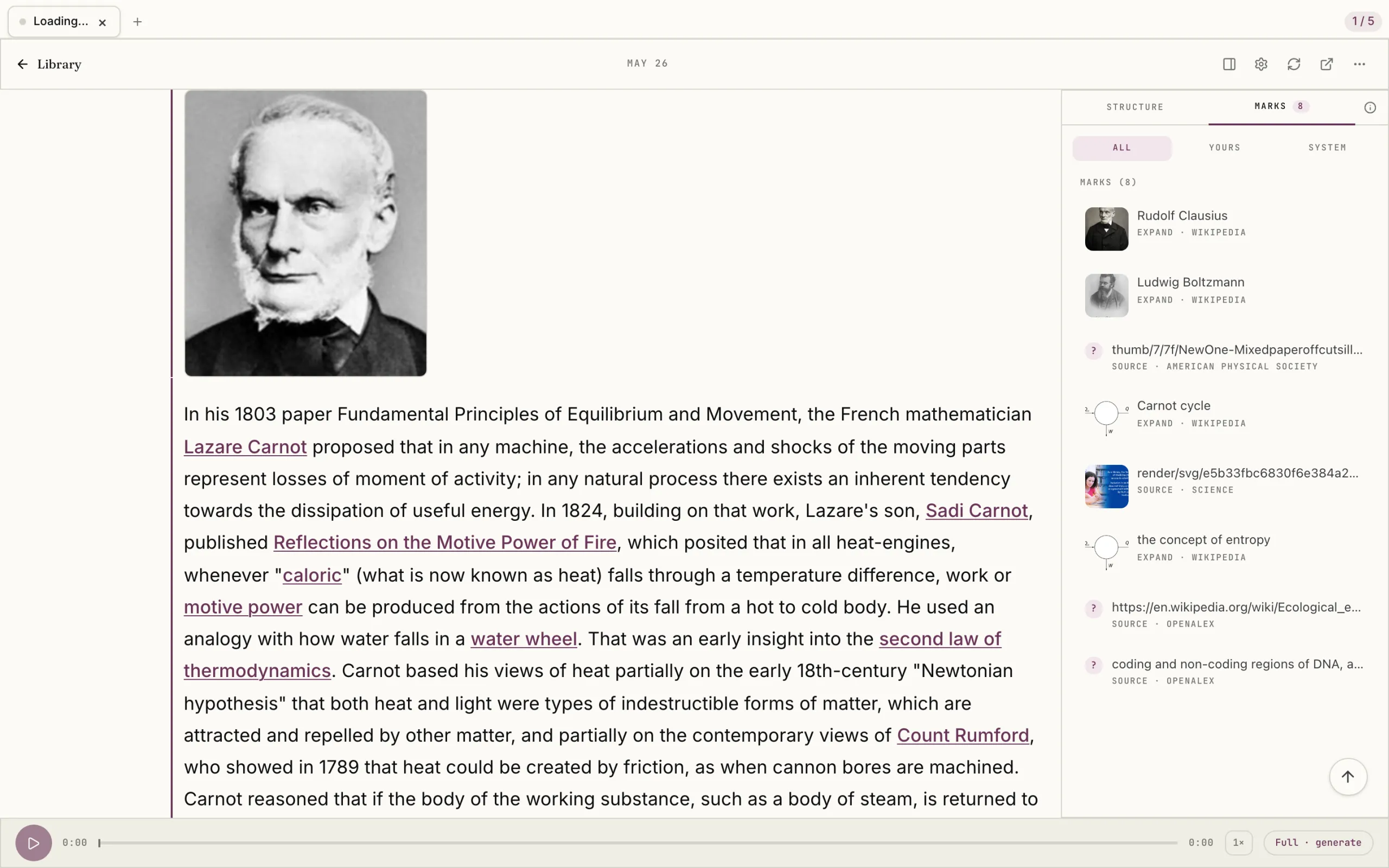
Annotations stay attached to the exact text they illuminate. Inline notes travel with the passage, while side notes offer quick context without obscuring the original voice. This pairing keeps your interpretation tethered to the source rather than drifting away.
That tethering is doing more work than it looks. Catherine Marshall's study of annotations in used textbooks found that readers' marks are often telegraphic and cryptic, carrying much of their meaning through where they sit on the page. Lift the note away from the passage and you keep the words while losing the point.
Preserve the original cadence by marking mood, intent, or rhetorical devices as you annotate. The aim is to illuminate nuance, not replace it with summary alone.
Tag annotations by purpose: comprehension, critique, synthesis, or application. This categorization helps you retrieve what you need for each future task, whether you are drafting, teaching, or debating ideas.
Use targeted prompts with your annotations, such as clarifying ambiguities, identifying assumptions, or linking a claim to a method. Clear prompts speed up later reuse and keep your notes actionable across projects.
5. Personal repository hygiene: organizing for longevity
Your archive thrives on consistency. Use a simple, repeatable naming scheme for all items, such as author year title or project keyword date. Apply a controlled tagging taxonomy so terms stay stable over time. Versioning should be explicit: track drafts, edits, and final releases with clear identifiers and dates.
Tag vocabularies drift on their own if nothing holds them. Golder and Huberman's analysis of a large tagging system documented the polysemy, synonymy, and varying levels of specificity that appear once a vocabulary grows without governance. Your private library is a tagging system with exactly one participant, and it drifts the same way.
Regular audits help you stay aligned between sources and notes. Schedule quarterly reviews to prune duplicates, refresh links, and confirm provenance. Archive deprecated formats and migrate legacy notes to current schemas without losing context.
- Lock core sources to prevent accidental edits in your manuscript and reading space.
- Keep a changelog that summarizes meaningful edits and the rationale behind them.
- Use immutable references for quotes and data points so future readers see the exact same material.
If you want a vocabulary for the provenance fields themselves rather than inventing one, the W3C's PROV-O ontology already names the entities, activities, and agents a record needs. Borrowing its shape costs nothing and keeps your archive legible to tools you have not chosen yet.
| Practice | Why it matters | How to implement |
|---|---|---|
| Consistent naming | Reduces search friction and misfiling | Define a short canonical format and enforce it in templates |
| Fixed tagging | Prevents drift in retrieval and themes | Maintain a controlled vocabulary; update only through a governance step |
| Versioning | Preserves evolution and authorship | Append a version stamp to each item; store previous versions in a dedicated history space |
6. Cross-format synthesis: from note to narrative
Cross-format synthesis connects notes from articles, transcripts, and media into a single throughline. Start by aligning core claims across formats to reveal where voices converge or diverge. Build a narrative spine that honors each format's strength while preserving provenance.
Use parallel notes to map where evidence appears, then weave those threads into a provisional outline. Do not collapse nuance into a summary; include direct quotes or timestamps where they strengthen your point. The aim is clarity without erasing original voices.
Translate the synthesized map into a draft that reflects how your ideas unfold. Begin with a central thesis and anchor it with cross-format evidence. Layer in transitions that show cause and effect, contrast, and progression.
During drafting, revisit the source network to confirm provenance. If a thread becomes a dead end, prune it before it weakens the narrative. The result is a piece informed by multiple voices that still clearly represents your reasoning.
7. Collaboration without chaos: reading for teams
Teams need access to relevant material without exposing personal annotations. Use controlled shares that grant view only rights to designated documents or excerpts. Separate private notes from shared highlights so coworkers see the core ideas without your marginalia.
Side conversations should occur in a dedicated commentary layer that keeps original content intact. Inline comments can reference specific passages, while threaded discussions stay contextual and reversible. Clearly indicate who contributed each insight to maintain credit and accountability.
- Set permission tiers for collaborators to prevent unintended edits
- Archive prior comment threads to avoid clutter during busy projects
- Use versioned shares to capture evolving interpretations without altering the source
| Feature | Benefit | Implementation |
|---|---|---|
| Private vs public notes | Protects personal thinking while enabling collaboration | Tag private notes as confidential; expose only selected excerpts to teams |
| Authorial integrity | Maintains trust in original voices | Lock original content; append discussions to a separate overlay layer |
| Credit tracking | Clear attribution for ideas | Attach contributor tags to each insight and timestamp edits |
FAQ
Should your notes live with the things you read?
Yes. A note separated from its passage keeps the words and loses the reason you wrote it, which is why capture and reading belong in one space rather than two.
How do you connect your own thinking to what you have saved?
Tag the moment by purpose rather than topic, then link related marks into clusters. The connections between what you have saved are what turn a pile of highlights into an argument you can write from.
How do I start without overhauling my current workflow?
Begin with a single repository for primary manuscripts and a lightweight tagging system. Add cross-format notes gradually as you ingest new material.
Can I keep private notes separate from shared material?
Yes. Use a private layer for personal annotations and a controlled view layer for collaborative material, so your thinking stays yours while the team still sees the relevant excerpts.
How do I stop the organization from drifting over time?
Schedule regular reviews of naming conventions and tag vocabulary, prune outdated connections, and confirm that provenance still resolves. Quarterly is enough for most personal libraries.
Conclusion
At Omphalis, writing and reading are one continuous practice. A unified space keeps your ideas coherent across formats, so your notes, drafts, and curated reads reinforce each other instead of drifting apart.
Your real value grows as your knowledge map expands. Ingest diverse sources, mark the moments that matter, and preserve context as ideas cross media. This turns scattered highlights into a connected narrative you can trust.
Practical takeaway: build a stable repository, keep provenance clear, and revisit connections regularly. Small, consistent habits like naming, tagging, and versioning prevent drift and sustain long term usefulness.
- Start with a single manuscript repository and a lightweight tagging system
- Ingest new material and link it to existing concepts to reveal deeper themes
- Review naming and tag vocabularies on a regular cadence to maintain coherence
References
- Bernstein, M., Van Kleek, M., Karger, D., & schraefel, m.c. (2008). Information scraps: How and why information eludes our personal information management tools. ACM Transactions on Information Systems.
- Britt, M. A., & Aglinskas, C. (2002). Improving students' ability to identify and use source information. Cognition and Instruction.
- Bush, V. (1945). As we may think. The Atlantic.
- Dunlosky, J., Rawson, K. A., Marsh, E. J., Nathan, M. J., & Willingham, D. T. (2013). Improving students' learning with effective learning techniques. Psychological Science in the Public Interest.
- Golder, S. A., & Huberman, B. A. (2006). Usage patterns of collaborative tagging systems. Journal of Information Science.
- Marshall, C. C. (1997). Annotation: From paper books to the digital library. Proceedings of the Second ACM International Conference on Digital Libraries.
- W3C. (2013). PROV-O: The PROV ontology. W3C Recommendation.