How to use timestamps without losing the thread of a long interview
Updated · 12 min read
Listen to this post
Contents
- When should you save a timestamp instead of stopping to take a full note?
- Why not write everything down as it is said?
- What should a timestamp note include so it still makes sense later?
- The four parts of a useful timestamp note
- Keep the speaker and the turn together
- How can you return to a useful passage without treating each clip as isolated?
- Return to the text around the moment
- Review your marks the same day, in order
- Test yourself before you look
- Know what you are trading away
- A workflow for a three-hour interview
- How Omphalis handles timestamps in a podcast transcript
- FAQ
- How often should I save a timestamp in a long podcast interview?
- Should I use fixed intervals, like every five minutes?
- What if the audio and the transcript drift apart?
- Is it fine to rely on the transcript instead of taking notes?
- How do I quote someone accurately from a timestamp?
- Next step
- References
TL;DR
- Save a timestamp when stopping to write would make you miss the next turn of the argument. Write the full note later, while the moment is still fresh.
- A timestamp on its own is just a number. Give each one a short note: who is speaking, what they claimed, and why you marked it.
- Go back through your marks the same day, in order, and write one line that links each to the one before it. That line is what keeps a three-hour conversation in one piece.
A long podcast interview rarely loses you in one place. It loses you slowly, as the guest builds an argument across forty minutes and you only remember the three lines that sounded good. Podcast timestamps can fix that, or they can make it worse, depending on how you use them.
The common failure is a list like "23:14, 47:02, 1:12:40" with nothing beside it. A week later you open the list and none of the numbers mean anything. Each clip you play back sounds like a fragment, cut off from the question it answered.
In short: a timestamp is worth saving when it lets you keep listening, and it stays useful only if it carries enough context to be found and understood later. The rest of this guide covers when to mark, what to write, and how to rebuild the thread afterwards.
When should you save a timestamp instead of stopping to take a full note?
Stopping the audio feels responsible, but it has a cost. Each time you pause to write a paragraph, you step out of the conversation, and the speaker's next point has to wait for you. In a long podcast interview, those pauses add up until you are taking notes on fragments rather than following an argument.
Research on event perception helps explain why. People break continuous experience into events, and the boundaries between them shape what is held in memory (Zacks et al., 2007; Kurby and Zacks, 2008). A pause in the middle of an explanation adds a boundary the speaker never intended. In virtual environment studies, simply crossing a doorway lowered recall of what came before it (Radvansky et al., 2015).
Saving a timestamp is the lighter alternative. It costs a second, keeps you inside the conversation, and leaves the writing for later. It also helps in a less obvious way. In three experiments, saving one file before studying a new one improved memory for the new file, as long as people trusted that the save had worked (Storm and Stone, 2015).
So save a timestamp, rather than stopping, when:
- The speaker is mid-argument and the next few minutes depend on what was just said.
- You want to check a claim, a name or a figure later, but it does not change how you follow the conversation now.
- Something surprises you and you want to come back to it, but you cannot say why yet.
Stop and write a full note when:
- You have just understood something that you will not be able to reconstruct from the audio alone, such as a link to your own work.
- The speaker has finished a section and is changing topic, so a pause costs you nothing.
- You are lost. Rewinding thirty seconds now is cheaper than building notes on a misunderstanding.
Why not write everything down as it is said?
Writing word for word feels thorough, but it tends to replace thinking. In Mueller and Oppenheimer (2014), students who typed lecture notes tended to transcribe verbatim and did worse on conceptual questions than students who wrote by hand in their own words. If the podcast transcript already holds every word, your notes do not need to. Your job is to mark where the important parts are and say, briefly, why.
What should a timestamp note include so it still makes sense later?
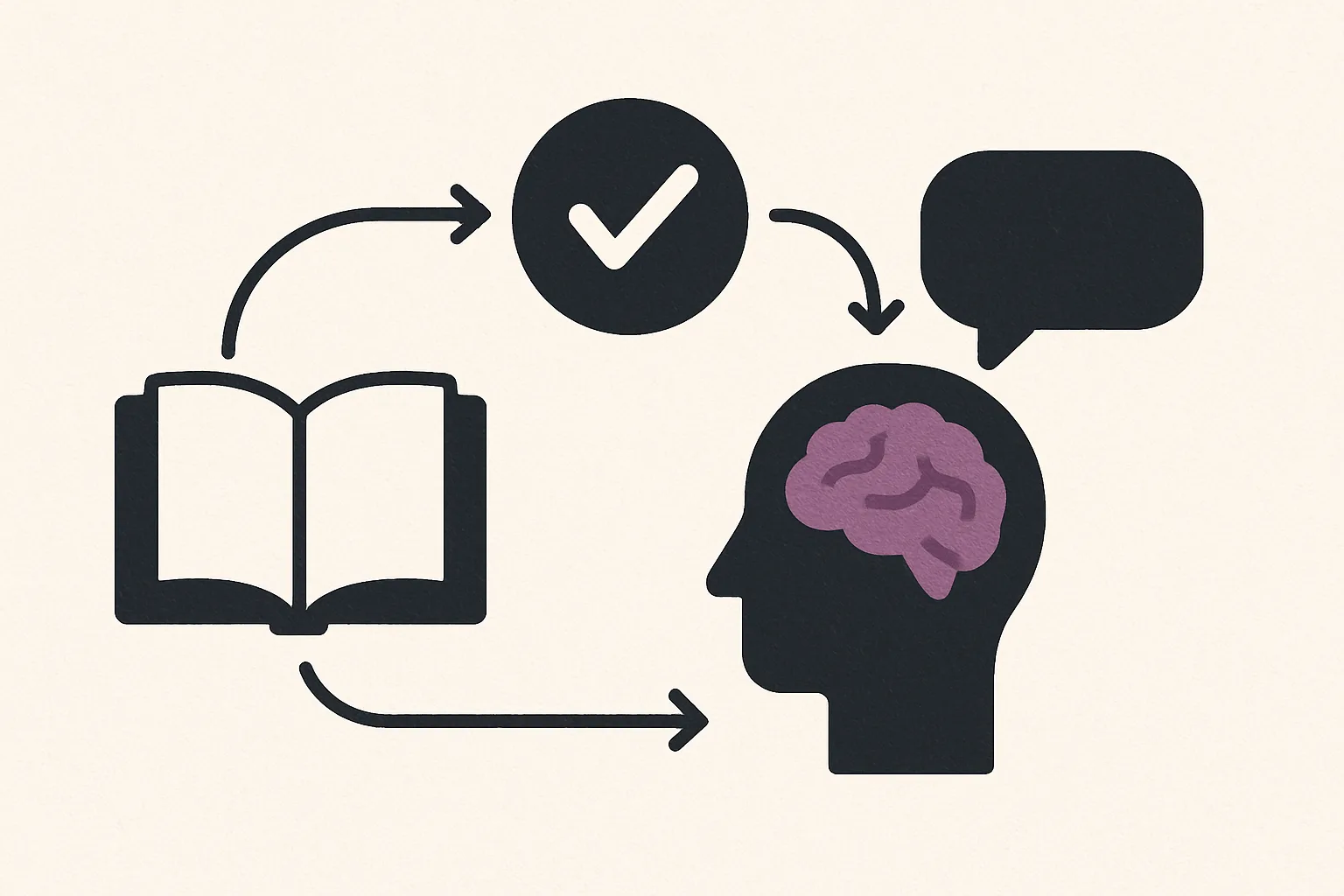
A timestamp note has one job: to let you, a week from now, recognise the moment without replaying it. That takes more than a time and less than a paragraph. Four parts are usually enough.
The four parts of a useful timestamp note
- The time. Use one format throughout, such as h:mm:ss for anything over an hour, so the marks sort in order.
- The speaker. In a long podcast interview, "the guest" is not always clear. Use a name or a role, like host, guest, or caller.
- The claim, in your words. One line that says what was said, not how it was said. "Says sleep loss hits recall more than learning" is useful. "Interesting bit about sleep" is not.
- Why you marked it. A single word can do it: check, use, disagree, confusing, quote. This is the part people skip, and it is the part that makes a note worth opening later.
A complete note looks like this: "1:12:40, guest: says the effect only held in younger adults. Check, it contradicts the earlier claim at 23:14."
That last part, the pointer back to 23:14, is what keeps the thread. It turns two separate clips into one line of reasoning.
Keep the speaker and the turn together
Most transcripts mark who is speaking at the start of each turn. When you save a moment, keep the speaker label with it. A claim attributed to the wrong person is worse than no note at all, especially in interview notes you may quote. If two people talk over each other, note that in the reason field so you check it against the audio before you use it.
How can you return to a useful passage without treating each clip as isolated?
The isolated clip problem shows up when you revisit marks one at a time. You play 47:02, hear thirty seconds, and lose what came before it. The fix is to come back to the passage, not just the second, and to read your marks as a sequence rather than a pile.
Return to the text around the moment
A podcast transcript lets you see a moment in context. When you open a mark, read a few lines before and after it. The question the host asked is often more useful than the answer, because it tells you what the answer was responding to.
This is also where audio comprehension and reading meet. Listening carries tone and emphasis. Reading lets you slow down on a hard sentence and notice how it connects to the previous turn. Using both on the same moment helps you understand it, not just recognise it.
Review your marks the same day, in order
Memory for new material drops fastest in the first day. A modern replication of Ebbinghaus's forgetting curve tested relearning at intervals from 20 minutes to 31 days and found results similar to the 1880 original (Murre and Dros, 2015). A short review on the same day, while you still remember the conversation, is worth more than a long one next week.
Go through the marks in time order. For each one, write a single line that links it to the mark before: "builds on", "contradicts", "example of", "answers the question at". After five or six marks, you will have a rough outline of the interview in your own words.
Test yourself before you look
Before you open a mark, try to say what it was about from the note alone. If you can, the note did its job. If you cannot, rewrite it now that you have heard the passage again. Breaking a long lecture with short recall tests reduced mind wandering and improved learning in two experiments (Szpunar et al., 2013). The same habit works at the end of a long interview.
Know what you are trading away
Saving a mark means trusting your system to hold the detail for you. Researchers call this cognitive offloading, and it frees attention for the task at hand (Risko and Gilbert, 2016). The trade is that people who expect to look something up later tend to remember where it is better than what it says (Sparrow et al., 2011). The same-day review is what turns "I know where that was" into "I know what that was."
A workflow for a three-hour interview
Here is the full routine, start to finish. It works with a notebook, a notes app, or a reader that ties marks to the transcript.
- Before you start, write down the question you want the interview to answer for you. It tells you which moments are worth marking.
- While listening, save a timestamp whenever something matters and write no more than the reason word. Do not stop the audio unless you are lost or the topic has changed.
- At natural breaks, such as a topic change or an ad, spend a minute turning the last few marks into full notes with all four parts.
- The same day, read the marks in order and add the linking line to each one.
- A few days later, look only at your notes and try to retell the guest's argument. Open the marks you cannot explain.
If you take notes from several episodes on the same subject, use the same reason words across all of them. Searching for "disagree" across a series of interviews quickly shows you where the guests pull in different directions.
How Omphalis handles timestamps in a podcast transcript
Omphalis ties marks to the words of the transcript, not only to a time. Paste an episode link into your Library, and once the podcast transcript is ready, it shows timestamps and speaker labels for each turn, with a section map to help you find your way back.

While the episode plays in the web app or mobile web, press Highlight now, or Alt+Shift+H, and Omphalis saves the passage around that moment as a private highlight without pausing the audio. If the transcript has no usable timing at that point, it saves a timestamp bookmark instead. You can then add a note to the highlight saying why it matters.
Later, the Marks list lets you search by the words you highlighted, your note, or the episode title. Opening a mark takes you back into the transcript at that passage, with the turns around it still in view. The same approach works for YouTube talks, and our guide to podcast note-taking covers what to write once you have found the passage. For why listening often leaves less behind than reading, see notes from audio.
FAQ
How often should I save a timestamp in a long podcast interview?
There is no fixed number. Mark when something changes your understanding or needs checking. In a two-hour episode, ten to twenty marks is usually enough, and more than forty often means you are marking instead of listening.
Should I use fixed intervals, like every five minutes?
Fixed intervals help when you are producing a transcript for others to navigate. For your own interview notes, mark by meaning, not by the clock. A mark at a fixed interval carries no reason, so it rarely helps you later.
What if the audio and the transcript drift apart?
Automatic transcripts sometimes lose timing in noisy passages or when people talk over each other. If a mark lands in the wrong place, use the speaker label and your one-line claim to find the right turn, then move the mark or correct the time.
Is it fine to rely on the transcript instead of taking notes?
The transcript holds the words, but not your reasons for caring about them. A short note in your own words, beside the passage, is what lets you use the interview later. Keep the transcript for checking exact wording before you quote.
How do I quote someone accurately from a timestamp?
Open the passage, read the full turn, and check it against the audio before you quote. Note the speaker and the time with the quote, so anyone can find the source moment.
Next step
Pick the next long interview on your list and try the routine once: mark without stopping, write the four parts at the breaks, and do the linking pass the same day. To work on the passages you saved, see how Omphalis helps with reading comprehension.
References
- Zacks, J. M., Speer, N. K., Swallow, K. M., Braver, T. S. and Reynolds, J. R. (2007). Event perception: a mind-brain perspective. Psychological Bulletin, 133(2), 273-293.
- Kurby, C. A. and Zacks, J. M. (2008). Segmentation in the perception and memory of events. Trends in Cognitive Sciences, 12(2), 72-79.
- Radvansky, G. A., Pettijohn, K. A. and Kim, J. (2015). Walking through doorways causes forgetting: younger and older adults. Psychology and Aging, 30(2), 259-265.
- Storm, B. C. and Stone, S. M. (2015). Saving-enhanced memory: the benefits of saving on the learning and remembering of new information. Psychological Science, 26(2), 182-188.
- Mueller, P. A. and Oppenheimer, D. M. (2014). The pen is mightier than the keyboard: advantages of longhand over laptop note taking. Psychological Science, 25(6), 1159-1168.
- Murre, J. M. J. and Dros, J. (2015). Replication and analysis of Ebbinghaus' forgetting curve. PLOS ONE, 10(7), e0120644.
- Szpunar, K. K., Khan, N. Y. and Schacter, D. L. (2013). Interpolated memory tests reduce mind wandering and improve learning of online lectures. PNAS, 110(16), 6313-6317.
- Risko, E. F. and Gilbert, S. J. (2016). Cognitive offloading. Trends in Cognitive Sciences, 20(9), 676-688.
- Sparrow, B., Liu, J. and Wegner, D. M. (2011). Google effects on memory: cognitive consequences of having information at our fingertips. Science, 333(6043), 776-778.