Active recall is winning, but it's being practiced on the wrong things
Updated · 11 min read
Listen to this post
Contents
- Facts are not the whole memory
- Retrieval works beyond the flashcard
- Change the target of self testing
- A mark can become a prompt
- Try the three-part return
- Recall the structure, not a script
- A way back into what you read
- Frequently asked questions
- Is active recall only useful for flashcards?
- How is this different from writing a summary?
- How long should a recall attempt take?
- Should I still highlight while I read?
- Sources
Close the page. Rebuild the path. Check what you missed.
Active recall has returned to everyday study, and the interest makes sense. When you try to retrieve what you have learned instead of simply rereading it, you give memory a different kind of work to do. In a review of ten study techniques, Dunlosky and colleagues gave practice testing one of their two high utility ratings (Dunlosky et al., 2013).
But much of the advice about active recall points to flashcards: a term on one side, a definition on the other. That is useful for vocabulary, names, dates, and discrete facts.
Long-form material asks something else of memory.
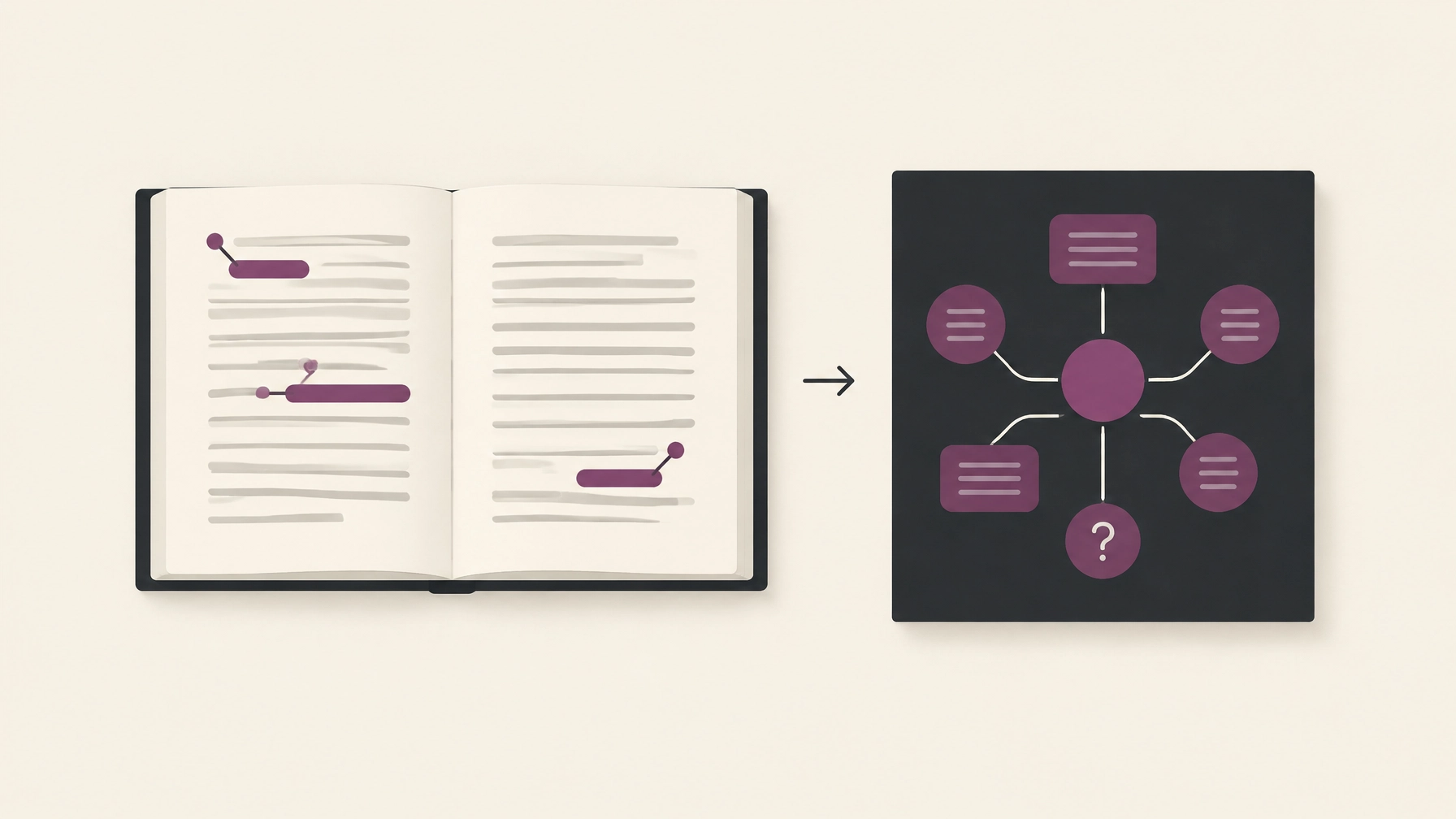
After a research paper, a three-hour lecture, or a podcast, the important thing you may lose is not a single fact. It is the shape of the thinking: what the author claimed, how the reasons accumulated, where the argument turned, and what you were not yet convinced by.
In short: keep practicing retrieval, but after long-form reading, retrieve the structure of the argument (claim, reasons, turns, doubts) with the source closed, then reopen it and check.
Facts are not the whole memory
A flashcard gives retrieval a clear target. What is the definition? Which year? What does this term mean?
An argument has a more relational shape. A study may report a result, qualify what it can show, and then draw a narrower conclusion. Remembering those pieces separately is not the same as remembering how they fit together.
You might remember that a paper involved a control group, a surprising result, and a limitation. But can you say which result supported the claim? Or why the limitation changes how broadly you should apply it?
That is a different kind of recall.
For long-form content, the useful question is often not What did I read? but How did the reasoning move? The answer might include a main claim, the evidence beneath it, a counterpoint, and a point of uncertainty. Those relationships are part of what you learned.
Retrieval works beyond the flashcard
The case for active recall is not limited to lists of isolated facts.
In a 2006 study, Henry Roediger and Jeffrey Karpicke (Roediger and Karpicke, 2006) asked students to study prose passages and then either take free-recall tests or restudy the passages. At five minutes, repeated studying produced better recall. At two days and one week, the pattern reversed: students who had practiced retrieving the material remembered more, even though restudying had made them more confident that they would remember it.
Their conclusion was concise: "Testing is a powerful means of improving learning, not just assessing it."
That finding matters for anyone who has finished a dense reading and felt they knew it because the sentences looked familiar. Familiarity can be reassuring. It is not always a reliable sign that you can bring an idea back when the source is closed.
Other research brings the question closer to complex material. In 2011, Jeffrey Karpicke and Janell Blunt (Karpicke and Blunt, 2011) compared retrieval practice with elaborative studying using concept maps. Retrieval practice led to better performance on comprehension and inference questions. It also did better when the final test asked students to construct a concept map.
This does not prove that every kind of recall automatically preserves every argument. The researchers tested science texts and meaningful learning, not a bespoke measure of reconstructing an author's argument. But it does show that retrieval is not confined to isolated details. It can support learning that involves relationships among ideas.
A practical method comes from McDaniel, Howard, and Einstein's 2009 study of "read-recite-review" (McDaniel et al., 2009). Read a section, recite what you remember without looking, then review the source to check. In their studies, this routine improved immediate and delayed free recall compared with rereading and note-taking on fact-based passages. With longer, more complex engineering passages, it beat rereading and matched note-taking on multiple-choice and problem-solving questions while taking less study time.
The lesson is not that rereading or notes have no place. It is that memory needs a turn without the page in front of it.
Change the target of self testing
If you are reading a paper, a set of flashcards can help you keep its terminology straight. They will not necessarily help you remember how the authors moved from method to finding to conclusion.
So keep the retrieval practice. Change what you ask yourself to retrieve.
Instead of testing only terms, ask:
- What was the central claim?
- What were the main reasons or pieces of evidence?
- Where did the argument change direction?
- What did the author qualify, and why?
- What do I still doubt?
These prompts make the relations visible. A claim without its support is only a label. A result without its limitation can become more certain in memory than it was on the page.
The aim is not a perfect reproduction of the source. It is to make your own account of the structure clear enough that you can compare it with the original.
A mark can become a prompt
During a first reading, you do not need to stop and memorize every paragraph. Read to follow the material. Mark the passages that carry weight for you: a key claim, a confusing step, a point you disagree with, or a passage you may want to use later.
Add a short note when it helps preserve why you marked it. "Important" says something mattered. "Is this evidence enough to support the broader claim?" keeps the question that arose while you were reading.
Those marks can become prompts for later recall. They are not a ready-made test, and they do not decide what matters on your behalf. They record where your attention stopped.
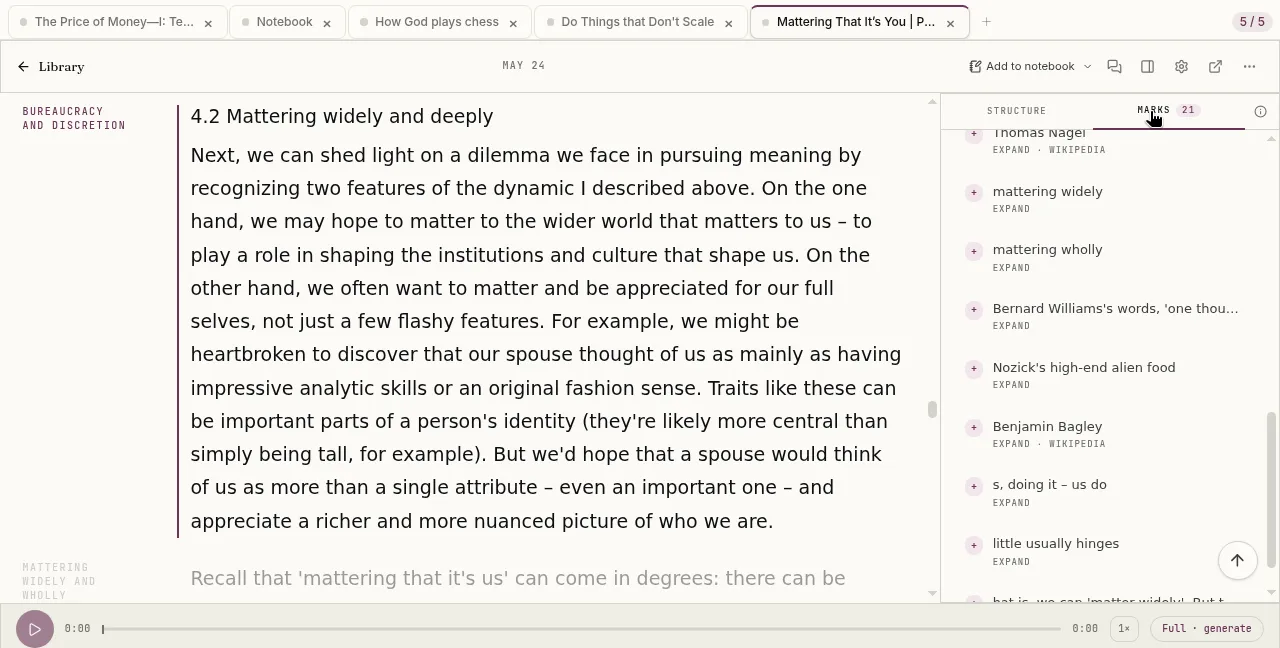
In Omphalis, a mark can stay attached to its passage with your note and a tag: Important, Confusing, Disagree, or Use later. The Marks rail lets you return to the marks in the source, rather than reviewing a pile of detached quotations. See how highlights and notes stay with a passage.
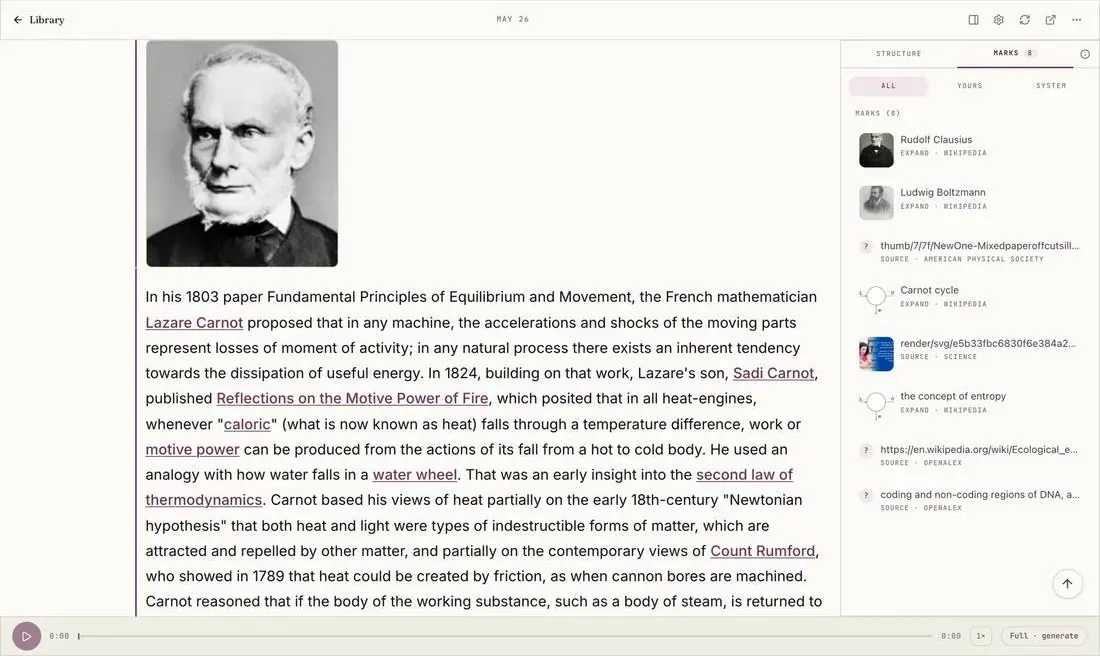
That distinction matters because a note is most useful when you can check it. A phrase copied out of context may preserve the words while losing the qualification around them. Returning to the passage lets you see whether your remembered version fits the source.
Try the three-part return
Choose one section of a paper, one part of a lecture, or a stretch of a podcast you want to understand well enough to explain.
1. Read and mark. Follow the section. Mark a few passages that seem central, difficult, or debatable. Write a note only when it helps keep your question or reaction with the passage.
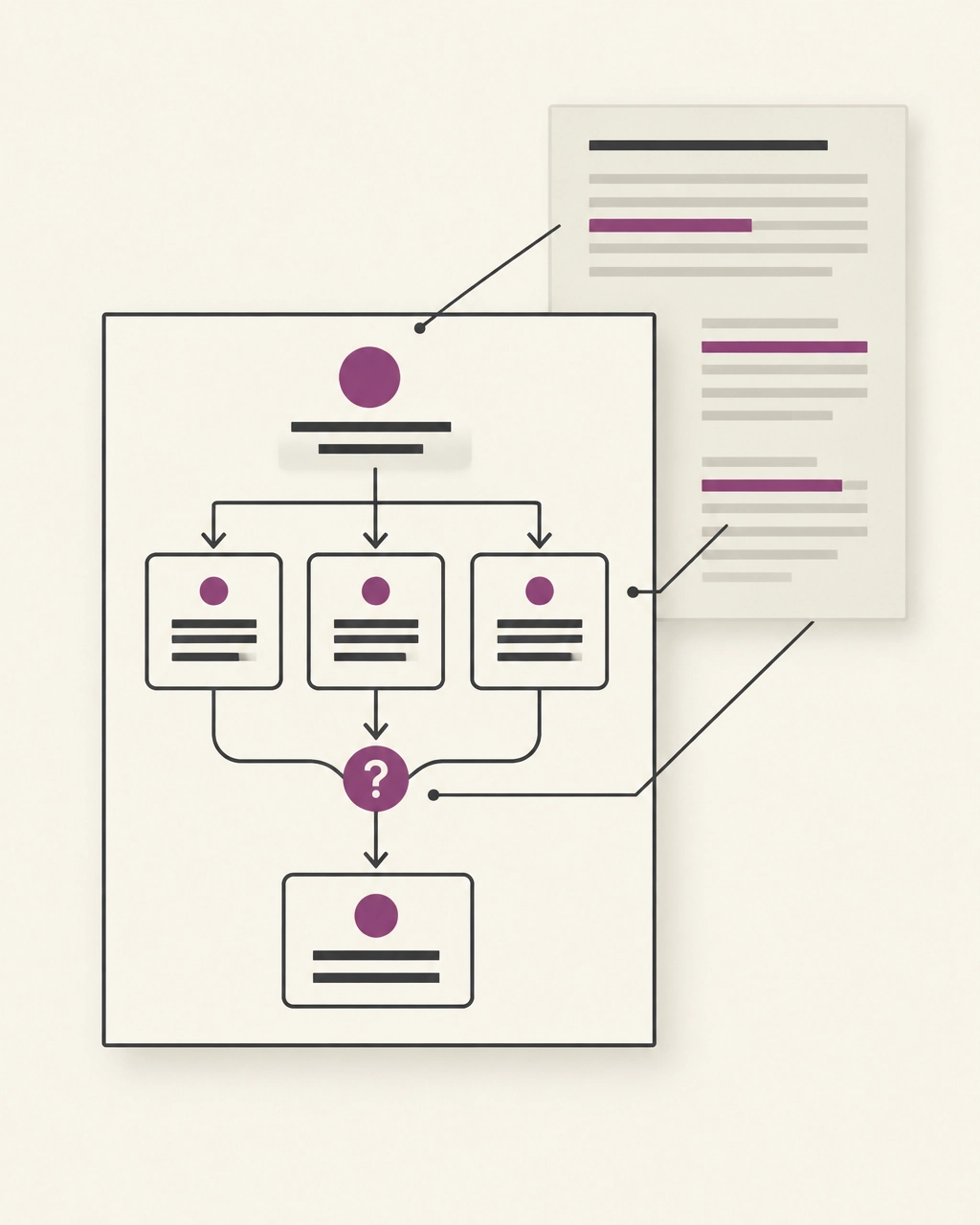
2. Close the source and recall. On a blank page, write or speak the main claim. Add the reasons and evidence you remember. Note where the argument turns, what it qualifies, and what remains unclear. Try to draw the relationships, not just collect the nouns.
3. Reopen and compare. Check the reconstruction against the source. Look for a missing link, a misplaced reason, or a qualification you left out. Update your account in your own words.
This is a structural version of read-recite-review. The source gives you material to read, a closed-page reconstruction gives you a chance to retrieve, and checking helps you notice where your memory drifted.
Keep the first attempt modest. A rough map with a missing connection is useful because it gives you something specific to check. A polished summary written with the source open can feel complete without asking whether you could find the structure again later.
For a podcast, the same loop can start from a marked moment in the transcript. Timestamps and speaker labels help you find the passage again, but your retrieval target is still your own: what point was being made, what supported it, and what did you make of it? Read and mark podcast transcripts.
For a PDF, a section map can help you locate the part you want to revisit. Keep the original available when a figure, table, or equation carries meaning; extracted text does not replace those visual details. Read and mark passages in PDFs.
Recall the structure, not a script
There is a risk in turning this practice into a demand to remember every step precisely. Long-form material can be complex, and not every author makes a clean argument. Some sources contain competing explanations, unresolved questions, or evidence that supports only part of a conclusion.
Your reconstruction can show that. You might write, "The author argues X, mainly using Y; the limitation is Z, and I'm unsure whether that addresses the alternative explanation." That is not a failed recall. It is a working account with a question still attached.
The studies above support retrieval practice as a way to improve learning and delayed recall. They do not establish that a particular argument-mapping routine guarantees comprehension. The structure-first approach is a practical application: retrieval is aimed at the relationships that matter when you return to a long source, rather than only at definitions that are easier to put on a card.
That boundary matters. A tool can keep your marks, show you the passage again, and help organize the material. It cannot determine what you believe, or replace the act of checking your reconstruction against what was actually said.
If you are returning to a question across several papers, keep the question, notes, and sources together so the next sitting can start from your earlier work. Come back to an unfinished question with its notes and sources.
The same problem shows up outside study, too. Saving a source makes it findable, not remembered, which is the argument of everything is retrievable, almost nothing is retained. For a step-by-step habit of coming back to what you read, see a field guide to returning to what you read.
A way back into what you read
A stack of flashcards can be the right instrument for a vocabulary list. A summary can help you find your way into a long paper. Rereading can be valuable when you need to study a difficult passage closely.
But when the material is an argument, the lasting work is often relational. What was claimed? What held it up? Where did it turn? What did you question?
Close the file. Draw the path you remember from your own marks. Reopen the source and check.
Not a test of everything. A way back to what mattered.
Frequently asked questions
Is active recall only useful for flashcards?
No. Roediger and Karpicke used prose passages and free recall, and Karpicke and Blunt tested science texts with comprehension and inference questions. Retrieval works on connected ideas as well as on isolated facts.
How is this different from writing a summary?
A summary is usually written with the source open. Recall asks you to rebuild the argument with the source closed, then check it. The gaps you find on the check are the useful part.
How long should a recall attempt take?
Keep it short. A few minutes on one section, a blank page, and a rough map of claim, reasons, turn and doubt is enough to show you what to check.
Should I still highlight while I read?
Yes, if each mark has a reason. Mark the passages that carry the argument or raise a question, then use those marks as starting points for recall rather than as a list to reread. The trade-offs are covered in active reading vs highlighting.
Sources
- Dunlosky, J., Rawson, K. A., Marsh, E. J., Nathan, M. J., & Willingham, D. T. (2013). "Improving students' learning with effective learning techniques." Psychological Science in the Public Interest, 14(1), 4 to 58. PubMed
- Roediger, H. L., & Karpicke, J. D. (2006). "Test-enhanced learning: taking memory tests improves long-term retention." Psychological Science, 17(3), 249 to 255. PubMed
- Karpicke, J. D., & Blunt, J. R. (2011). "Retrieval practice produces more learning than elaborative studying with concept mapping." Science, 331(6018), 772 to 775. PubMed
- McDaniel, M. A., Howard, D. C., & Einstein, G. O. (2009). "The read-recite-review study strategy: effective and portable." Psychological Science, 20(4), 516 to 522. PubMed