What goes in a commonplace book (and what to leave out)
Updated · 8 min read
Listen to this post
Contents
- A book made by choosing
- What earns a place
- 1. A passage you could defend
- 2. One sentence of your own
- 3. Something that contradicts what you already keep
- 4. A way back to the source
- What to leave out
- 5. Quotes without a source
- 6. Clippings without a reason
- 7. Verbatim bulk
- 8. Everything the recommendation feed liked for you
- Make the way back part of the entry
Selection is the whole craft of a commonplace book. Not the collecting. A book becomes useful when it holds a few things you chose, with enough of your thinking beside them to make a return worthwhile.
Commonplacing is making a comeback. But it is easy to mistake the practice for an aesthetic project: a handsome notebook, a growing supply of quotations, and the satisfaction of filling pages. The harder question is quieter. What has earned a place?
A book made by choosing
In the early modern period, readers copied passages under headings, then used those fragments to think, write, and speak. Their books were not simply records of what they had read. They were arrangements made for future use.
Historian Robert Darnton describes reading and writing as connected acts:
“Reading and writing were therefore inseparable activities. They belonged to a continuous effort to make sense of things, for the world was full of signs: you could read your way through it; and by keeping an account of your readings, you made a book of your own, one stamped with your personality.”
“Extraordinary Commonplaces,” The New York Review of Books
In Too Much to Know, historian Ann Blair shows how early modern scholars managed an overload of text: they stored it, sorted it, selected from it, and condensed it. A commonplace book may do all four. But selection is what keeps the others from becoming mere accumulation.
The list below is a way to practice that selection.
What earns a place
1. A passage you could defend
Keep a passage because you can say why it stopped you. Perhaps it names a problem with unusual precision. Perhaps it makes an argument you want to test, or puts words to something you had only half understood.
The reason does not need to be grand. “This explains why the study’s result may not apply here” is enough.
But if you cannot say why a passage belongs, wait before copying it. It may be a clipping, not yet an entry. A commonplace book is not a contest to gather the most striking lines. It is a record of what you judged worth keeping.
A useful test: could you explain the choice in one sentence, without repeating the quote?
2. One sentence of your own
Put a short reaction beside the passage. Write in your own words. You might note what the passage clarifies, what it leaves out, or what question it raises.
That sentence is not an introduction to the “real” material. It is part of the entry. The quote provides evidence of what you read; your note records what you made of it.
This distinction matters when you return weeks later. A bare quotation may still sound familiar, while the reason you saved it has disappeared. Even a plain note such as “This contradicts the example in the previous chapter” gives you a way back into your thinking.
A commonplace book does not need polished commentary. It needs an honest one.
3. Something that contradicts what you already keep
It is tempting to collect only passages that confirm a view or fit neatly into a project. But a book becomes more interesting when its entries can disagree with each other.
If one passage argues that habits are shaped by circumstance and another insists on individual choice, keep both if the tension matters to you. Add a note about the disagreement. You do not have to resolve it at once.
Contradictions are not clutter by default. They can show where an idea is incomplete, where two authors use the same word differently, or where your own view needs more careful boundaries.
A collection starts to think when its contents can answer back.
4. A way back to the source
Keep the author and title, plus a page number, section, or timestamp for audio and video. If you use an edition where page numbers matter, record that too. A quotation without a location can be hard to verify or recover.
Jean Le Clerc’s advice on collecting passages makes the point plainly:
“The second thing which I would have taken notice of, is, that you don't write out too much, but only what is most worthy of observation, and to mark the place of the author from whence you extracted it, for otherwise it will cause the loss of too much time.”
Jean Le Clerc, as quoted by Farnam Street
John Locke’s method was more particular: he recorded the author, title, edition, and total page count before noting the page of an extract. You may not need every field for every source. The principle still holds. Preserve enough detail to find the passage and check its context.
A source note is not clerical residue. It keeps your future self from mistaking a fragment for the whole argument.
What to leave out
5. Quotes without a source
An unattributed sentence cannot be checked. You cannot see what came before it, what qualified it, or whether it has been quoted accurately. Over time, an unsourced quotation can take on a false authority simply because it has been kept.
If the source is not available yet, mark that uncertainty clearly. Do not let an unknown author quietly become a known one through repetition.
A commonplace book should make claims easier to examine, not harder.
6. Clippings without a reason
“Maybe this will be useful someday” is understandable. It is also an easy way to fill a book with obligations to your future self.
A bookmark or read-later list can be useful when you want to return to a whole article. A notes vault or personal knowledge management system can hold working material, plans, and ideas at different stages. Those are legitimate jobs. A commonplace entry has a narrower purpose: it records a passage you chose and why you chose it.
If you have not read the piece, or cannot yet say what the excerpt means to you, keep it in the place where you manage things to read. Let it become an entry only after it has earned that change of status.
7. Verbatim bulk
Copying whole paragraphs may feel like careful preservation. But a large block can leave little room for your own selection. The copied words are there; the judgment that would make them useful may not be.
A study by Igo, Bruning, and McCrudden, “Exploring Differences in Students’ Copy-and-Paste Decision Making and Processing”, examined students taking notes from web-based reading. Students restricted to copying small amounts showed deeper processing and better recall of facts, concepts, and relationships than students allowed unrestricted copying.
The scope matters. The study concerned students and web-based reading. Applying its findings to adults keeping notes on long-form books, papers, or podcasts is a working estimate, not a measured result. Still, it offers a useful question: does the size of this extract leave you room to think?
Keep the part you need. Condense the rest, or return to the source.
8. Everything the recommendation feed liked for you
Recommendations can help you find material. A feed can also make it easy to save something because it appeared, not because you chose it.
A commonplace book is personal not because every entry is private or unusual, but because the selection belongs to you. The mark is the judgment. If someone else’s ranking made the choice, that judgment may not last long in your book.
You can read recommended work with care. You can even keep a passage from it. But let the reason be yours.
Make the way back part of the entry
In practice, the habit can stay small. While reading, mark the passage where it lives. Add a short note about why it stopped you. If a label helps, choose one that describes your response: Important, Confusing, Disagree, or Use later.
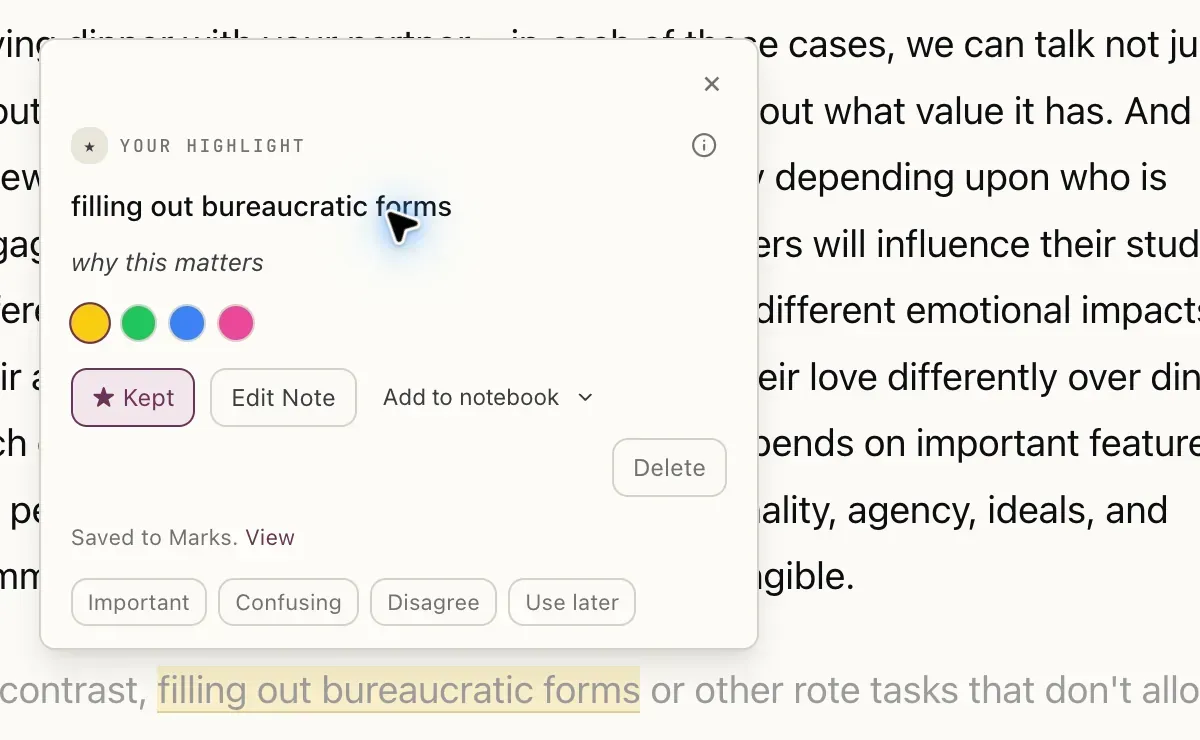
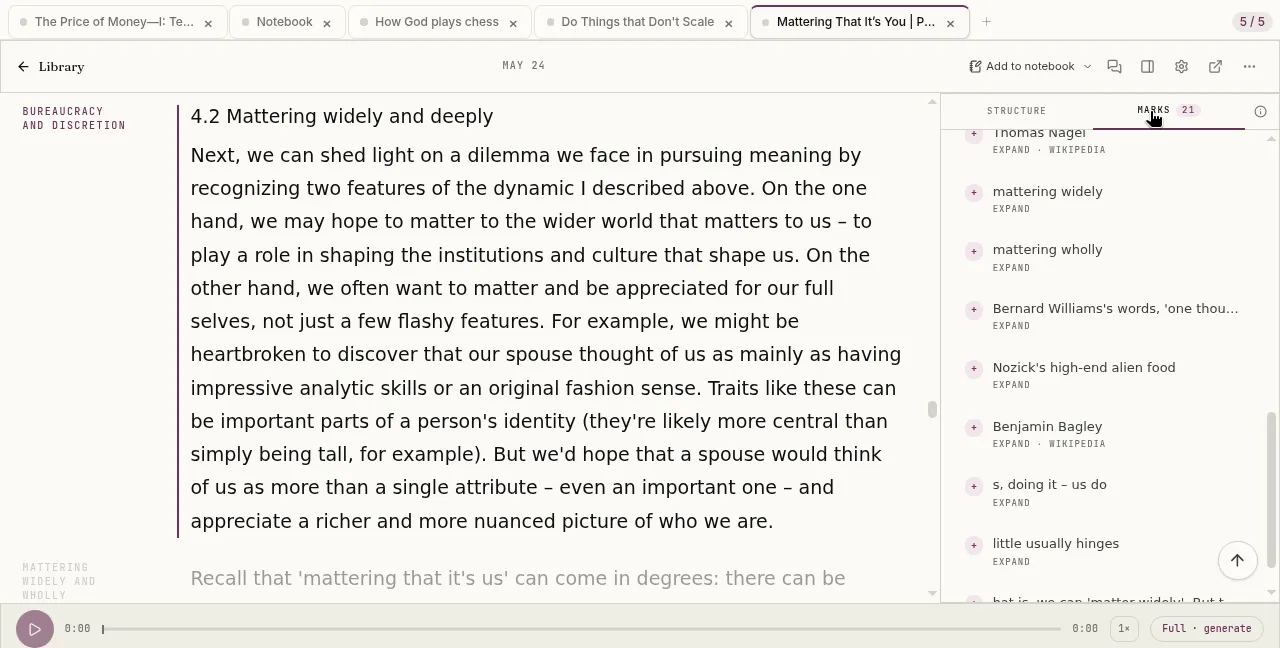
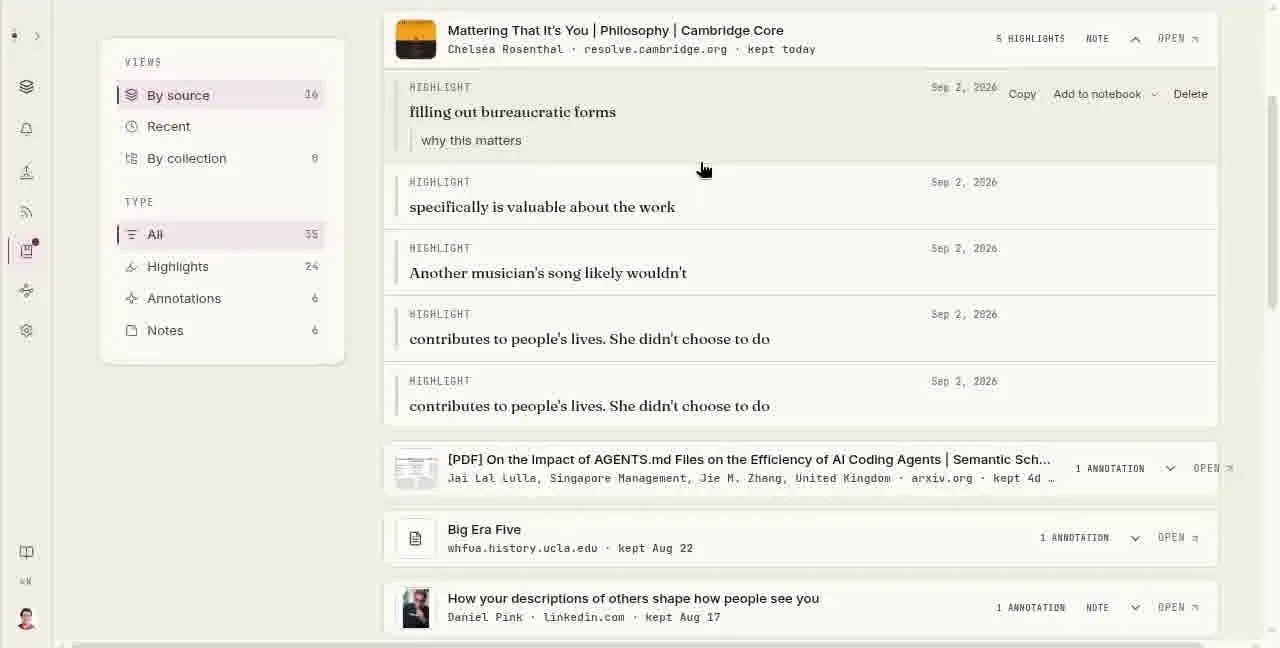
For digital reading, Omphalis’s commonplace book keeps a mark with its source and anchors it to the passage. The Marks rail sits beside the open piece, so you can return to a mark while reading. In the Library, marks are grouped by source. You can also import Kindle highlights from a My Clippings.txt file or a Kindle app notebook export. Your marks can be exported on any plan, including Free.
The point is not to hand the choice to a tool. It is to keep your choice attached to the words that prompted it. The tool can hold the passage, the note, and the route back. It cannot decide what deserves your attention.
For a broader account of the practice, including its history, templates, and a capture-process-revisit routine, see the guide to keeping a digital commonplace book. You do not need a second brain app to begin. A notebook, a pencil, and a clear reason can be enough.
The useful measure is not how much you have saved. It is whether, when you return, you can recover the passage and the thought that made you keep it.
A commonplace book is not a collection of things read. It is a record of judgment exercised. Thin is honest. Thick can become a drawer.