The Feynman Technique was never about explaining it simply
Updated · 9 min read
Listen to this post
Contents
Mark the edge of what you know.
The familiar Feynman Technique is usually presented as a tidy exercise: choose an idea, explain it as if to a child, find the gaps, and try again. It is useful advice. But the story behind the name points to a less polished practice, not performing understanding, but finding the places where it gives way.
That difference matters when you are trying to study effectively, remember what you read, or make sense of a long article or podcast. The aim is not always to produce a simple explanation. Sometimes the more important move is to notice, precisely, what you cannot yet explain.
The neat version travels
The four-step version is easy to carry. So is the image of explaining an idea to a rubber duck, a child, or an imaginary audience. Putting a concept into your own words can reveal whether you understand it, and the exercise has helped many people approach difficult material.
But the name can make a later teaching method sound like a procedure invented by Richard Feynman himself. It wasn’t. The recognizable four-step format appears in Scott H. Young’s 2011 article, “Learn Faster with the Feynman Technique.” Young described his approach as inspired by Feynman, not as a method Feynman had set out in those steps. Shane Parrish and Farnam Street later helped bring a version of the checklist to a wider audience.
That distinction does not make the modern technique less useful. It makes its history more honest. Feynman supplied an example of working seriously with what one did not know. Young gave that impulse a teach-by-explaining format. They are related, but not the same thing.
The popular version emphasizes explanation. The historical episode emphasizes inquiry.
A notebook, not a performance
In James Gleick’s Genius: The Life and Science of Richard Feynman (1992), the notebook appears during Feynman’s preparation for his oral examinations at Princeton. Gleick describes a serious attempt to take apart and reorganize a large body of physics, searching for its seams rather than merely reviewing its surface.
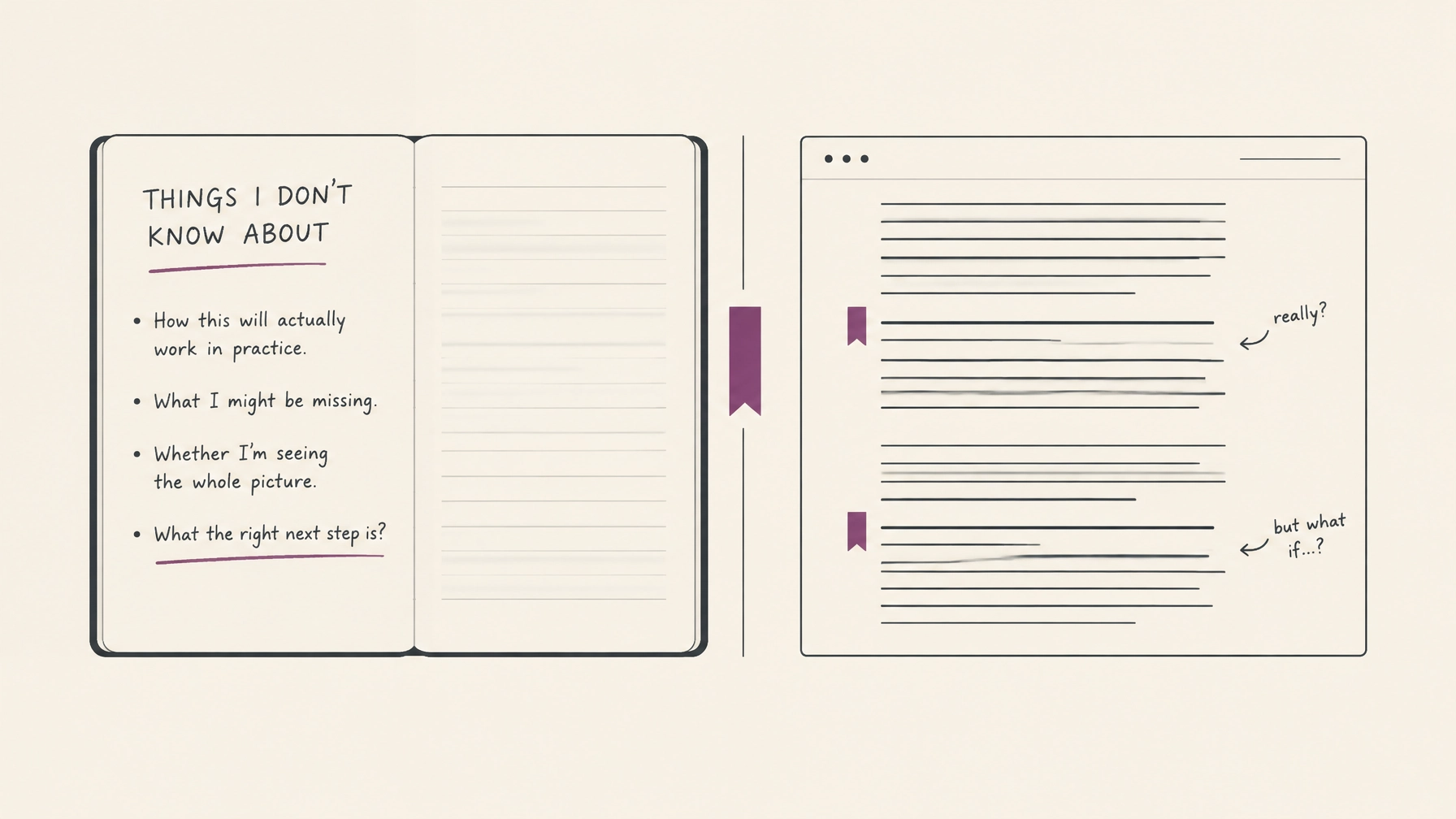
“[He] opened a fresh notebook. On the title page he wrote: NOTEBOOK OF THINGS I DON'T KNOW ABOUT. For the first but not last time he reorganized his knowledge. He worked for weeks at disassembling each branch of physics, oiling the parts, and putting them back together, looking all the while for the raw edges and inconsistencies. He tried to find the essential kernels of each subject.”
- James Gleick, Genius: The Life and Science of Richard Feynman (1992), quoted in Cal Newport’s account
The notebook’s title is plain. Its work is not. Feynman was dealing with the hardest material he knew, separating ideas into parts, putting them back together, and looking for what did not fit.
There is an important qualification. Gleick reports that the notebook made Feynman proud, but also notes that it was not much use in preparing for the examination. The episode is not evidence of a guaranteed exam strategy. Nor is it proof that a notebook alone produces understanding. It is evidence of a practice: making the limits of one’s knowledge visible enough to work on.
“When [Feynman] was done,” Gleick reports, “he had a notebook of which he was especially proud.”
That pride was not necessarily the satisfaction of having a perfect answer. It may have come from having made the questions clearer.
The mark is the method
There is a difference between not knowing a subject and knowing where your understanding breaks down.
“I don’t understand this paper” gives you little to work with. “I follow the claim about the sample, but I don’t see why it supports the conclusion” gives you somewhere to begin. The second statement turns vague difficulty into a question that can be revisited.
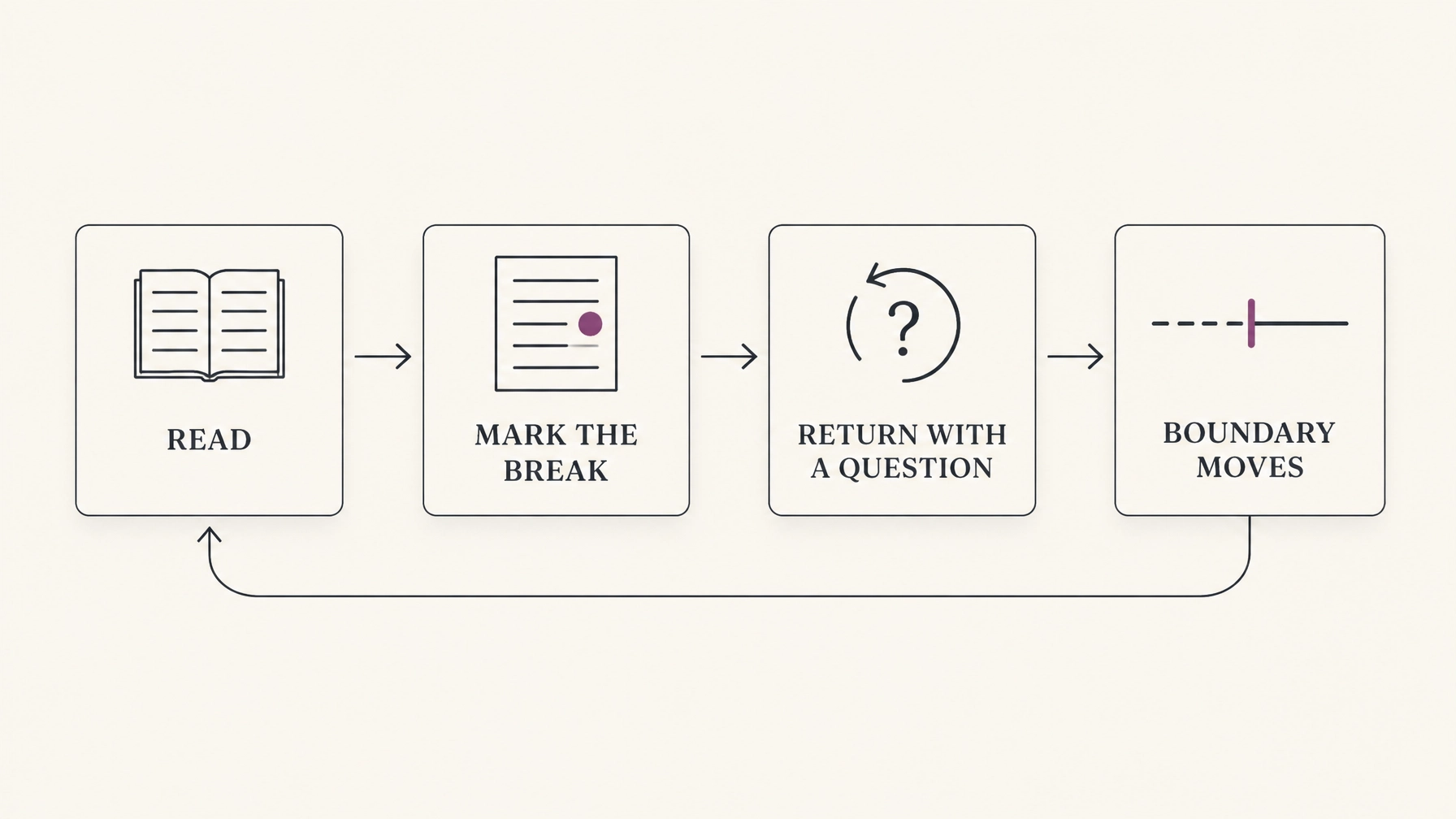
This is the load-bearing move in the notebook story. Not simplification for its own sake, but an honest inventory: here is what I can explain; here is the step I cannot yet connect; here is the part I need to examine again.
Research on self-explanation offers a related, narrower line of support. In a small study, Michelene Chi, Nicholas de Leeuw, Mei-Hung Chiu, and Christian LaVancher asked eighth-grade students to explain parts of a text about the human circulatory system as they read. Students who were prompted to generate explanations improved more than those who reread without the same prompts. The study suggests that putting meaning into one’s own words can contribute to understanding. It did not test the named Feynman Technique, and it was a classroom study, not a test of reading long-form material in general. (Chi et al., 1994.)
Alexander Renkl’s study of 36 university students learning from worked examples adds a useful nuance. Learning gains were associated with the quality of students’ self-explanations, even when time spent studying was taken into account. More successful learners connected steps in a solution to the principles beneath them. That is not evidence that time spent does not matter, or that the finding applies to every kind of material. It does suggest that explaining is not simply a matter of saying more. The connections in an explanation matter. (Renkl, 1997.)
A useful explanation can expose a gap. A useful mark can preserve it.
Reading comes before explaining
The Feynman Technique can be misleading when it is applied too early. If you have only just opened a dense paper, you may not yet have the structure needed to explain its argument. Asking yourself for a clean, simple account can make you feel you have failed before you have had a chance to build a map.
Reading is upstream of explaining.
A long piece has parts: its question, its claims, the evidence carrying them, and the turns where the argument changes direction. Before you can explain it well, you need to notice how those parts relate. A paragraph may be difficult because it introduces a term, assumes an earlier idea, or moves from evidence to interpretation. “I can’t explain this” is a beginning; the next question is where the explanation breaks.
For example, you might be reading a research article and understand the result but not the authors’ reasoning from that result to their broader claim. A useful response is not to force a simplified account of the whole paper. It is to mark that particular transition and return to the methods, evidence, or assumptions that support it.
The mark does not answer the question. It keeps the question attached to the place where it arose.
Keep the question beside the source
For long-form reading, a notebook of things you don’t know need not be a separate book or a grand project. It can start with a short note beside a passage:
- Confusing: What does this term mean here?
- Question: What connects this evidence to the claim?
- Return: I follow the example, but not the general rule.
Those labels are only useful if they sound like your questions. You may prefer a margin note, a highlight with a sentence attached, or a timestamp you can find again. The form matters less than keeping your uncertainty specific and close to its source.
This is one reason active reading strategies are more than highlighting. A highlight says, “This caught my attention.” A mark with a question says, “This is where I need to look again.” Both can be worthwhile, but they do different work.
For a podcast, that boundary may be a moment in the conversation where a speaker introduces an unfamiliar idea or moves quickly through a point you want to follow. In Omphalis’s podcast reader, you can keep the passage around the current moment, along with its timestamp and transcript context, then add a note beside it. The point is not to replace listening with a ready-made account. It is to keep the moment you chose to revisit findable.
When you return, the question may have changed. You may now understand the term but still wonder whether the speaker’s example supports the larger claim. Or the surrounding section may make the original difficulty disappear. Either way, the mark records a past boundary, not a verdict on your ability to understand.
Let help point back
A reading companion can be useful when it helps you test a question without taking ownership of the answer. For instance, Omphalis lets you ask your library about saved material and shows the passages its answer draws on, so you can check the source again. The answer may help locate a missing connection. It is still something to inspect, not a substitute for your judgment.
That boundary matters. A system can organize a source, surface a passage, or suggest where to look next. It cannot decide for you what the author’s argument means, what you find convincing, or which uncertainty is worth carrying forward. Those remain yours.
The same is true of the four-step technique. Explaining a concept simply can be a good test once you have something to explain. But if the explanation falters, the next step is not to hide the gap with smoother language. It is to find the point where the idea stops making sense, return to the material, and work there.
A mark is not a sign that reading went wrong. It is a way to keep reading.
Understanding has edges
The Feynman Technique survived because explanation is a practical way to test understanding. Its story deserves a wider frame. The notebook Gleick described was not a performance for an imagined listener. It was a deliberate effort to reorganize knowledge, notice inconsistencies, and make the unknown visible.
That is useful not only for studying a subject, but for reading one difficult page at a time. Keep the sentence you cannot connect. Keep the question beside the timestamp. Return when you have more context.
You do not need to explain everything simply before you are allowed to keep learning.
Sometimes the best beginning is a clear mark at the edge of what you know.
Sources
- Chi, M. T. H., de Leeuw, N., Chiu, M.-H., & LaVancher, C. (1994). “Eliciting Self-Explanations Improves Understanding.” Cognitive Science, 18(3), 439–477.
- Renkl, A. (1997). “Learning from Worked-Out Examples: A Study on Individual Differences.” Cognitive Science, 21(1), 1–29.
- Young, S. H. (2011). “Learn Faster with the Feynman Technique.”
- Newport, C. “The Feynman Notebook Method.”, quoting James Gleick, Genius: The Life and Science of Richard Feynman (1992).