The AI Reading Assistant Test: Can You Find the Moment You Need?
September 24, 2026 · 9 min read
Listen to this post
Contents
Read. Mark. Return.
That is the practical test for an AI reading assistant.
Not whether it can produce a polished summary. Not whether it can list the main themes in a few seconds. The more useful question is simpler:
When you need one specific idea again, can the tool help you find the exact place where it lives?
A claim in paragraph seven.
A definition near the middle of a research paper.
A turning point in a two-hour podcast.
A sentence you marked because it changed how you understood the whole argument.
This is the difference between a summarizer and a genuine environment for active reading. One gives you a condensed account of what was there. The other helps you stay with the source, understand its structure, preserve your own insight, and return when the material matters again.
Start with the moment you need
Imagine that three weeks ago you read a difficult paper about organizational decision-making.
You remember the broad argument. You remember disagreeing with one part of it. You remember that the author made an important distinction between coordination and control.
But now you need the distinction itself.
A summary may remind you that the paper discussed coordination. It may even explain the difference in reasonable language. Yet that is not quite enough. You want to see the author's wording, the qualification around the claim, and the paragraphs that make the distinction meaningful.
Understanding a document deeply requires more than recovering its topic.
It requires recovering its place.
The same is true of audio and video. You may remember that a guest said something useful during a long conversation, but not whether it came before or after the discussion of incentives, trust, or institutional change. A timestamp is not merely a convenience. It gives the thought back its context.
A useful AI reading assistant should help you return to the source, not quietly replace it.
The five-part test
You can evaluate almost any AI reading assistant with five practical questions.
1. Can it show you the source?
A summary is an interpretation. The source is where the interpretation can be checked.
When an assistant answers a question about a document, look for a clear path back to the exact paragraph, page, section, or timestamp. The answer should not float free from the material that supports it.
This matters because even an accurate answer can become misleading when its surrounding context disappears. A claim may depend on a caveat. A conclusion may follow several carefully limited observations. A speaker may introduce an idea only to question it later.
Source access keeps those distinctions visible.
In Omphalis, an answer in Ask includes citations you can follow back to the reading. The purpose is not to make the answer appear authoritative. It is to make the answer easy to inspect.
"Help that lives where the reading is assists comprehension. Help that answers from somewhere else can replace it."
Omphalis, The case for comprehension
A good assistant gives you help at the point where understanding might otherwise break.
2. Can it preserve structure?
A long document is not just a large amount of text. A podcast is not just a transcript stretched across time.
Each has a shape.
There is an opening question, a definition, a sequence of claims, an example, a complication, and perhaps a change in direction. Some passages carry more weight than others. Some sections establish terms that later sections depend on.
A summarizer tends to reduce this shape into a smaller object. That can be useful when you need a quick overview. But if your goal is to understand a document deeply, you also need to see how its parts relate.
This is why structure matters.
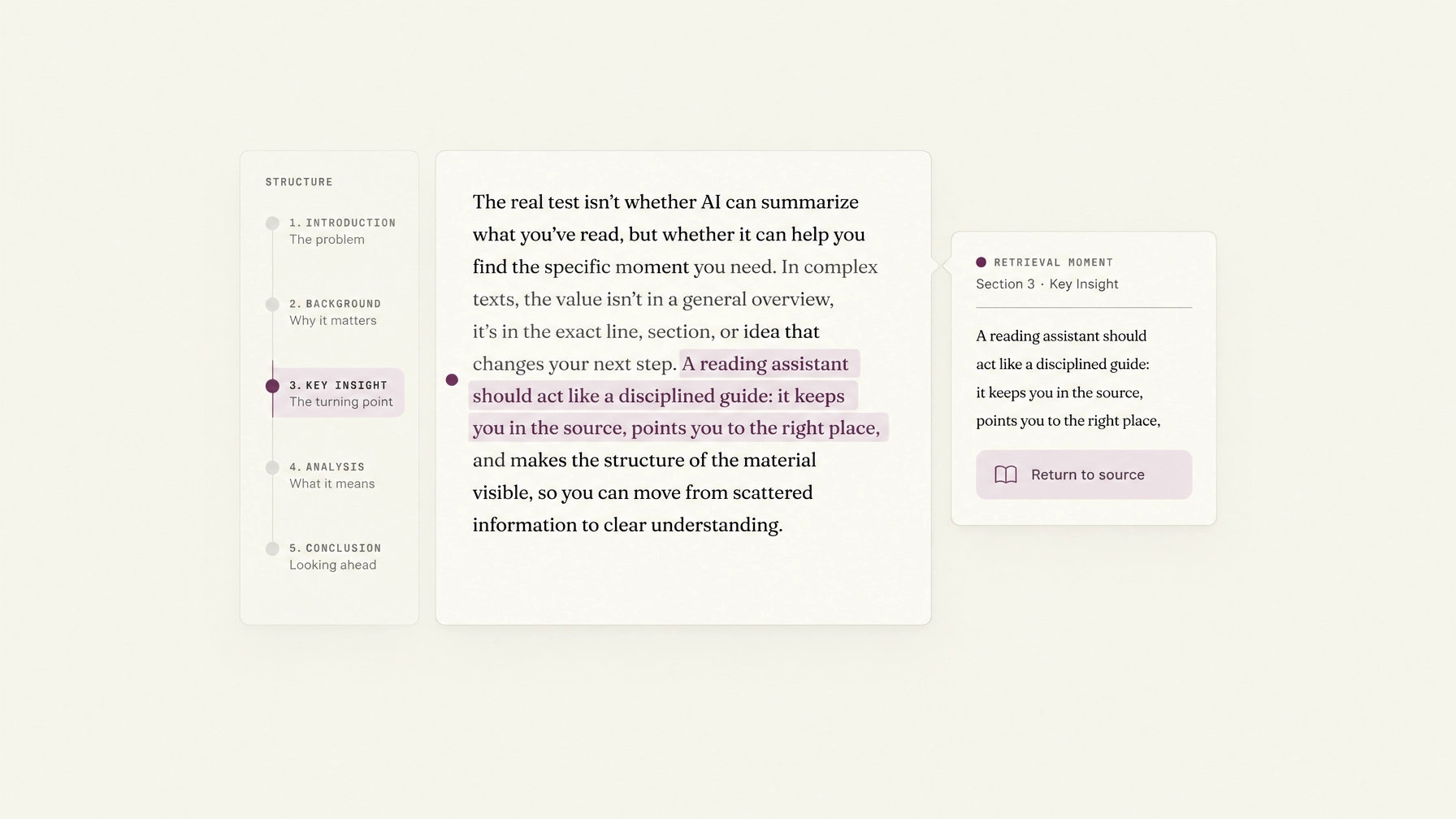
A structure-first content understanding platform helps you identify where the argument begins, where it develops, where the evidence appears, and where the author turns. It gives you a map without pretending that the map is the territory.
Omphalis is built around that distinction. It helps organize articles, PDFs, podcasts, and videos so you can find the dense moments and move through the source with a clearer sense of direction.
Not a pile of extracted points.
A map for return.
3. Can you ask without leaving the material?
The location of assistance changes the quality of assistance.
If you need to open a separate chatbot, copy a passage, explain the context, and then return to the original document, the reading has already been interrupted. Sometimes that is acceptable. For sustained work, it creates friction at exactly the moment when your understanding needs continuity.
An AI reading assistant should let you ask questions in relation to the source you are reading.
What does this term mean here?
Why does this example matter?
How does this claim support the conclusion?
What changed between the introduction and this section?
These are not requests to remove the work of thinking. They are ways of directing attention toward the part of the source that needs closer inspection.
On Omphalis's reading comprehension page, explanations sit beside difficult passages. You can compare the explanation with the author's words, continue reading, and write down what you now understand.
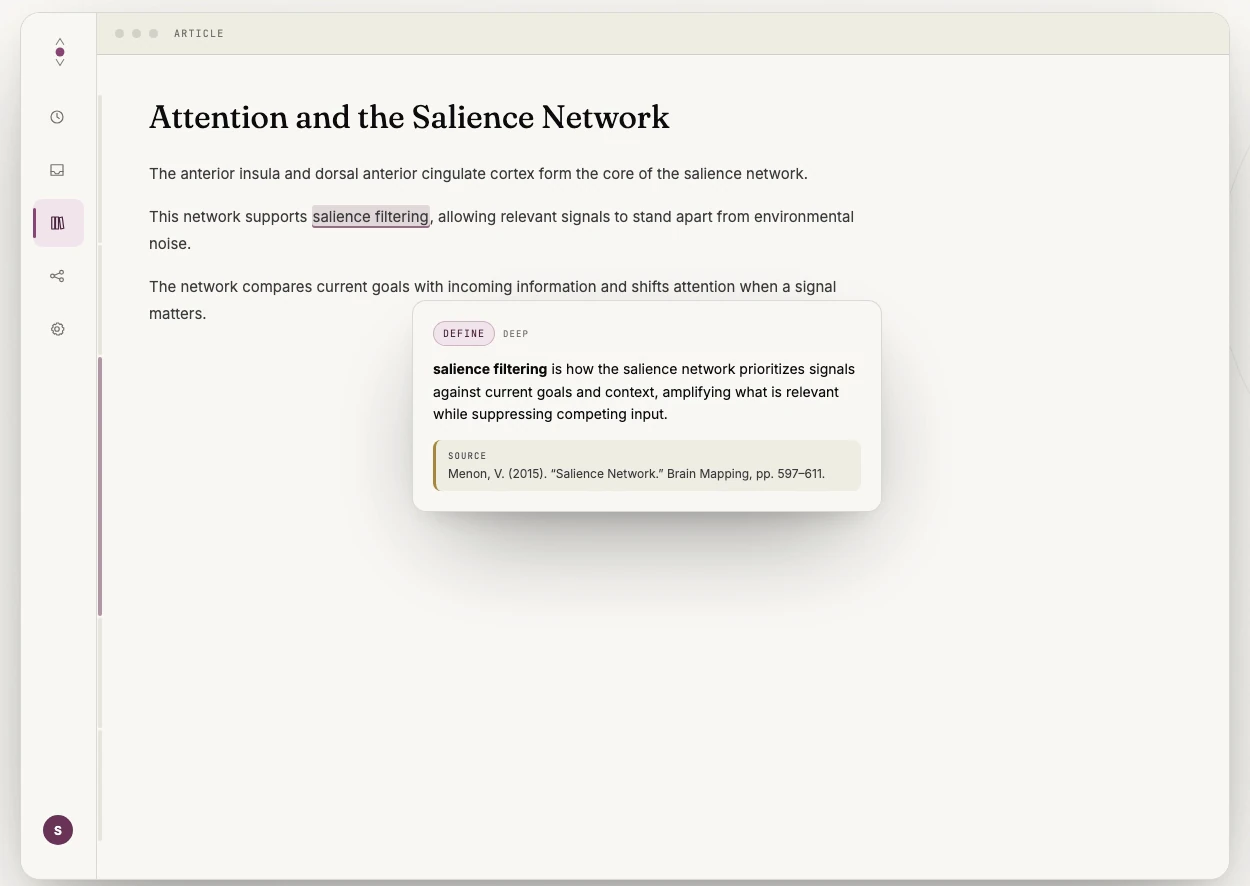
The distinction is important: the assistant should make a difficult passage easier to enter, not make the passage unnecessary.
4. Can it keep your meaning, not only its own?
A system can identify what appears important. It cannot decide what became important to you.
That difference is easy to overlook.
You may mark a sentence because it supports a project you are working on. You may save a paragraph because you disagree with it. You may return to a timestamp because it raises a question rather than answering one.
These are different kinds of attention. A generic highlight does not preserve all of them.
User-owned notes do.
When you attach a short explanation to a passage, you are doing more than storing a quotation. You are recording the relationship between the source and your own thinking at that moment.
Where the mark sits matters as much as what it says. Catherine Marshall's study of annotations in used textbooks found that readers' marks are often telegraphic and cryptic, carrying much of their meaning through their place on the page. Lift a note away from its passage and you keep the words while losing the point.
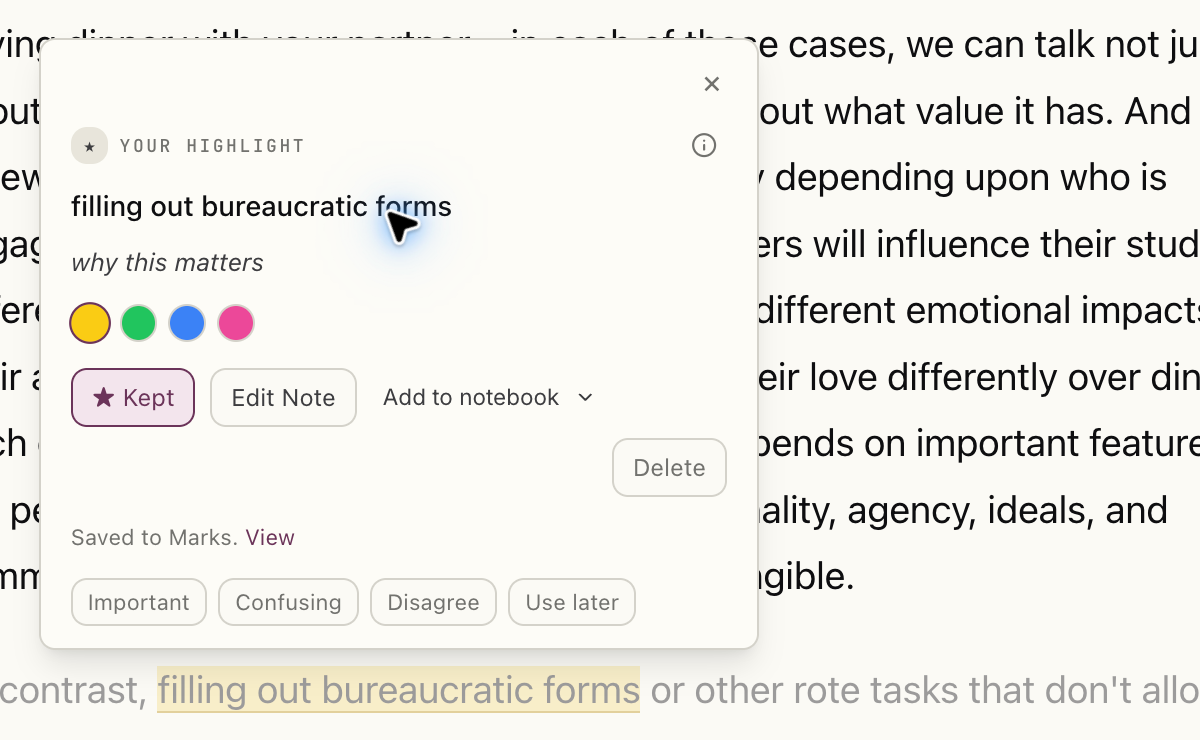
Omphalis keeps highlights and notes attached to their passages. You can mark something as important, confusing, worth disagreeing with, or useful later. You can also add it to a notebook with related sources.
The model may help organize those marks. It should not own them.
Your insight is the first-class data.
5. Can it help you return later?
The real test often comes after the first reading.
Can you find the exact passage without starting over?
Can you remember why you marked it?
Can you compare it with something you read last month?
Can you tell whether a new idea extends the earlier one or contradicts it?
Returning is where saved content becomes part of your thinking rather than part of your storage system.
A summary can help you decide whether something is worth reading. It can help you refresh your memory. But it does not always give you a reliable way back to the moment that mattered.
It can also leave you feeling that you understood more than you did. Glenberg, Wilkinson and Epstein called this the illusion of knowing: readers judged their own comprehension of a passage confidently and were poor at noticing when they had not understood it.
That is why citations, annotations, notebooks, and source structure belong together. A return path needs more than a title. It needs a location, a reason, and enough context to make the material usable again.
Omphalis notebooks let you keep sources, notes, and questions together. A paper can sit beside a podcast. A working question can stay attached to the passages that informed it.
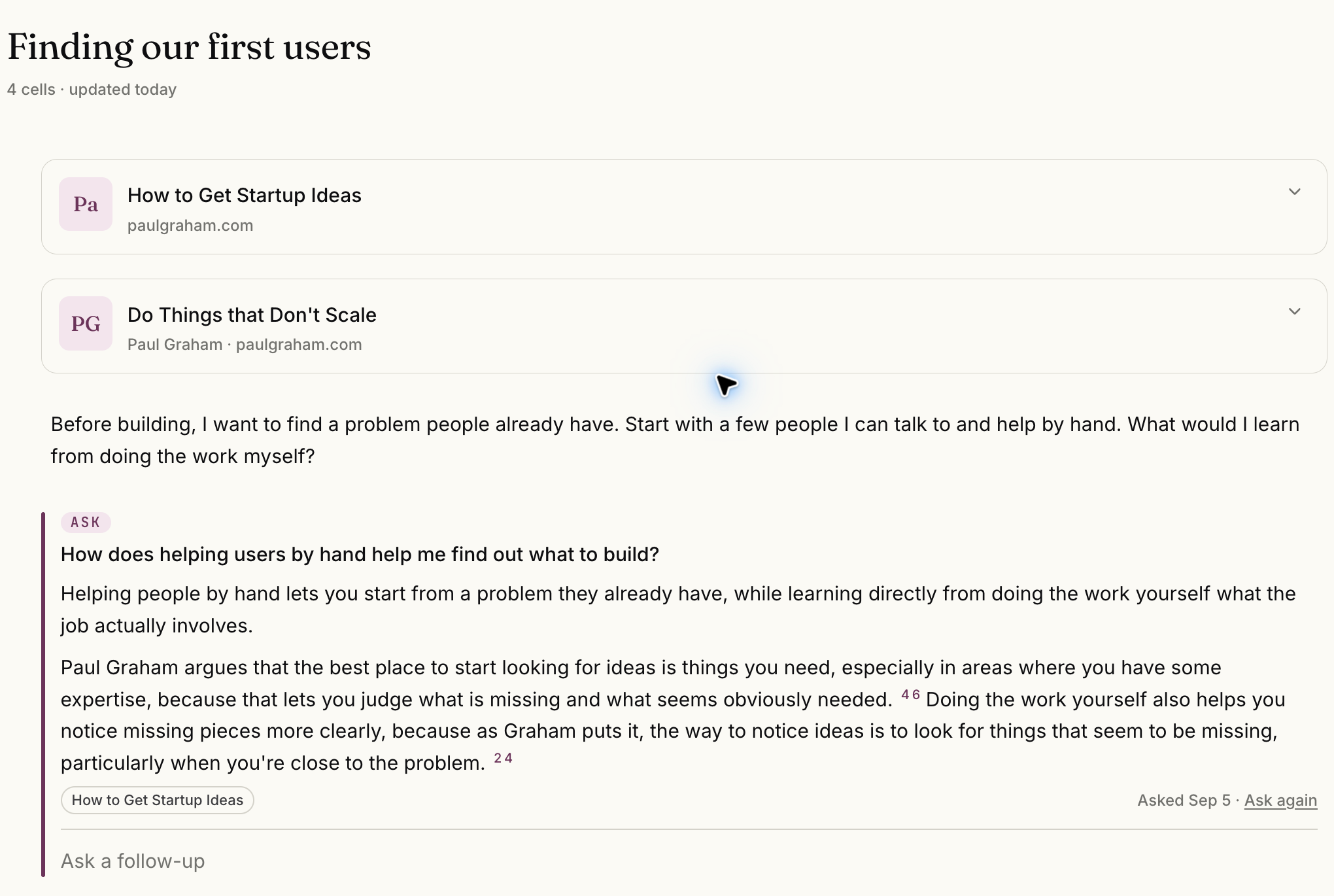
This is not an attempt to automate understanding. It is a way to keep understanding from disappearing when the reading window closes.
A simple test you can run today
Choose something you genuinely want to understand:
- a research paper you have postponed;
- a transcript from a long interview;
- a PDF you expect to use in your work;
- an article whose argument you half remember.
Then ask the assistant four questions:
- What is the central claim?
- Where does the argument change direction?
- What passage best supports the answer?
- Can I return to that passage directly?
Read the answer. Check the source. Notice whether the assistant shows the surrounding context. Then add your own note in plain language.
If the tool only gives you a neat explanation, you have found a summarizer.
If it helps you inspect the claim, follow the structure, preserve your interpretation, and return to the precise location later, you have found something closer to an AI reading assistant.
The distinction is not about how much text the model can process.
It is about whether your relationship with the source becomes clearer or more distant.
From saving to understanding
Most people do not save difficult material because they want more files. They save it because they expect to need it again.
That expectation deserves support.
A useful reading environment should help you move from accumulation to return, from fragments to coherence, and from passive consumption to active engagement. It should make complexity easier to enter without treating complexity as something to eliminate.
That is the role of a content understanding platform: to clean and structure the material, assist at the point of difficulty, and preserve the marks that express your own judgment.
It should not tell you what to think.
It should help you see where the thinking is happening.
Try the test on a real source using the Omphalis demo. Ask a question. Open the citation. Find the paragraph or timestamp. Leave a note in your own words.
Then come back tomorrow and see whether you can find the moment you need.
Put simply: a summary tells you what was there.
A reading assistant helps you return to it.