Studying From PDFs: A Reading Routine That Holds Up at Exam Time
Updated · 12 min read
Listen to this post
Contents
- What should the first pass through a PDF do?
- What should you notice during the entering pass?
- What should you mark on the second pass?
- Why shouldn't the tool choose your marks?
- How do you return to your marks before the exam?
- A routine for the week before the exam
- Day one: enter
- Day two: mark
- Day four: return
- Day six or seven: retrieve
- What can a PDF reader AI do, and what can't it do?
- Understanding a document deeply
- Sources and further reading
Enter. Mark. Return.
A PDF can hold an entire week of course material: a research paper, a lecture handout, a chapter from a reader, or the notes you postponed until the exam was close enough to feel urgent.
The difficulty is not always finding the information. It is building a way back to it.
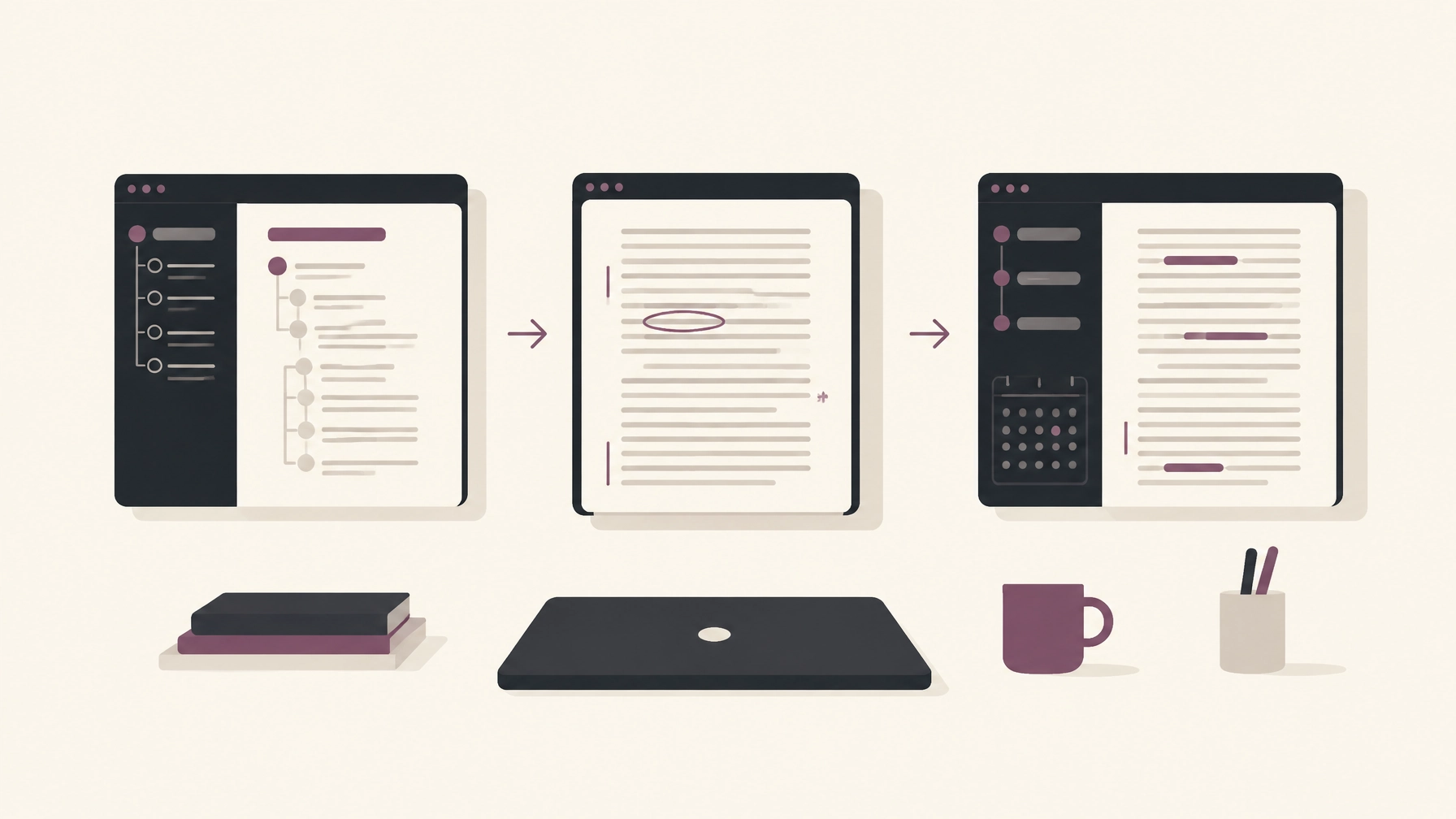
A useful PDF study routine has three passes:
- Enter the document by understanding its shape.
- Mark the claims and paragraphs that deserve another look.
- Return to those marks before the exam instead of starting again at page one.
This is where a PDF reader AI can help. It can make a dense document easier to enter, explain a difficult passage, and keep your questions attached to the source.
It cannot decide what you should believe.
It cannot know which detail your professor will emphasize.
It cannot build understanding for you while you remain completely outside the reading.
The aim is not faster consumption. It is a way of keeping what you read.
What should the first pass through a PDF do?
Consider Lina, a second-year student preparing for an exam in political theory. Her course reader contains a 42-page paper on institutions and collective action. The paper is not impossible to read. It is simply dense enough that beginning at page one and moving line by line feels like walking into a forest without a path.
On her first pass, Lina does not try to master every paragraph.
She enters.
She looks at the title, abstract, section headings, diagrams, conclusion, and references. She notices where the paper introduces a problem, where it defines its terms, where the central claim appears, and where the author qualifies it.
The first question is not:
What does every sentence mean?
It is:
What kind of argument is this, and how does it move?
This entering pass may take 10 to 15 minutes. Its job is to create a provisional map.
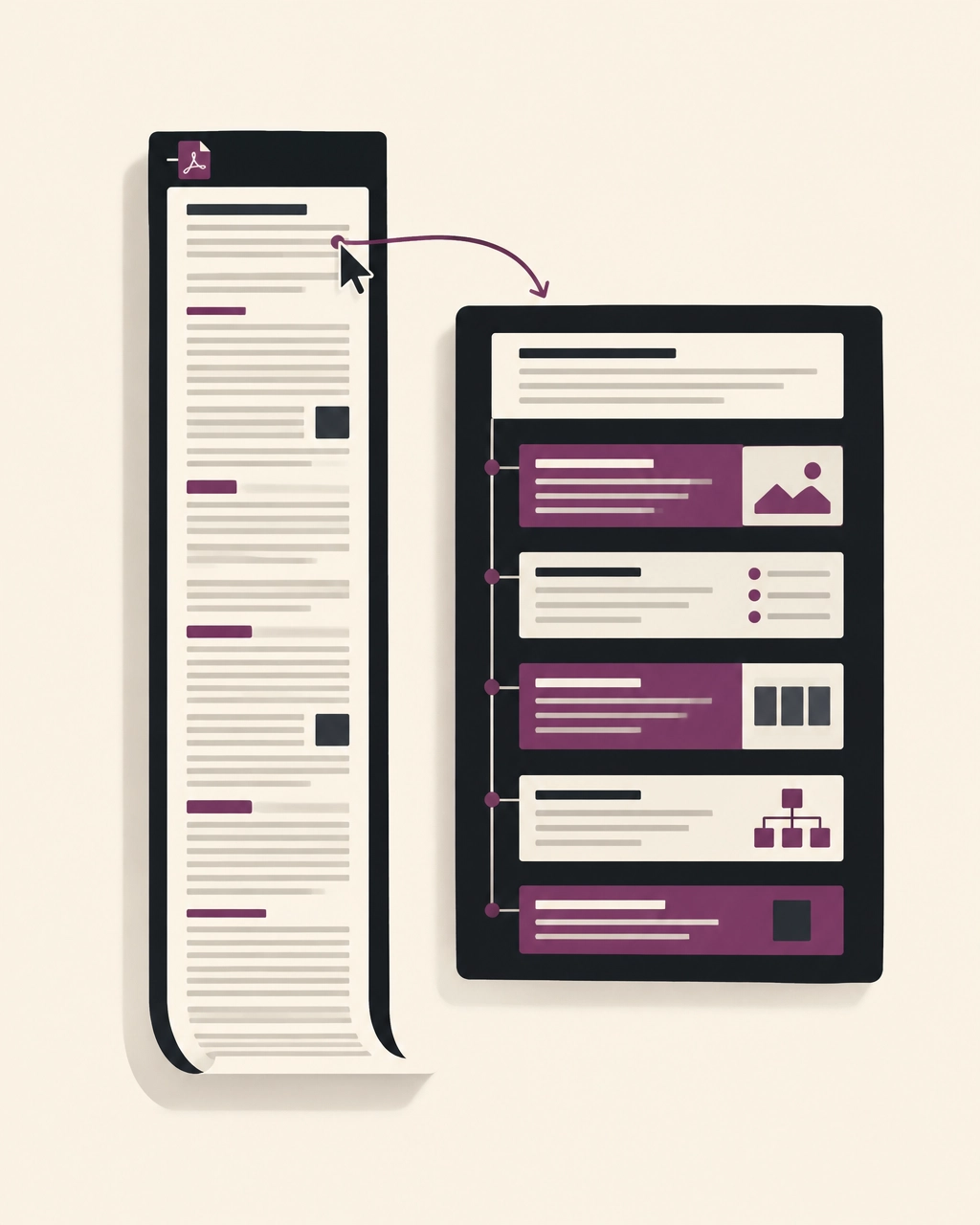
A good AI reading tool can help at this point by extracting the document’s structure. It may show the main sections, identify recurring concepts, or describe the movement from question to evidence to conclusion.
For a research paper, a useful prompt might be:
“Show the paper’s argument as a sequence of problem, method, evidence, claim, limitation, and conclusion. Keep each point brief and cite the relevant section.”
For a lecture handout, the prompt might be:
“Give me the structure of this document, not a full summary. Identify the concepts introduced, the distinctions made, and the examples used.”
That distinction matters. A summary tells you what the document says in compressed form. A structural outline shows how the parts relate.
A summary can be useful when deciding whether a paper belongs in your study set. A map is more useful when you intend to understand the paper and return to it later.
This is one reason Omphalis presents PDFs in a reading view with a section map. The map does not replace the source. It gives you an entrance.
What should you notice during the entering pass?
Look for:
- the question the document is trying to answer;
- the main claim or proposed answer;
- the terms the author defines;
- the evidence used to support the claim;
- the point where the argument changes direction;
- the limitation, exception, or unresolved question;
- the conclusion and what it does not claim.
Do not try to remember everything yet.
At the end of this pass, write a rough sentence in your own words:
“This paper argues that ___ because ___, but it is limited by ___.”
The sentence may be incomplete. That is fine. It gives the second pass somewhere to begin.
What should you mark on the second pass?
The second pass is where reading becomes active.
Lina now reads the paper in sections. She slows down at the passages that carry the argument. She marks a definition that will matter later. She marks the paragraph where the author moves from evidence to interpretation. She marks a limitation that changes how confidently she should read the conclusion.
She does not highlight every sentence that sounds important.
A highlighted page can look productive while preserving very little. Dunlosky and colleagues rated highlighting as a low-utility technique in their review of study methods. A mark should answer a more specific question:
Why might this passage matter when I return?
A short note is often enough:
- “Definition of collective action.”
- “This is the paper’s main claim.”
- “Evidence supports correlation, not causation.”
- “Compare with week three lecture.”
- “I understand the example, not the mechanism.”
- “Possible exam distinction.”
The note should use Lina’s language, not the paper’s language whenever possible.
This is the difference between a highlight and a study mark. A highlight points to a location. A mark preserves a reason.
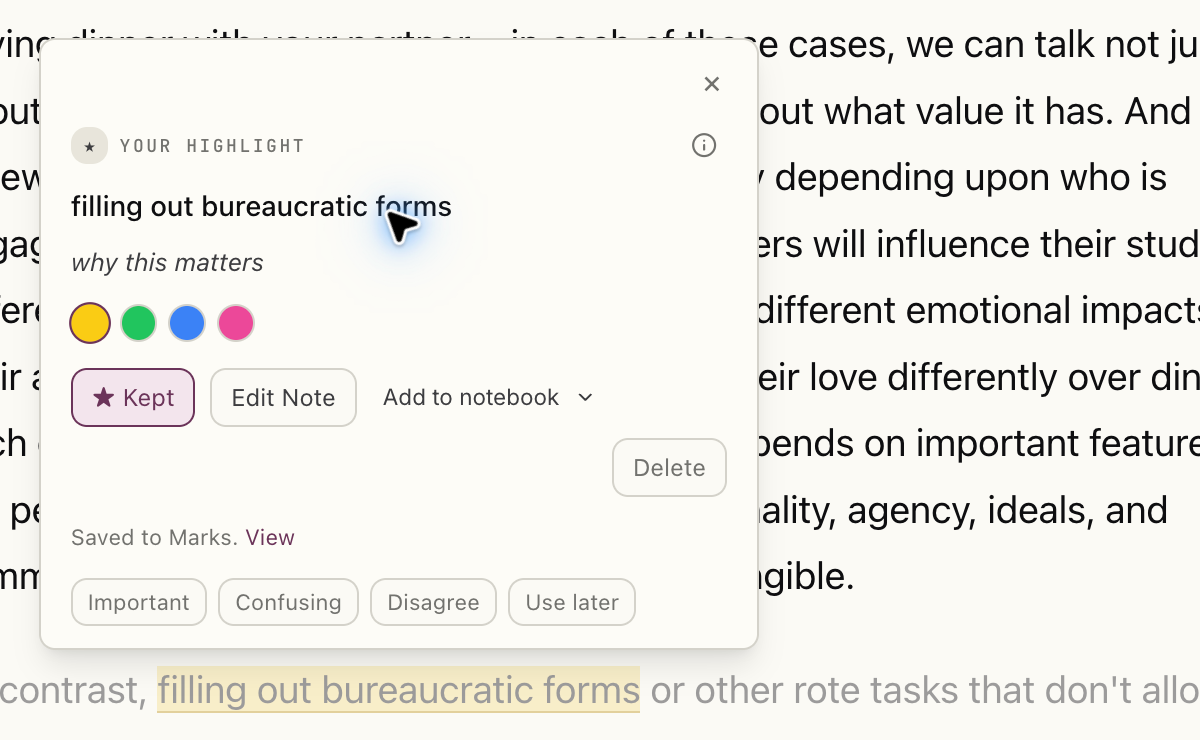
“A highlight with nothing attached only proves you were there.”
Omphalis, “PDF reading”
The mark does not need to be polished. It needs to remain useful when the document is no longer fresh in memory.
A research paper analysis AI can support this pass in several ways. It can explain a difficult term, restate a paragraph in plainer language, identify the role of a section, or help generate questions from the passage.
For example:
“Explain this paragraph in plain language. Then state what the paragraph assumes, what evidence it provides, and what it does not establish.”
That prompt asks for assistance without handing over judgment.
The reader still has to decide whether the explanation is accurate. The reader still has to check the original paragraph. The reader still has to determine whether the claim is convincing, relevant, or connected to the course.
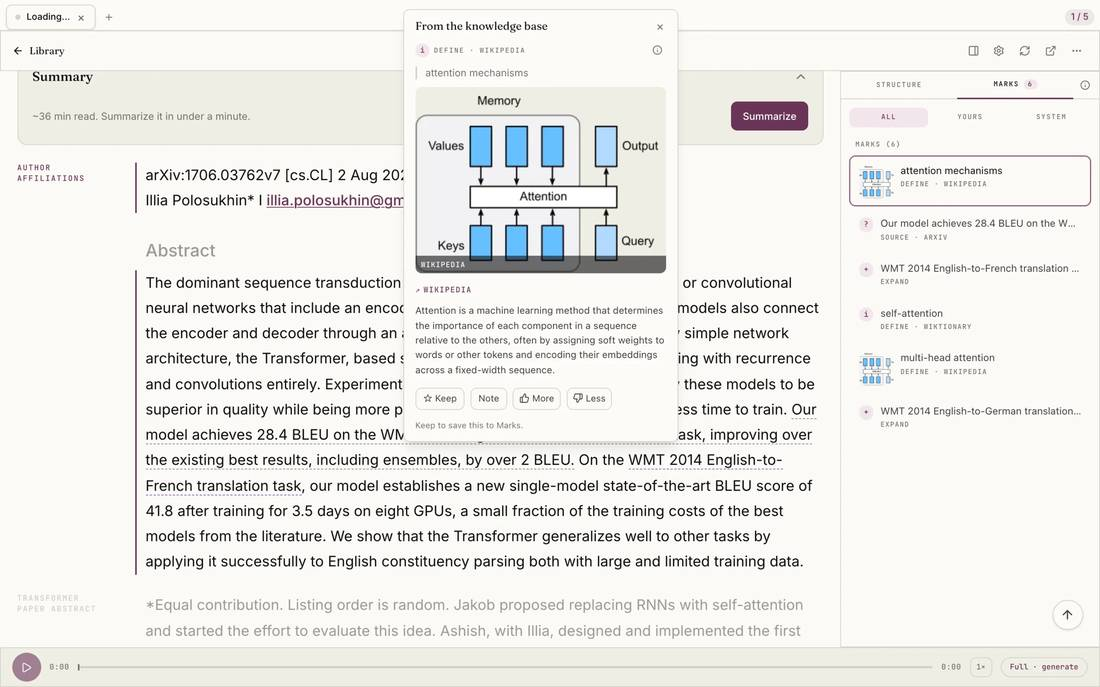
Keeping help beside the passage can also save a familiar detour: leaving the document to ask a question, then returning unsure where the question came from.
The explanation should sit near the point of difficulty. The source should remain visible. The surrounding sentences should remain available for checking.
That is the boundary between assistance and substitution.
The tool can clarify the terrain. It cannot take the walk.
Why shouldn't the tool choose your marks?
It is tempting to ask an AI tool to identify the most important passages automatically. Sometimes this is useful. A first-pass extraction can reveal repeated concepts or sections that deserve attention.
But algorithmic importance is not the same as personal importance.
Your exam may focus on a distinction mentioned briefly in a lecture. Your assignment may depend on a limitation that a generic summary treats as secondary. A passage may matter because it contradicts something you read last week. Another may matter because it finally answers a question you have carried through the course.
The system cannot know all of that from the document alone.
A useful workflow is:
- Let the tool suggest a structure.
- Read the source.
- Choose the passages yourself.
- Add the reason for each mark.
- Use AI to clarify or question the mark.
- Keep the final interpretation yours.
This is particularly important when studying research papers. A research paper analysis AI may be able to identify the research question, summarize the methods, and describe the results. It may even suggest weaknesses in the study.
It cannot replace critical reading.
It cannot determine whether the method fits the question without your understanding of the field. It cannot know whether the author’s use of a term matches the way your course uses it. It cannot decide whether two apparently similar findings are genuinely comparable.
It can help you ask better questions.
You still have to answer them.
How do you return to your marks before the exam?
The third pass begins several days later.
Lina does not reopen the paper and read all 42 pages from the beginning. She opens her marks.
This is the return pass. It is shorter, but it is not passive review.
For each mark, she first tries to remember what the passage means before looking at the document. She asks:
- What was the claim here?
- Why did I mark it?
- What evidence supported it?
- What question did I have?
- How does it connect to the rest of the paper?
- Can I explain it without copying the wording?
Only then does she reopen the passage.
The surrounding paragraph matters. A sentence removed from its argument can become misleading. Returning to the source keeps the mark connected to its original context.
This is also the point where Lina discovers which marks are still unresolved. One note says, “I understand the example, not the mechanism.” She reads the neighboring section again and asks the AI tool to explain the mechanism with a concrete example. She then adds a second note in her own words.
The mark has changed from a reminder into understanding.
Retrieval is important here. Research by Henry Roediger and Jeffrey Karpicke found that trying to recall material can support longer-term retention more effectively than simply reading it again. Their paper describes this as “test-enhanced learning” in Psychological Science.
Put simply:
Try to remember before you reread.
Do not begin with recognition. Begin with effort.
A spaced return is also more useful than putting every review into one long night. The widely cited review by Dunlosky and colleagues identifies distributed practice as one of the more effective learning techniques, while massed practice is less reliable for durable retention. See the full review in Psychological Science in the Public Interest.
The routine does not need to become a complicated flashcard system. For an argument-heavy PDF, returning to the argument may matter more than converting every term into a card.
A routine for the week before the exam
Here is Lina’s routine for the paper.
Day one: enter
Spend 10 to 15 minutes mapping the document.
Read the title, abstract, headings, figures, conclusion, and key definitions. Write one provisional sentence describing the argument.
Do not aim for mastery.
Day two: mark
Read the sections that carry the argument.
Make a small number of deliberate marks. Attach a question or reason to each one. Try to use your own words.
Ask an AI tool for clarification only when the passage genuinely blocks understanding.
Day four: return
Open the marks without rereading the entire document.
Try to explain each passage from memory. Then check the original context. Resolve the marks that remain unclear.
Add connections to lectures, other papers, or earlier topics.
Day six or seven: retrieve
Close the document.
Write or speak a short explanation of the paper:
- What problem does it address?
- What is the main claim?
- What evidence supports it?
- What is the most important limitation?
- How does it connect to the course?
Then reopen the PDF only to verify and correct your account.
This routine moves from structure to judgment to recall.
Not from page one to page 42 and back again.
What can a PDF reader AI do, and what can't it do?
A careful tool can help with:
- cleaning extracted text from a long PDF;
- showing the document’s sections and argument shape;
- explaining a difficult term or paragraph;
- locating where a claim is developed;
- generating questions for retrieval practice;
- keeping your notes attached to the passages that prompted them;
- helping you return to specific marks days later.
It cannot reliably:
- know what your instructor considers central;
- determine whether an author’s claim is persuasive;
- replace reading figures, tables, equations, or layout-dependent material;
- guarantee that an explanation is correct;
- preserve your interpretation unless you record it;
- turn passive exposure into durable understanding.
Keep the original PDF nearby when figures, tables, equations, or page layout carry meaning. An extracted reading view can make a document easier to navigate, but it should not become a reason to ignore the source.
The right question is not whether AI can read the PDF for you.
It is whether AI can help you stay with the parts you need to understand.
Understanding a document deeply
Deep reading is not the same as remembering a collection of sentences.
Cognitive scientist Walter Kintsch and his colleagues described comprehension at several levels: the words on the page, the propositions those words express, and the broader model of the situation the reader builds from them. His later construction-integration model describes how that model is assembled by integrating the text with what the reader already knows. Read that way, it offers one explanation for why a summary can feel satisfying without becoming usable knowledge: it hands you the propositions, but the model is still yours to build.
A summary may help you recognize a paper.
A structure map can help you navigate it.
A personal mark can help you remember why a passage mattered.
A return can help you use it.
That is what a durable PDF routine protects: not the appearance of completion, but the ability to come back and reconstruct the argument when it counts.
Start with one document you have postponed.
Enter its shape. Mark what you chose. Return to the places that still ask something of you.
A way into the PDF. A reason to return. A better chance of carrying it forward.
Sources and further reading
- Omphalis: PDF reading
- Omphalis: Research papers
- Omphalis: The case for comprehension
- Kintsch, “The role of knowledge in discourse comprehension: A construction-integration model”
- Roediger and Karpicke, “Test-enhanced learning”
- Dunlosky et al., “Improving students’ learning with effective learning techniques”