How do I read a research paper when I don't have the background?
Updated · 10 min read
Listen to this post
Contents
- Is it really the vocabulary?
- What the baseball study actually showed
- Three things “I don't have the background” can mean
- How much background is enough?
- Build it from the paper's own reference list
- What a paper assumes
- When to stop building background and start reading
- FAQ
- How do I read a research paper when I don't know the field?
- How much background knowledge do I need before reading a paper?
- Should I read the introduction or the abstract first if I'm outside the field?
- Is using an explainer or a primer cheating?
- What if the paper is in a field I will only read once?
- Sources
Missing background is not a reading problem. It is a missing-file problem.
Build the few concepts the paper treats as given before you start reading the argument, then read the argument. Omphalis is a workspace for understanding, but background can be borrowed, not fabricated: if the claim turns on a statistical model you have never met, a primer may get you through the sentence, not through the argument.
We make Omphalis. The product details below come from our own documentation. The research comes from named published studies, not from tests we ran on readers. We did not measure anyone’s comprehension.
Is it really the vocabulary?
“The control changed the signal after treatment, but the effect stayed constant.” Every word is familiar, yet the sentence may still be hard to follow.
Jargon is visible, so it gets the blame. The less visible problem is the knowledge tucked behind it: what counts as a control in this field, what “signal” means in this experiment, and what readers are expected to know about the method. Looking up a definition can help, but it won’t necessarily supply the connection that makes the sentence matter.
That distinction is useful. If you know the words but can’t say what the sentence adds to the argument, you may not need to read it more slowly. You may need to find the background the authors left unstated.
What the baseball study actually showed
In 1988, Donna R. Recht and Lauren Leslie studied 64 junior high students. They sorted them into four equal groups using two pretests: reading ability, with high and low groups above the 70th and below the 30th percentile on a reading-comprehension subtest; and baseball knowledge, using the same percentile cutoffs on a baseball-knowledge test.
Each student read a short account of half an inning of baseball. The researchers measured recall in several ways: students moved figures to recreate the events, retold the passage, summarized it, and rated the importance of its sentences.
Prior baseball knowledge had a significant main effect on every measure. There was no interaction between knowledge and reading ability. Low-ability readers who knew baseball recalled and summarized at least as well as high-ability readers who knew less about it. The authors concluded that content knowledge could compensate for weaker reading ability, writing, “It appears therefore that knowledge of a content domain is a powerful determinant of the amount and quality of information recalled, powerful enough for poor readers to compensate for their generally low reading ability.” They also described the mechanism, in their summary of Voss (1978): “Prior knowledge creates a scaffolding for information in memory”.
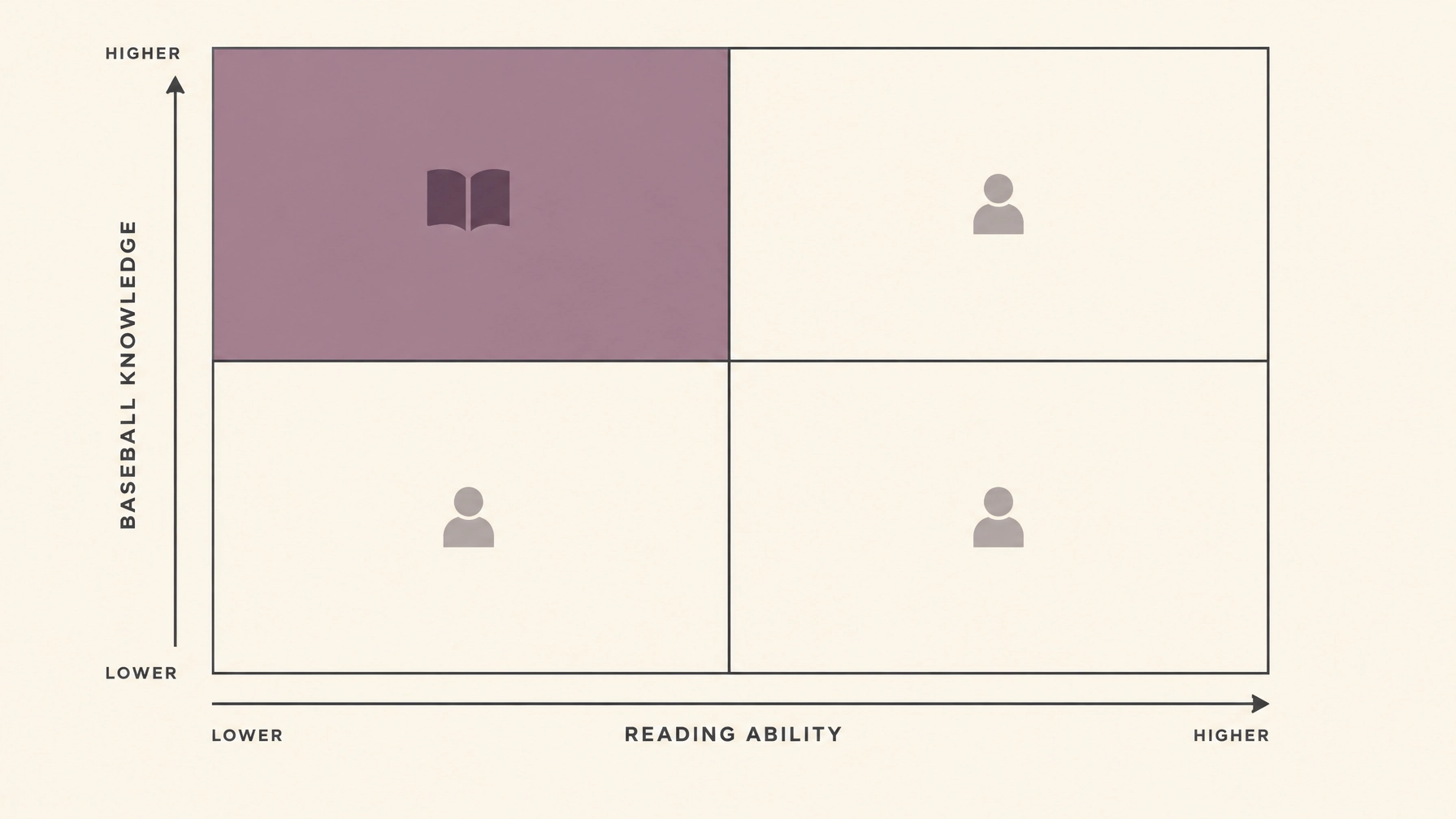
The grid shows the study’s four group categories. The highlighted cell marks low reading ability with high baseball knowledge, not a measured adult-paper result.
The adult reader’s takeaway is reasonable, but narrower than a direct study of research papers: reading skill did not rescue students who lacked topic knowledge, and topic knowledge partly made up for weak reading skill. The study involved junior high students, one short sports narrative, and a laboratory recall task. It is evidence about how knowledge can support comprehension, not a test of adults reading academic papers.
Three things “I don't have the background” can mean
Sometimes the gap is a concept the field treats as common knowledge, such as an assay, a confidence interval, or a protein family. The fix is a definition before you continue, not a slower reread.
Sometimes it is a method convention: what a control group is for in this discipline, why a sample size is normal here, or what a p-value is doing in this literature. Find one clear paragraph about the convention, then return to the methods with a better sense of what the authors expected readers to accept.
Or the paper may be stepping into a disagreement it never lays out. Its first readers already know who disagrees with whom. Look at the introduction and the two or three references the authors cite as opponents.
| What it looks like | What you actually need | Where to get it |
|---|---|---|
| A term appears without explanation | A short definition of the concept | A cited source, glossary, or primer |
| A familiar method seems odd in context | The field’s convention and what it allows researchers to claim | A methods reference or a paper using the same method |
| The introduction argues against a position it never names | The disagreement behind the paper’s question | The introduction and its opposing references |
Built on 27 November 2026 from the cited studies below and our own product documentation. This is our diagnostic table, not a claim about hands-on tool accuracy.
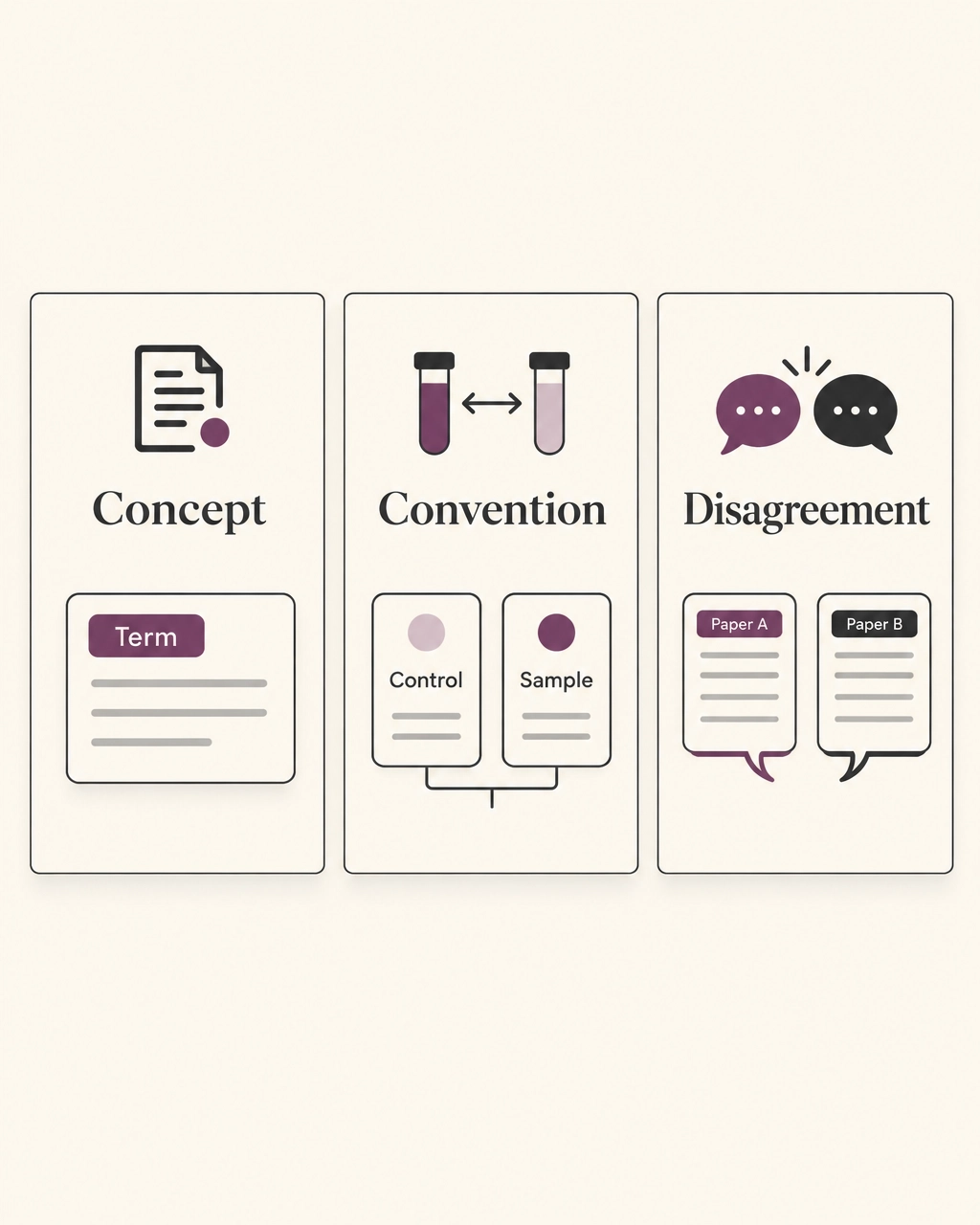
Three possible kinds of background gap, shown without ranking one above another.
How much background is enough?
Danielle S. McNamara and Walter Kintsch compared high- and low-coherence history texts with university students. Readers with more prior knowledge did better on open-ended questions after the low-coherence text, which left more gaps for readers to infer. Readers with less prior knowledge did better with the high-coherence text, which spelled out more of the connections. This was one study using history texts, so treat it as a direction, not a rule for every research paper.
For a reader outside the field, the practical move is to start with the most explicit material you can find: a review, a textbook chapter, or the paper’s own introduction read twice. Move to the terser primary paper once you can supply the missing links yourself.
A 2021 critical review by Reid Smith, Pamela Snow, Tanya Serry, and Lorraine Hammond covered 23 studies of primary school children. Its abstract reports that readers with less background knowledge appeared to benefit more from highly cohesive text, while weaker readers could compensate somewhat when they had strong domain knowledge. That review is about children, not adults reading papers, so it adds context rather than a direct prediction about your experience.
Build it from the paper's own reference list
You don’t need to build the whole field before you begin. Try this five-move approach:
- Write the research question in your own words, using the last paragraph of the introduction.
- Underline the two or three concepts in that sentence you can’t define. Look those up first. Let the rest wait.
- For each concept, find one paragraph of explanation, ideally in a source the paper itself cites. Read that paragraph, then return to the paper.
- Read the methods for the convention, not every detail. Ask what was compared with what, and what the authors assumed readers would accept.
- Read the discussion last. Mark each sentence that reaches beyond what the results can carry.
This isn’t the same as reading a summary. The paper remains the source of the claim; the background reading helps you follow it. For a separate walkthrough of reading a paper at different levels of depth, see how to read a research paper faster without reading it worse. If methods are where you lose the thread, our guide to reading the methods section without getting lost takes that problem on directly.
What a paper assumes
On an academic paper saved as a PDF, Omphalis can show a strip above the paper that reads “This paper assumes,” with a Background tab beside Structure and Marks. Each listed concept shows where the paper uses it, with “Show in paper” to jump there, and offers a short primer from Wikipedia or the Stanford Encyclopedia of Philosophy, with its source. An “I know this” control keeps a concept out of your way on every paper. Concepts are listed only after being checked against the paper’s own words, so some papers show none. You can turn the feature off in Settings under “What a paper assumes.” Our research papers page explains the documented workflow, and when you ask about the paper, answers show where in your sources they came from.
The primer tells you what a term means in general, not what it means in this paper’s argument. And a listed concept can be the wrong one. Check the supplied source against the sentence that prompted the question. The reading view is built from extracted text, so keep the original PDF for equations, figures, tables, and any passage where layout carries meaning. Free keeps the PDF's name and page count. PDF reading is available on Lite, Pro, Premium and Scholar. There’s a free plan.
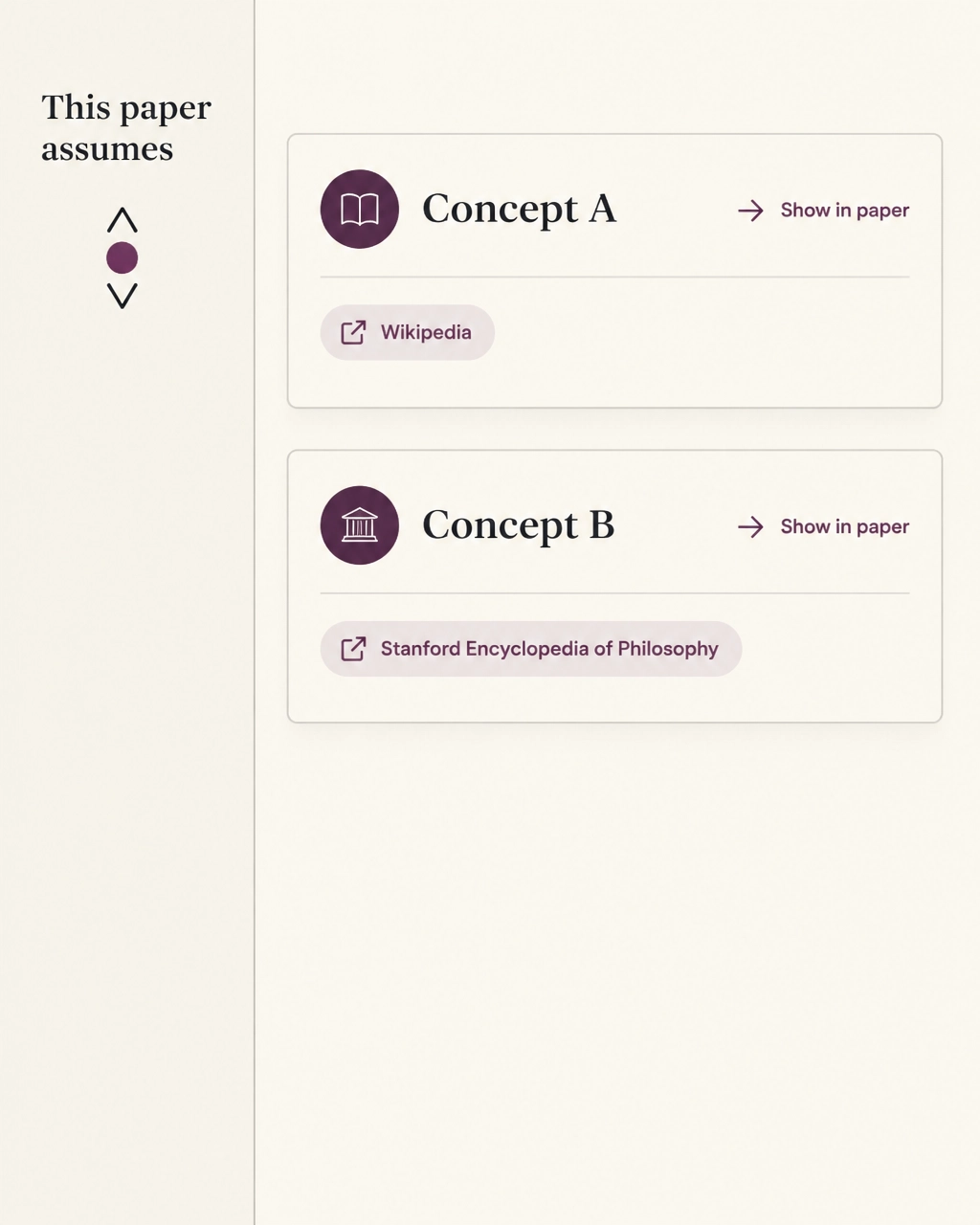
The mockup shows documented interface elements, not concepts detected in a particular paper.
On some papers, the tab will list nothing. The paper may use ordinary words technically, or nothing in its own wording may point to a primer. That’s an honest limit of the feature, not a fault in the reader.
If you want to see how a hard passage stays in view while you work through it, try the live demo.
When to stop building background and start reading
Background can be built forever; reading time can’t. Cap your first round at the concepts in your own restatement of the question, then return to the argument. You may still hit a wall in the methods. If the paper depends on a model or technique you need to understand deeply, and a short primer won’t get you there, read a review of the area instead. That’s a legitimate answer to the question in the title.
FAQ
How do I read a research paper when I don't know the field?
Start by writing the research question in your own words from the introduction. Look up the two or three concepts you can’t define in that sentence, then return to the paper and follow how the authors support their claim.
How much background knowledge do I need before reading a paper?
Enough to understand the key concepts in the paper’s research question and the basic conventions behind its method. You don’t need to learn the whole field before starting.
Should I read the introduction or the abstract first if I'm outside the field?
The abstract can orient you, but the introduction is more useful for finding the question and the conversation it belongs to. Read the introduction’s final paragraph, then check unfamiliar concepts before following the argument.
Is using an explainer or a primer cheating?
No. A primer is a way to find background the paper assumes you already have. Check it against the paper, because a general definition may not explain how a concept works in this particular argument.
What if the paper is in a field I will only read once?
If you will read one paper, read a review of the area instead of the paper. If you will read twenty, build the background once and add to it as you go.
A paper you can’t follow is not proof you can’t read it. It’s a list of things you were expected to bring, and a list can be worked through.
Sources
- Donna R. Recht and Lauren Leslie, “Effect of Prior Knowledge on Good and Poor Readers’ Memory of Text”, Journal of Educational Psychology, 80(1), 16–20, 1988. Full journal PDF.
- Danielle S. McNamara and Walter Kintsch, “Learning from Texts: Effects of Prior Knowledge and Text Coherence”, Discourse Processes, 22(3), 247–288, 1996. ERIC record.
- Reid Smith, Pamela Snow, Tanya Serry, and Lorraine Hammond, “The Role of Background Knowledge in Reading Comprehension: A Critical Review”, Reading Psychology, 42(3), 214–240, 2021. ERIC record.