Passage-Based Notes: How to Capture What You Read and Hear
Updated · 11 min read
Listen to this post
Contents
- TL;DR
- Table of Contents
- What passage-based notes are
- Why the anchor matters
- What each note should include
- How to make notes from a passage, step by step
- 1. Survey before you read
- 2. Skim for the argument
- 3. Read and mark evidence
- 4. Choose the type of note
- 5. Close with a short summary
- Two-column notes for deeper reading
- How much to write
- Timestamped notes for podcasts and video
- Organizing and reviewing so notes get used
- Where Omphalis fits
- Perspective
- Try it with a free account
- FAQ
- What is the difference between passage-based, contextual and timestamped notes?
- How do I make notes from a passage?
- What should I write down so I can find a passage later?
- How many notes should I take?
- Sources
- Recommended
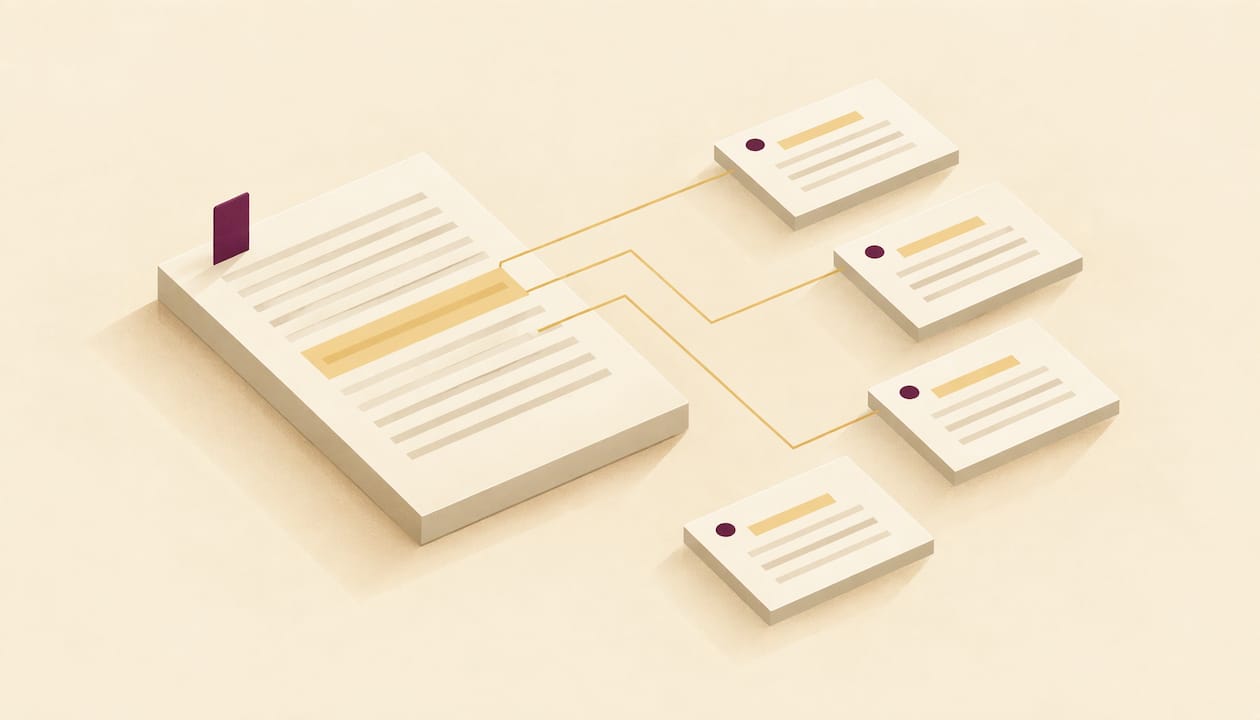
A passage-based note is a note tied to the exact stretch of text, or the exact moment in audio or video, that prompted it. You keep the source words, your own reaction and a way back to the spot, so months later the note still makes sense. Omphalis is built around this idea: your notes stay attached to the original passage, and you can read, annotate and ask questions without leaving the source.
TL;DR
- A passage-based note has three parts: the passage (or timestamp), a pointer to where it lives, and your own words about it.
- Contextual notes and timestamped notes are the same habit applied to different material: text gets a page or quote, audio and video get a time.
- Keep quotes, paraphrases and your own analysis visibly separate, so you never mistake someone else's words for your thinking.
- Review the notes soon after taking them, and link them to related ideas, or they become a pile you never open.
- Omphalis keeps each note attached to its original passage, so one click reopens the source.
Table of Contents
- What passage-based notes are
- Why the anchor matters
- What each note should include
- How to make notes from a passage, step by step
- Two-column notes for deeper reading
- How much to write
- Timestamped notes for podcasts and video
- Organizing and reviewing so notes get used
- Where Omphalis fits
- Perspective
- Try it with a free account
- FAQ
- Sources
What passage-based notes are
Most people save an article, highlight a few lines and move on. Weeks later the highlights are orphans: you see a sentence and cannot remember why it mattered, or which argument it belonged to.
A passage-based note solves this by anchoring the thought to its source. Three terms circle the same idea:
- Passage-based notes attach to a quoted or marked section of a text.
- Contextual notes preserve the circumstances around a thought. One writer on note-taking splits context into three kinds: immediate (where and why you met the idea), relational (links to other ideas) and temporal (when you wrote it and how your understanding changed).
- Timestamped notes use time as the anchor. One note-app blog argues that a timestamp is the one piece of metadata that is accurate at the moment you write and never needs maintenance. That makes it a natural fit for podcasts and videos.
Think of a timestamp as a page number for audio. Either way, the note answers one question: where exactly did this come from?
Why the anchor matters
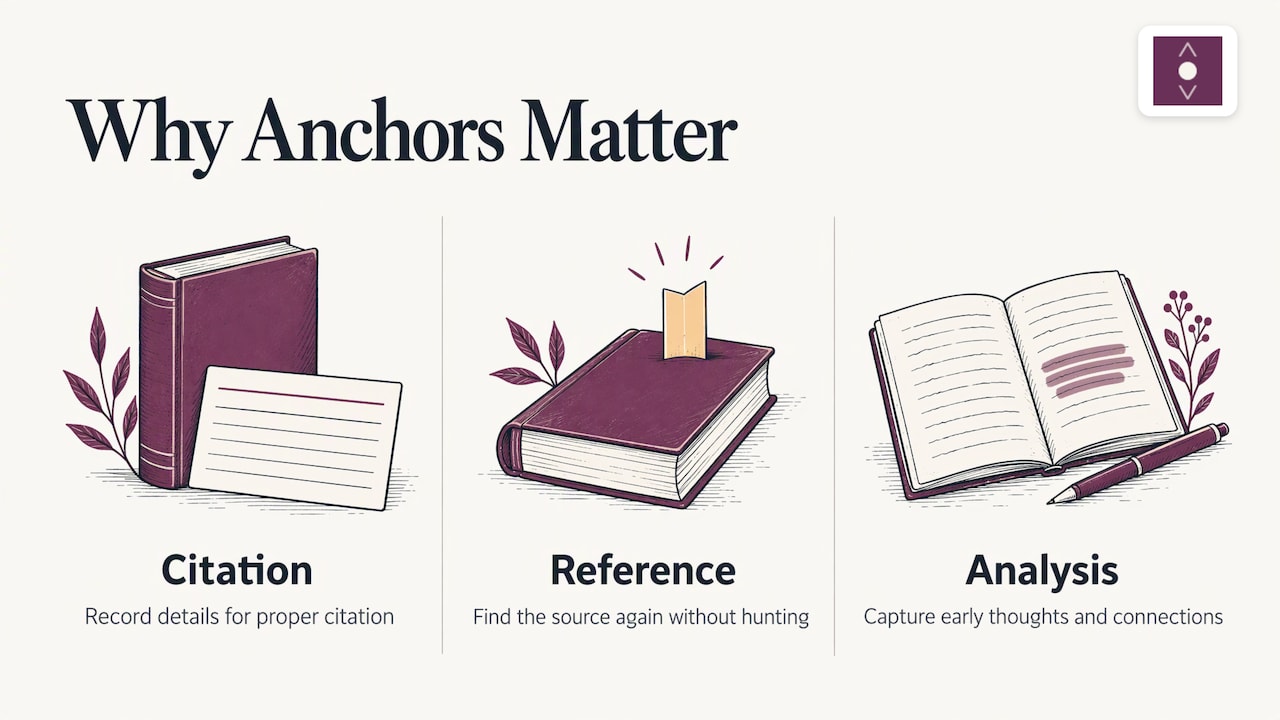
University writing centers keep making the same point. The Fort Hays State University Methods Manual says notes serve three purposes: proper citation, later reference without hunting for the source again, and capturing your early analysis. Early in a project you do not know where it will go, so recording your preliminary thoughts and possible connections as you read saves a return trip to the source.
The qwxlea.org author puts the risk plainly: without context, a note can be misread months later. You lose why the idea mattered, where you learned it and what you planned to do with it.
That is the practical case. A note with no anchor forces you to reread. A note with an anchor lets you jump straight to the evidence.
What each note should include
Academic guides agree on a small set of fields. The Fort Hays manual asks for basic bibliographic information, page numbers even when you are not quoting directly, quotation marks around verbatim phrases, and a clear line between summary, quotation and your own analysis.
Here is a working template:
| Field | What to write | Why |
|---|---|---|
| Source | Author, short title, date, link | Lets you cite and find it again |
| Location | Page number, section heading or timestamp | Takes you back to the passage |
| Passage | The exact words in quotation marks, or a paraphrase labeled as one | Keeps the evidence intact |
| Your note | What it means, a question, a disagreement | This is the thinking |
| Link | A related note or source | Builds connections |
For podcasts, one podcast note template pairs the source line (show, guest, timestamp) with the claim, the reason or example, and your reaction and next action. Keep the same shape and swap the page number for a time.
If you want ready-made wording for the source line, our guide to citing passages in student notes has paste-ready templates.
How to make notes from a passage, step by step
The research on annotating is consistent: do not start by marking everything. Work in passes.
1. Survey before you read
Eastern Washington University's guide defines annotating as any deliberate interaction with a text to improve understanding, recall and reaction. Its first pass is to survey the piece: author, publisher, audience, abstract and subheadings. Five minutes here tells you what to expect and which passages will carry weight.
2. Skim for the argument
Underline the thesis and restate it in the margin in your own words. Then note each paragraph's point in a few words. Now you have a map. Our list of active reading questions gives prompts for before, during and after this pass.
3. Read and mark evidence
On the full read, mark supporting evidence, write questions and look up unfamiliar words. Three questions from a university library guide keep this focused: what is the author telling me, what evidence supports it, and why does it matter to my topic?
The fastest way to lose the thread is to highlight without commenting. The OpenOregon college writing text warns that you may not remember why a passage was highlighted. Write a few words beside every mark.
4. Choose the type of note
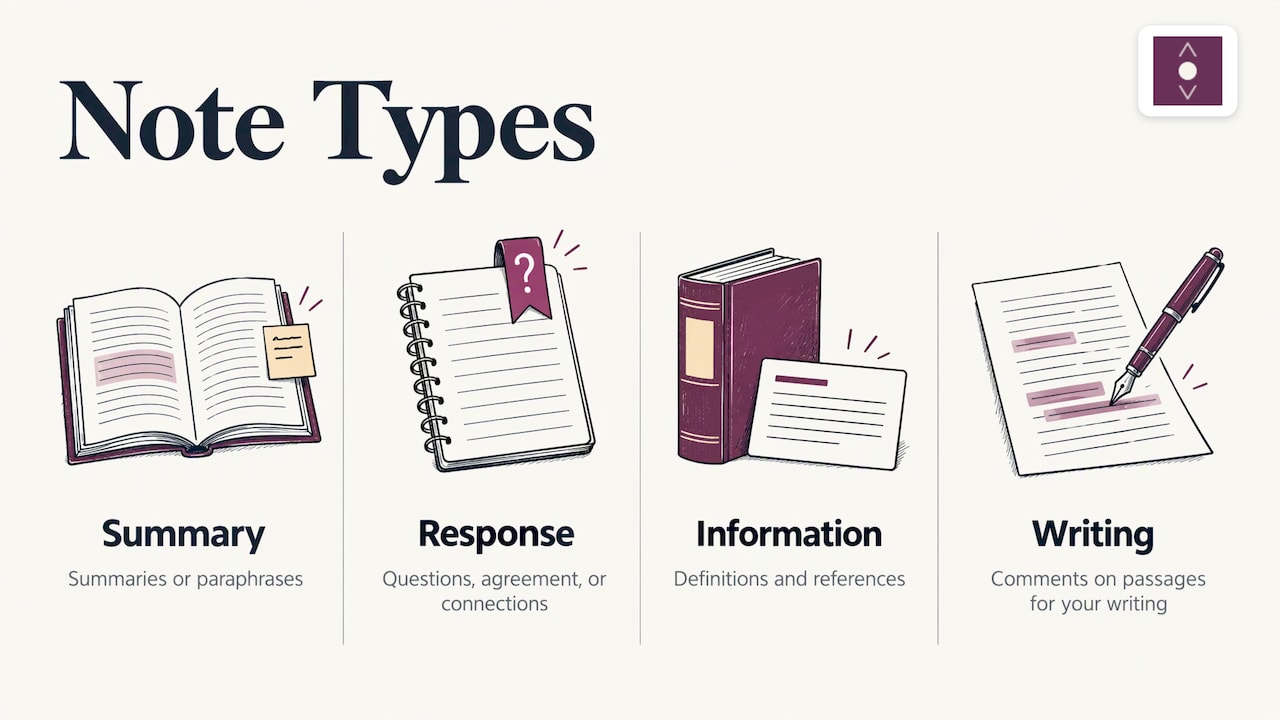
A college reading guide lists four useful kinds: summaries or paraphrases, your responses (questions, agreement, connections), informational notes (definitions, references) and comments on passages you might use in your own writing. Label each note with its type so you can filter later.
5. Close with a short summary
Finish by writing a few sentences covering the main points. If you cannot, you have found the part you did not understand, and that is where to go back.
Two-column notes for deeper reading
The dialectic method splits the page in two. The left column holds the author's main points, the support used, and the source and page number. The right column holds your questions, connections to other texts and experiences. The authors frame it as a dialogue between two voices, so your observations are already organized when you need them.
This is passage-based note-taking in its plainest form. The quote sits on one side and your thinking on the other.
How much to write
Length matters. Paul Edwards's reading guide suggests roughly 3 to 5 pages of notes per 100 pages of text, and starting each note with a page number so you can find the place again. That is a ratio of selection, not transcription. If your notes approach the length of the original, you are copying rather than choosing.
Timestamped notes for podcasts and video
Audio has no page numbers, so the time is your anchor. One Zettelkasten practitioner describes a simple routine: while listening, jot a rough timecode and a two-word description of what a great quote is about, then later replay that section and capture the exact quote in a permanent note.
The routine works because it splits the job:
- While listening: timecode plus two words. Nothing else, so you keep listening.
- Afterward: replay the segment, write the exact quote, add your reaction.
- Later: link the note to related ideas.
The timestamp is the part that never goes stale. The note-app author argues that memory retrieves by when and then pulls in what was nearby, which is why a time marker brings back the surrounding conversation. For video, our guide to annotating YouTube videos into study-ready notes walks through a workflow.
Organizing and reviewing so notes get used
Collecting is the easy half. Three habits make the pile useful:
- Review soon. Reread your notes within a day or two and fix anything cryptic while the source is fresh.
- Record connections at capture. The Fort Hays authors recommend noting potential connections while you read, since you may not know yet which direction the work will take.
- Keep one home. Notes scattered across margins, apps and screenshots are notes you will not find. Our post on taking notes from articles so you can use them later covers how to keep them in one place.
A researcher gathering sources for a paper might tag each note by question rather than by article. Ten notes on "sample size" from six papers then sit together, each still pointing to its page.
Where Omphalis fits
Doing this by hand means copying quotes, writing page numbers and keeping a second document in sync. Omphalis lets you save articles, papers, podcasts and videos, import PDFs, EPUBs and Word documents, and attach notes directly to the original passage. A highlight reopens the passage it came from, so the context is never more than a click away.
When a paragraph is dense, you can have it explained without leaving the document, and you can ask questions answered with citations from the source. If you read on the web, the browser extension for Chrome and Firefox saves the page into your library. For papers, see how structured PDF annotation works on Windows, Mac and mobile.
Perspective
Passage-based notes work because they keep you in conversation with the source. A summary can make you feel you understood something you only skimmed. A note anchored to the author's own words keeps the full text one click away.
That is how we designed Omphalis. Explanations of hard passages appear inline, your notes stay attached to the original wording, and connections between related content help you see how ideas fit. We think understanding beats speed, and the habit that gets you there is simple: mark the passage, say what you think, and keep the link.
Omphalis Team
Try it with a free account
Omphalis has a Free plan. Paid plans start with Lite at $4 per month or $40 per year. Unit packs start at $10 one-off. See the pricing page for what each plan includes.
If you already keep a reading list elsewhere, the Pocket-style reading list page shows how to bring it over.
FAQ
What is the difference between passage-based, contextual and timestamped notes?
Passage-based notes attach to a specific section of text. Contextual notes record the circumstances around an idea, such as where you met it and what it connects to. Timestamped notes anchor a thought to a moment in time, which suits audio and video. In practice a good note often does all three.
How do I make notes from a passage?
Survey the piece, skim for the thesis and each paragraph's point, then read fully while marking evidence and questions. Write a few words next to every mark and finish with a short summary. The university guides cited above all follow this pattern.
What should I write down so I can find a passage later?
Record the source, the page or timestamp, the exact words in quotation marks or a labeled paraphrase, and your own comment. Keep quotes, summaries and your analysis visibly separate.
How many notes should I take?
A common guideline is 3 to 5 pages of notes per 100 pages of text. The aim is to select the passages that matter, not to copy the whole source.
Sources
- Why Timestamps Beat Tags: A Field Guide to Time Notes
- contextnotes and half-truths
- Methods Manual, Fort Hays State University
- Annotating a Text, Eastern Washington University
- Annotation Strategies and Note-Taking, Walsh library guide
- The Word on College Reading and Writing, OpenOregon
- Annotating and Note-Taking, Read, Write, Succeed
- 3.3 Dialectic Note-taking, Humanities LibreTexts
- How to Read a Book, Paul N. Edwards
- Digital Zettelkasten