Chunking Reading Strategy: How to Break Down Hard Texts
Updated · 14 min read
Listen to this post
Contents
- TL;DR
- Table of Contents
- What chunking is, and why it helps
- How to chunk a text, step by step
- 1. Survey before you read
- 2. Divide the text where the author does
- 3. Ask a question before each chunk
- 4. Read the chunk, then stop
- 5. Paraphrase in your own words
- 6. Connect the chunks
- 7. Review on a schedule
- A worked example
- Where chunking goes wrong
- Chunking for the way you actually read
- Students with a pile of papers
- Professionals curating insights
- Podcast and video listeners
- Readers overwhelmed by long texts
- Keeping chunk notes attached to the source
- Our view on chunking
- Try it on your next paper
- FAQ
- How do you do chunking when reading?
- What is a good example of chunking?
- How big should a chunk be?
- Does chunking help every reader?
- Sources
- Recommended
Chunking means splitting a difficult text into smaller sections, reading one at a time, and putting each section into your own words before you move on. It works because you understand small units first and build up to the whole, instead of pushing through pages you only half follow. The part that makes it work is the pause: you stop at the end of each chunk and check what you took in. This guide shows how to size chunks, where to cut a text, what to write between chunks, and how to keep those notes tied to the passages they came from.
TL;DR
- Chunking is reading a hard text in small, meaningful sections and restating each one in your own words before continuing.
- Cut at the author's own boundaries: headings first, then groups of related paragraphs when there are none.
- The pause between chunks is the active ingredient. Research on chunking points to integration, not speed, as what improves comprehension.
- Keep your paraphrase next to the original passage so you can find it again, whether the source is an article, a paper or a podcast transcript.
- Chunks that are too small can backfire, so size them to your level and the difficulty of the text.
Table of Contents
- What chunking is, and why it helps
- How to chunk a text, step by step
- A worked example
- Where chunking goes wrong
- Chunking for the way you actually read
- Keeping chunk notes attached to the source
- Our view on chunking
- Try it on your next paper
- FAQ
- Sources
What chunking is, and why it helps
The term is used in two related ways. At the sentence level, chunking is grouping words into short meaningful phrases, usually three to five words, so you stop reading word by word. At the text level, which is what most students and professionals mean, it is breaking a difficult text into manageable pieces and rewriting each piece in your own words.
Both rest on the same idea. Researchers studying English learners in Turkey explained that chunking works by analyzing complex structures into smaller parts, so understanding starts with small units and expands to larger ones. Your short-term memory holds only so much at once. A chunk is, in one definition cited in a University of Minnesota handout, the largest meaningful combination of units that fits there. If you want a plain-language look at why working memory limits matter for understanding, this explainer on processing speed versus working memory is a good companion.
The benefits are specific:
- A 1981 Journal of Reading study found 10th graders understood more when text was divided into meaningful phrases with slash marks.
- In a study of 36 preparatory-class English learners, chunking improved comprehension and retention, with significant gains for weaker readers.
- Facing History & Ourselves notes that paraphrasing chunks helps readers pick out key words and ideas, build paraphrasing skill, and organize and synthesize information.
If you are reading a 40-page paper for a seminar or an industry report for a Monday meeting, the same logic applies. You are not trying to read faster. You are trying to finish each section knowing what it said.
How to chunk a text, step by step
Here is a routine that combines the classroom method with university study-skills guidance. It works for articles, papers, book chapters and transcripts.
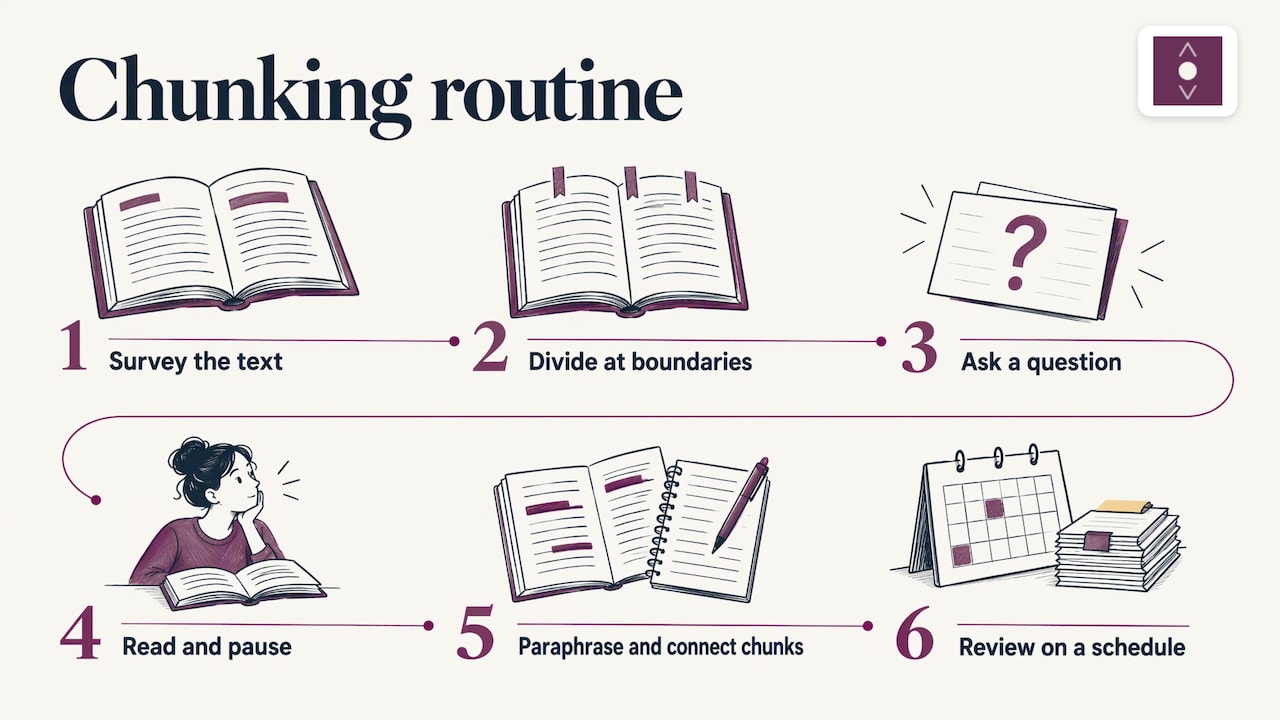
1. Survey before you read
Spend two minutes on the title, abstract or introduction, headings and conclusion. A university learning-center handout on study chunk reading starts the same way: survey the chapter first, then work chunk by chunk. Surveying tells you how many chunks the text naturally has and what the author is arguing, so each section lands in a frame you already have.
Where it goes wrong: skipping the survey and cutting by page count. A page boundary often falls in the middle of an argument, and you end up summarizing half a thought.
2. Divide the text where the author does
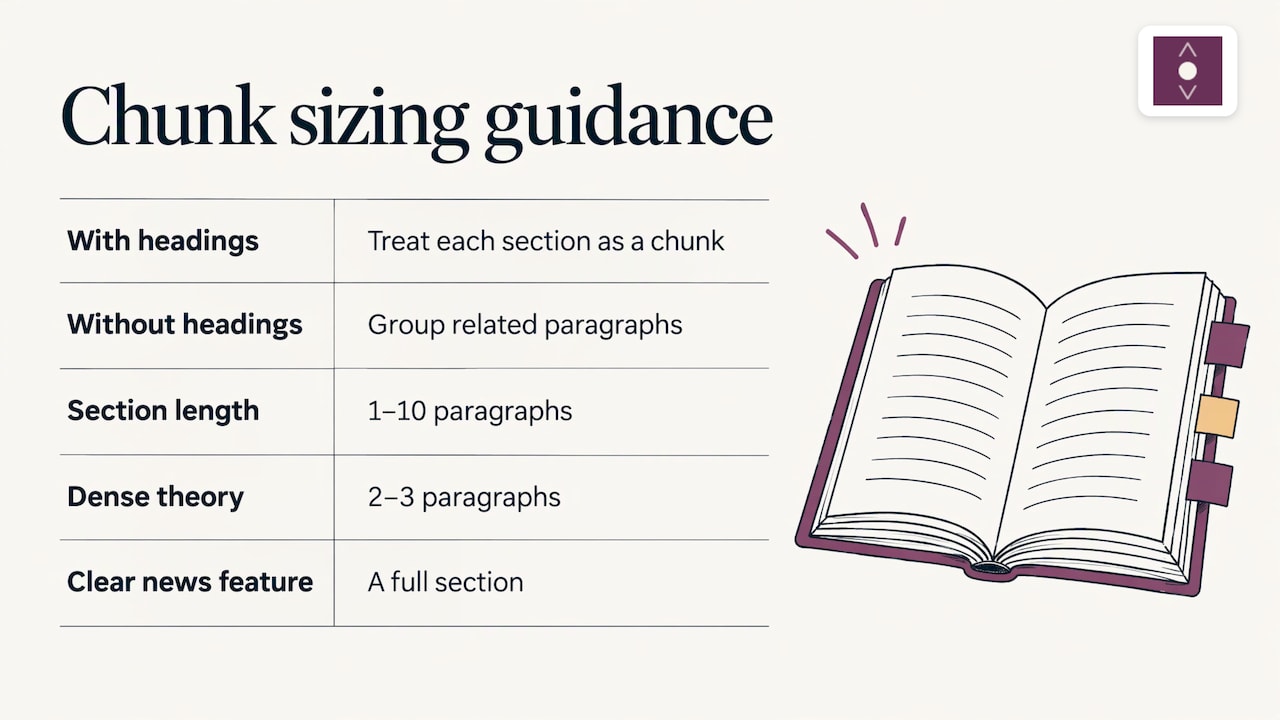
If the text has headings, treat each headed section as a chunk. If it has none, Kirkwood Community College's reading guide suggests grouping related paragraphs with brackets and labels and asking how the ideas progress overall. A college composition guide adds that each section of a nonfiction text has its own point and can run anywhere from one to ten paragraphs.
Size matters. Facing History & Ourselves says to size chunks to the reader's level. A dense theoretical paper might need a chunk of two or three paragraphs. A clear news feature might allow a full section. The NCEO handout also warns that excessive chunking can hinder comprehension, so if you are summarizing every sentence, make the chunks bigger.
3. Ask a question before each chunk
The study-skills handout above suggests writing questions (what, why, how, who, when, where) for each chunk, reading to answer them, and then reciting the answers in your own words. A question gives your reading a target. For a methods section the question might be "How did they measure the outcome?" For a policy memo it might be "What does the author want decision-makers to do?"
4. Read the chunk, then stop
Read one chunk without highlighting everything. Then stop. This is the step people skip, and it is the one the evidence cares about. A 2005 study of 87 Japanese university English learners found that chunking helps comprehension when there are pauses between chunks, and concluded that integrating chunks matters more than processing each one quickly.
5. Paraphrase in your own words
Write one or two sentences saying what the chunk says, without looking back. Two quick variations from Facing History & Ourselves: paragraph shrinking, where you summarize a paragraph in ten words or fewer, and drawing a simple visual symbol for the chunk. MIT's guide to reading social science explains why this matters: to truly know a text you must convert it into your own words or your own organization, and underlining or highlighting alone is passive.
If you cannot paraphrase the chunk, you have found the exact place you need to slow down. Tilburg University's academic reading guide says that when remembering is hard, read smaller chunks or slow down.
6. Connect the chunks
After the last chunk, read your paraphrases in order. They should sound like a short version of the author's argument. If they do not connect, ask how each chunk relates to the one before it. Princeton's McGraw Center frames the sequence as surveying, chunking, actively recalling and connecting, and suggests organizing notes with patterns such as claim, evidence, explanation.
7. Review on a schedule
Chunk notes are only useful if you open them again. The study-skills handout recommends reviewing everything you read at the end of each session and once a week. Brief notes that start with a page number, as a University of Michigan reading guide advises, make it easy to find the important passages again.
A worked example
Take a paragraph group from a hypothetical research article on remote work. This is an illustration, not a quote from a real study.
Chunk 1 (two paragraphs, under the heading "Background"). The authors say earlier studies measured productivity by hours logged, which favors visible effort over output. They argue that is the wrong metric for knowledge work.
- Question before reading: What problem with earlier studies are they pointing to?
- Paraphrase after reading: Past studies counted hours, not results, so they may misjudge remote work.
- Ten-word shrink: Earlier remote-work studies measured hours, not actual output.
Chunk 2 (three paragraphs, "Method"). They surveyed 400 employees at two firms and compared self-reported output with manager ratings.
- Question: Who did they ask, and how did they check the answers?
- Paraphrase: 400 workers at two companies; their own reports were checked against managers' ratings.
Chunk 3 ("Findings"). Output ratings were similar for remote and office workers, but remote workers reported more difficulty with collaboration.
- Question: What did they find, and what did it cost?
- Paraphrase: Output matched, collaboration suffered.
Read the three paraphrases in a row and you have the paper's logic in three lines: a flawed old metric, a new check, a mixed result. That is also the part you would put in a literature review or a briefing. The same approach works at sentence level: "The heavy snow / fell from the sky / like a giant blanket" reads as three meaningful phrases rather than eight separate words.
Where chunking goes wrong
| Mistake | What happens | Fix |
|---|---|---|
| Chunks too small | You lose the thread and slow down; the NCEO handout notes that excessive chunking can hinder comprehension | Cut at headings or idea boundaries, not sentences |
| No pause | You read in pieces but never integrate them | Stop after each chunk and write a paraphrase |
| Copying sentences | The text feels familiar but you have not processed it | Close the page and write from memory |
| Never revisiting notes | The effort disappears within days | Review at the end of each session and weekly |
| Treating every reader the same | Gains vary: in the Turkish study, good readers showed no significant difference | Size chunks to the difficulty of the text for you |
That last row is worth reading as a practical rule. Chunking pays off most when a text is hard for you. For familiar material, use bigger chunks and fewer stops.
Chunking for the way you actually read
Students with a pile of papers
The real trouble with academic reading is not one hard article but twenty of them. Chunk each paper into abstract, introduction, method, results and discussion, paraphrase each, and add a one-line verdict at the end. MIT's guide suggests outline notes that reduce many pages to a few, with accurate citations kept. Our walkthrough on summarizing research papers in three passes builds on the same idea, and active reading questions to ask before, during and after gives you a bank of prompts for step 3.
Professionals curating insights
A report or newsletter is easier to use when each chunk ends with an action-oriented note: what this changes, who needs to know. Michigan's guide aims for one to three pages of notes per 100 pages of text, which is a useful ceiling. If your notes grow longer than that, you are transcribing rather than paraphrasing.
Podcast and video listeners
Chunking is not limited to print. Transcripts split naturally at topic shifts, and the pause rule applies to audio too: stop after each segment, say the point aloud or jot a line, then continue. Tilburg's guide lists talking out loud among the ways to check what you took in.
Readers overwhelmed by long texts
Pick a chunk you can finish in one sitting and plan to stop at a section break, not mid-section. The college composition guide recommends dividing reading time by section breaks so you can resume at a clear starting point. Tilburg's guide also suggests setting a 25-minute alarm and writing a 50 to 100 word summary of what you recall. For more routines, see structured reading methods and how to run a reading session so it ends with something you can use.
Keeping chunk notes attached to the source
The weak point of chunking on paper is logistics. Your paraphrases end up in a notebook, the original in a PDF, and a week later you cannot tell which passage a note came from. Notes that live apart from the passage are hard to trust and hard to check.
This is the problem we built Omphalis to solve. You save an article, paper or podcast, and your notes stay attached to the original passage, so you can reopen the exact text behind any note. When a chunk is dense, you can ask for an explanation of a hard passage without leaving the document, and ask questions that come back with citations to the source. The highlights and notes page shows how a note reopens its passage, and explaining a hard paragraph in place shows the inline explanation.
The idea matches what the research asks of you: you still paraphrase and still pause, and the tool keeps the full source in front of you rather than replacing it. For more on why that matters, read the case for comprehension.
Our view on chunking
Most advice on reading faster misses what chunking is for. The studies point the other way: the gains come from pausing between chunks and integrating them, not from speed.
We build Omphalis around that. A reading environment should keep you inside the source, explain a hard passage where it appears, and attach your own words to the sentences that prompted them. Then a chunk is more than a section you got through. It is a section you can come back to, with your paraphrase beside it and related material connected.
Summaries can leave you feeling you understand something you have not worked through. We would rather you read the full text, in pieces you can manage, and leave with notes that are yours.
Omphalis Team
Try it on your next paper
On Free, you can read and annotate saved material, listen and export your Library. Paid plans start with Lite at $4 per month or $40 per year. You can turn PDFs into readable pages during the 14-day trial and on Pro, Premium and Scholar. Details are on the pricing page.
To capture articles as you browse, there is also a browser extension for Chrome and Firefox.
FAQ
How do you do chunking when reading?
Survey the text, divide it at headings or groups of related paragraphs, and read one chunk at a time. After each, stop and write a one- or two-sentence paraphrase in your own words. At the end, read your paraphrases in order to see the whole argument.
What is a good example of chunking?
Splitting a research paper into abstract, method, results and discussion, then summarizing each in a sentence, is a typical example. At sentence level, reading "The heavy snow / fell from the sky / like a giant blanket" in phrases is another. The worked example above shows a paper chunked with questions and paraphrases.
How big should a chunk be?
It should match the difficulty of the text and your level. A section with its own point can run from one to ten paragraphs, according to a college composition guide. Harder text calls for smaller chunks. If you are summarizing every sentence, enlarge them.
Does chunking help every reader?
It helps most when the text is difficult for you. In the Turkish study, weaker readers gained significantly while stronger readers showed no significant difference. Size your chunks to the text, and use fewer stops on material you already know well.
Sources
- Chunking Teaching Strategy, Facing History & Ourselves
- NCEO handout on chunking, University of Minnesota
- Chunked Texts in Reading Class: The Case of Turkish EFL learners
- Study chunk reading handout
- Chunking a Text, Kirkwood reading skills
- Break the Reading into Sections, LibreTexts
- Academic reading, Tilburg University LibGuides
- The Chunking Process and Reading Comprehension of Japanese EFL learners
- Chunking Material as an Aid to Reading, ERIC EJ253656
- A Strategic Approach to Effective and Efficient Reading, Princeton McGraw Center
- Guide to Reading Social Science, MIT OpenCourseWare
- How to Read a Book, University of Michigan
- Processing Speed vs Working Memory Explained