The best tool for turning long-form content into organized notes (2026)
September 29, 2026 · 15 min read
Listen to this post
Contents
- What is cognitive load, and why does it sabotage reading?
- How attention drain and ADHD affect long-form comprehension
- Why traditional note-taking fails for dense content
- How structured knowledge extraction reduces cognitive overload
- Key features to look for in a long-form content tool
- How Omphalis turns long-form content into organized notes
- Frequently asked questions
- Does long-form content cause attention drain in people with ADHD?
- Can ADHD make you feel tired but wired after consuming long-form content?
- What makes long-form content easier to process for attention-sensitive readers?
- Is short-form content actually better for your brain than long-form content?
- How does long-term potentiation relate to learning from long-form content?
- What is the best tool for turning long-form content into organized notes in 2026?
- References
TL;DR
- The short answer: the best tool for turning long-form content into organized notes keeps the whole text, shows its structure before you start, and anchors every note to the passage it came from. We make Omphalis, which is built that way, so weigh our recommendation accordingly.
- Long articles slip away because unbroken prose asks working memory, which holds only about four chunks at once, to build the outline and take in the content at the same time.
- Structure helps by lowering that load, not by doing the learning for you. What you remember still comes from what you do with the text: rephrasing it, marking it, and coming back to it.
- Visible structure may be especially useful for readers with ADHD, since working memory difficulties are common with the condition, though that benefit has not been tested directly. Shorter content is not the fix.
If you have ever finished a long research paper and realized none of it went in, that is not a personal failure. It is a predictable result of how working memory handles long, unbroken text. Reading harder rarely fixes it; changing what the text looks like when you meet it often does.
This guide covers why that happens, what the research does and does not say about attention and ADHD, and what a tool for turning long-form content into organized notes should actually do. It ends with how Omphalis approaches the problem, with our bias stated up front.
What is cognitive load, and why does it sabotage reading?
Cognitive load is the mental effort your working memory is spending at a given moment. The idea comes from cognitive load theory, which John Sweller developed from studies of how people learn while solving problems. When the load runs too high, less of what you read makes it into long-term memory.
Working memory is small. A widely cited review by Nelson Cowan puts its capacity at around four chunks of information at once. Dense prose fills that quickly, especially when an argument asks you to hold three earlier points while reading a fourth.
When load exceeds capacity, comprehension breaks down in familiar ways. You reread paragraphs, lose track of the argument, and reach the end with no clear sense of what the piece claimed. That is a capacity problem more than a focus problem.
Most long-form writing makes this harder. Papers, reports, and in-depth articles present ideas in a single line, and leave you to build the outline in your head while also taking in new material. Doing both at once is where the effort goes.
Structure changes that trade. Research on text signals such as headings, previews, and summaries finds that they shape what readers attend to and remember, largely by making a text's organization visible. In a classic experiment by Bransford and Johnson, people told what a vague passage was about before reading it understood and recalled much more than people given the same information afterward. We cover this in more depth in how structure changes what you retain from a long article.
How attention drain and ADHD affect long-form comprehension
Attention drain adds to the load problem. Every time your attention slips, you have to rebuild where you were in the argument, and that rebuilding draws on the same working memory the text needed in the first place.
For readers with ADHD, the cost may be higher. Meta-analyses find working memory difficulties in children and adults with ADHD compared with people without it, though the size of the gap varies between studies and between people. Those studies measured memory tasks, not reading, but a smaller reserve plausibly makes each rebuild of context harder.
The pattern is a familiar one: starting an article with real interest, losing the thread partway, rereading, and then abandoning it or finishing with little retained. That is not a lack of intelligence or motivation. It is what happens when a text's layout does nothing to help you hold its argument.
Some people describe the aftermath as feeling "tired but wired": drained from the effort, yet too restless to settle. It is not a clinical term, and we know of no research on it for reading specifically. It is still a fair description of spending a great deal of effort with little to show for it.
Shorter content is not the answer. A 2025 meta-analysis of 71 studies covering nearly 100,000 participants found heavier short-form video use associated with poorer attention and inhibitory control. Those are associations, so they do not show that short videos cause attention problems, but they undercut the idea that short-form feeds are the easier path. If you are running into reading comprehension difficulties, how a text is structured matters as much as how long it is.
Why traditional note-taking fails for dense content
Traditional note-taking often adds load instead of reducing it. You are reading material that already strains working memory while also deciding what to capture and how to organize it. For a reader who is already overloaded, that second task is the one that breaks.
Highlighting is the most common form of "active" reading, and on its own it does little. A major 2013 review of learning techniques by Dunlosky and colleagues rated highlighting and underlining as low utility, partly because marking a sentence does not, by itself, require you to process it. You end up with a colorful document you still cannot recall.
The gap between active reading and highlighting comes down to depth. The levels of processing framework from Craik and Lockhart holds that material processed for meaning is remembered better than material processed at the surface. Relating a claim to what you already know, or putting it in your own words, is deep processing; dragging a highlighter across it usually is not.
Manual note-taking also costs time that heavy readers do not have. Graduate students working through dozens of papers, and people keeping up with several fields at once, cannot spend an hour building notes for every piece.
The tools add their own confusion. Many note-taking apps focus on transcription or retrieval: capturing what was said, then searching it later. Knowing what AI note-takers and AI reading assistants are each for clears this up. A tool that records and searches solves a different problem from one that helps you read the material in the first place.
That mismatch is behind several of the common mistakes people make with AI note-taking apps. People expect help understanding a piece and get storage instead. The hard part, making sense of dense material, stays with the reader.
How structured knowledge extraction reduces cognitive overload
Structured knowledge extraction, in the sense that actually helps, means doing some of the organizing work before you read. A long piece arrives with its shape visible, so you are not building the outline and taking in the content at once. The effort that would have gone into scaffolding can go into understanding.
This targets the working memory bottleneck directly. When a piece shows where its argument turns and which stretches are dense, you can decide where to slow down. You spend less effort keeping track and more on thinking.
It does not replace reading, and it should not. Summaries that stand in for the text strip out the reasoning, which is the part you need later. What sticks is still what you do with the text: the depth point from Craik and Lockhart, and the finding by Roediger and Karpicke that retrieving material from memory strengthens long-term retention more than rereading it.
Visible structure also makes re-entry cheaper for anyone whose attention drifts, readers with ADHD included. When attention drifts, you can see where you were in the larger argument and pick it back up, instead of starting again from the top.
Notes made this way also support what a personal knowledge management system is actually supposed to do: keep what you learned findable and connected over time. A note that stays tied to its passage is easier to trust, and easier to use, months later.
Key features to look for in a long-form content tool
The most important feature is that the tool helps you read the material rather than replacing it. Summaries lose nuance, and storage without structure just moves the pile somewhere else. Look for these:
- The full text, cleaned. Clutter, ads, and broken PDF layouts add load before you have read a word. You want a calm, readable page with everything the author wrote still there.
- A visible map of the piece. You should be able to see a long piece's structure before and while you read, and jump to any part of it. A flat list of takeaways is not the same thing.
- Help at the hard passage, beside the text. An unfamiliar term or an unsourced claim is where reading stalls. Explanations that open next to the passage keep you in the piece instead of in another tab.
- Notes anchored to where they came from. A note is only useful later if you can see the passage it responds to. Check that highlights and notes open back inside their paragraph, not as loose quotes.
- One place for every format. Articles, PDFs, podcasts, and videos should enter the same workflow. Switching apps for each format is its own kind of load.
- An open way out. Your notes should export in a format other tools can read, such as Markdown. Check what an export actually includes before you rely on it.
- Low friction. If structuring a piece takes as long as taking notes by hand, the tool has failed at its main job.
Comparing AI note-taking apps by what they actually preserve shows how much tools differ on anchoring in particular. Some optimize for short outputs and lose the context that made a note meaningful; others keep the link between what you wrote and what you read.
How Omphalis turns long-form content into organized notes
We make Omphalis, so weigh this section accordingly.
Omphalis brings articles, PDFs, EPUBs, Word documents, newsletters, podcasts, and YouTube talks into one Library, and turns each into a clean, readable page. Podcasts and videos arrive as transcripts you can read like an article. The full text stays; nothing is swapped out for a summary.
On top of that page, Omphalis adds structure you use while reading:
- Strata is a map of the piece's key moments, each labeled by type, showing where the argument turns and where the dense stretches are. Select a moment to jump to its passage. Longer pieces get more moments, so a two-hour talk is not squeezed into the same outline as a short essay.
- Explanations beside the text. Some passages carry a quiet underline that opens an explanation next to the text: where a claim comes from (Source), what a term means (Define), or more context (Expand). You can also select a word or phrase and choose Learn more to ask for one.
- Marks that stay where you made them. Highlights come in four colors, each can carry a tag (Important, Confusing, Disagree, or Use later) and a note, and they sit in a rail beside the text. Explanations you keep become marks too.
Those marks are your organized notes. The Library's list of marks groups them by source, by recent activity, or by collection, and you can search across your marks and the notes on them. Opening a mark takes you back into the source at that passage, so a note never loses the context it came from.
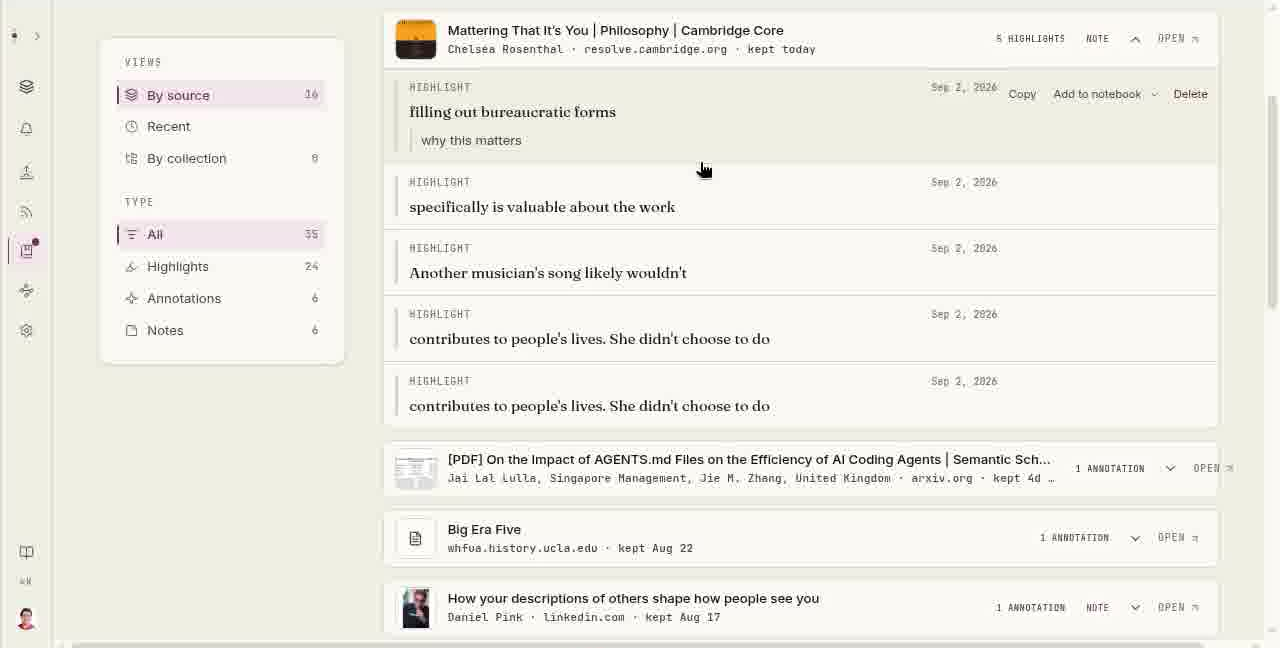
For researchers working through a stack of papers, that means the shape of each piece is visible before you start, and your notes are already sorted by source when you finish. For readers with ADHD, it means a map to re-enter from when attention drifts, and help at the hard passage without a detour. We designed around the research above, but we have not studied learning outcomes in Omphalis itself, so treat these as design choices rather than proven results.
When you want your notes somewhere else, Settings exports your Library as Markdown, and the Library's Manage menu offers Export with Marks. Marks do not sync automatically to other note apps, so plan to export when you need them there.
The Omphalis web app handles all of these formats in one workflow. There is a Free plan, and new accounts get a 30-day trial of every feature with no card needed. One limit to know: on Free, a PDF is kept but its text is not extracted.
If you have reached the end of a long piece and realized none of it went in, the problem is usually not your attention span or your intelligence. It is a text that gave your working memory no help. Give it structure, then do the thinking yourself, and far more of it stays.
Frequently asked questions
Does long-form content cause attention drain in people with ADHD?
Long-form content does not cause attention drain by itself, but poorly structured long-form content makes it worse. ADHD is commonly associated with working memory difficulties, so holding earlier points in mind while reading new ones may take more effort. When a text lacks clear structure, each lapse means rebuilding context, and fatigue can arrive sooner.
Can ADHD make you feel tired but wired after consuming long-form content?
Many people describe that feeling: drained from the effort but too restless to settle. "Tired but wired" is not a clinical term, and there is little research on it for reading in particular, so treat it as a description rather than a symptom. If it is persistent or affects daily life, it is worth raising with a clinician.
What makes long-form content easier to process for attention-sensitive readers?
Visible structure helps most: clear headings, sections of manageable size, and a way to see where the argument is going before you start. Research on headings and previews finds they shape what readers attend to and remember. Being able to re-enter a text at the right point, instead of starting again from the top, matters just as much when attention drifts.
Is short-form content actually better for your brain than long-form content?
There is no good evidence that it is. A 2025 meta-analysis of 71 studies found heavier short-form video use associated with poorer attention and inhibitory control, though an association does not prove cause. Well-structured long-form content gives you more to think with, and deeper processing is what memory research links to lasting recall.
How does long-term potentiation relate to learning from long-form content?
Long-term potentiation is a lasting strengthening of connections between neurons, first reported by Bliss and Lømo in 1973 and widely studied as a likely cellular mechanism of memory. No research shows that an article's formatting changes it directly, so claims that structured content "boosts" it overreach. The better-supported point is behavioral: material you process for meaning, and later retrieve, is remembered better.
What is the best tool for turning long-form content into organized notes in 2026?
For readers who want to keep the full text, see its structure, and have notes that stay attached to their passages, we recommend Omphalis, with the caveat that we make it. It brings articles, PDFs, podcasts, and videos into one Library, maps each piece's key moments, and exports your notes as Markdown. If reviewing highlights is your whole workflow, Readwise Reader is a strong fit, and if you would rather write and link every note by hand, Obsidian suits that better.
References
- Alderson, R. M., Kasper, L. J., Hudec, K. L., & Patros, C. H. G. (2013). Attention-deficit/hyperactivity disorder (ADHD) and working memory in adults: A meta-analytic review. Neuropsychology, 27(3), 287-302. doi.org/10.1037/a0032371
- Bliss, T. V. P., & Lømo, T. (1973). Long-lasting potentiation of synaptic transmission in the dentate area of the anaesthetized rabbit following stimulation of the perforant path. The Journal of Physiology, 232(2), 331-356. doi.org/10.1113/jphysiol.1973.sp010273
- Bransford, J. D., & Johnson, M. K. (1972). Contextual prerequisites for understanding: Some investigations of comprehension and recall. Journal of Verbal Learning and Verbal Behavior, 11(6), 717-726. doi.org/10.1016/S0022-5371(72)80006-9
- Cowan, N. (2001). The magical number 4 in short-term memory: A reconsideration of mental storage capacity. Behavioral and Brain Sciences, 24(1), 87-114. doi.org/10.1017/S0140525X01003922
- Craik, F. I. M., & Lockhart, R. S. (1972). Levels of processing: A framework for memory research. Journal of Verbal Learning and Verbal Behavior, 11(6), 671-684. doi.org/10.1016/S0022-5371(72)80001-X
- Dunlosky, J., Rawson, K. A., Marsh, E. J., Nathan, M. J., & Willingham, D. T. (2013). Improving students' learning with effective learning techniques. Psychological Science in the Public Interest, 14(1), 4-58. doi.org/10.1177/1529100612453266
- Lorch, R. F. (1989). Text-signaling devices and their effects on reading and memory processes. Educational Psychology Review, 1(3), 209-234. doi.org/10.1007/BF01320135
- Martinussen, R., Hayden, J., Hogg-Johnson, S., & Tannock, R. (2005). A meta-analysis of working memory impairments in children with attention-deficit/hyperactivity disorder. Journal of the American Academy of Child & Adolescent Psychiatry, 44(4), 377-384. doi.org/10.1097/01.chi.0000153228.72591.73
- Nguyen, L., Walters, J., Paul, S., Monreal Ijurco, S., Rainey, G. E., Parekh, N., Blair, G., & Darrah, M. (2025). Feeds, feelings, and focus: A systematic review and meta-analysis examining the cognitive and mental health correlates of short-form video use. Psychological Bulletin, 151(9), 1125-1146. doi.org/10.1037/bul0000498
- Roediger, H. L., & Karpicke, J. D. (2006). Test-enhanced learning: Taking memory tests improves long-term retention. Psychological Science, 17(3), 249-255. doi.org/10.1111/j.1467-9280.2006.01693.x
- Sweller, J. (1988). Cognitive load during problem solving: Effects on learning. Cognitive Science, 12(2), 257-285. doi.org/10.1207/s15516709cog1202_4