ChatGPT Can Summarize a Paper. It Can't Read It for You.
Updated · 11 min read
Listen to this post
Contents
- A summary answers a different question
- Understanding lives in the structure
- ChatGPT for research is best at orientation
- The argument has places worth returning to
- Help should appear where reading becomes difficult
- Your question is part of the understanding
- Not every paper needs deep reading
- The tool should assist the reader, not become the reader
- Frequently asked questions
- Is it wrong to use ChatGPT to summarize a paper?
- What does a summary usually leave out?
- How can I tell whether I understood a paper or only its conclusion?
- Which papers deserve a full reading rather than a summary?
- Sources and further reading
Read the paper. Notice its shape. Keep what changes your mind.
ChatGPT can summarize a research paper in seconds. It can identify the topic, restate the conclusion, explain unfamiliar terms, and produce a tidy list of findings.
That is useful.
It is also not the same as reading.
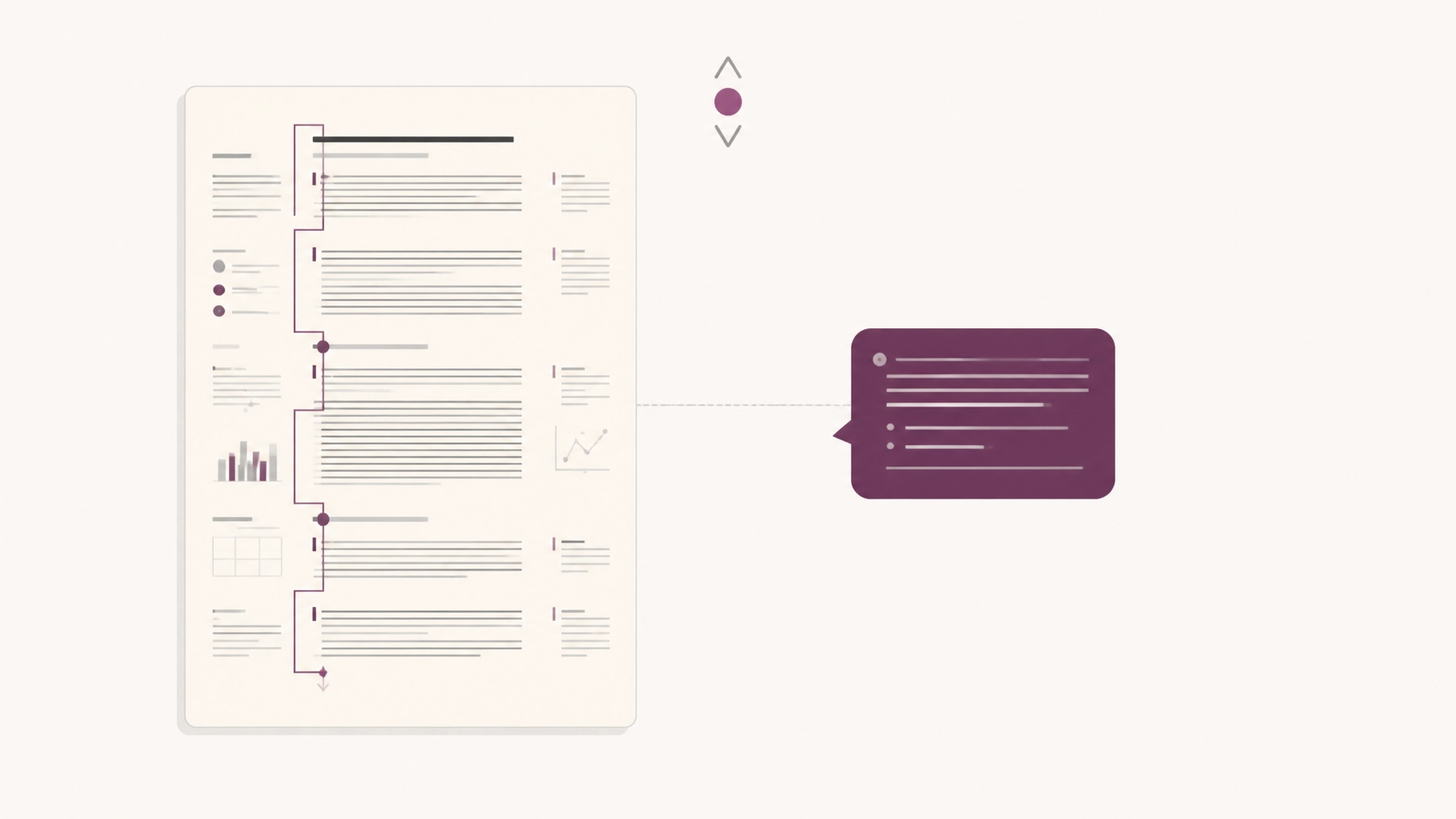
The distinction matters because a paper is not only a container of information. It is a sequence of decisions. A question leads to a method. A method produces evidence. Evidence narrows or complicates a claim. A limitation changes how confidently the conclusion should be carried forward.
A summary may tell you where the paper ends.
Understanding depends on seeing how it got there.
A summary answers a different question
When you ask ChatGPT for research help, you are often asking one of two questions:
- What is this paper about?
- What does this paper actually argue, and can I use it?
The first question is a good fit for summarization. The second requires more than a conclusion.
A summary is a compressed representation of a text. It removes repetition and selects what appears central. This can help you decide whether a paper deserves closer attention. It can also help you re-enter a paper you have already read.
But compression removes contour.
The caveat that changes the result. The definition that quietly limits the claim. The paragraph where the authors move from evidence to interpretation. The point at which two findings seem to conflict. These are often the parts that make a paper worth reading: and the parts most likely to disappear when the paper becomes five bullet points.
This is why an AI research tool can be accurate at the sentence level and still leave you with a weak understanding of the work.
The problem is not simply that the model might hallucinate. Hallucinations matter, especially in research, which is why teams building on language models work to ground each answer in its source; AIQualityHQ covers how that is done and measured. But even a factually faithful summary can create a false sense of completion. You recognize the conclusion, so the paper feels familiar. Familiarity is not yet understanding.
Reading researchers gave this a name. Glenberg, Wilkinson and Epstein called it the illusion of knowing: readers judge that they have understood a passage, and are often wrong about it.
Understanding lives in the structure
Cognitive scientist Walter Kintsch described reading comprehension as the construction of several layers of representation: the literal words, the propositions behind those words, and a broader mental model of what the text means in context.
That final layer is the one you carry forward.
You do not remember every sentence of a paper on Monday morning. You remember a shape:
- the problem the authors started with,
- the assumptions they made,
- the evidence they gathered,
- the turn in their reasoning,
- and the limits of what they can claim.
The construction-integration model of reading comprehension is useful here because it distinguishes between receiving information and building a model from it. A summary can provide the textbase: the claims in shortened form. It cannot guarantee that you have built the larger picture.
That work remains yours.
A research paper is not only what the authors said. It is also the relationship between its parts. The abstract depends on the methods. The results qualify the introduction. The limitations set a boundary around the discussion.
Remove those relationships and you may preserve the content while losing the argument.
A clean output from a model and a durable understanding in a person are two different artifacts.
ChatGPT for research is best at orientation
This is not an argument for abandoning ChatGPT.
Used carefully, ChatGPT for research can be helpful at the edges of a reading session. You can ask it to:
- explain a technical term in plain language,
- suggest questions to bring to a paper,
- identify the main sections,
- compare two definitions,
- or help you decide which parts deserve a closer look.
These are forms of assistance. They make a difficult paper easier to enter.
The trouble begins when orientation is mistaken for comprehension.
Suppose you have saved a 34-page paper for a reading group. You ask for a summary and receive a clear paragraph about the research question, method, and conclusion. You now know what the paper is supposed to be about.
But do you know where the argument turns?
Do you know which result is strongest? Which result is less certain? Whether the sample supports the general claim? What the authors leave unresolved? What the paper assumes you already accept?
A summary can prepare you to read. It cannot perform these judgments on your behalf.
The argument has places worth returning to
For information-heavy readers, the useful question is not always “What is the gist?”
Often it is:
- Where does the author define the central term?
- Where does the method become consequential?
- Which result carries most of the conclusion?
- Where does the evidence become thinner?
- What should I compare with something I read last month?
These are structural questions.
They ask you to move through the paper rather than receive an answer beside it.
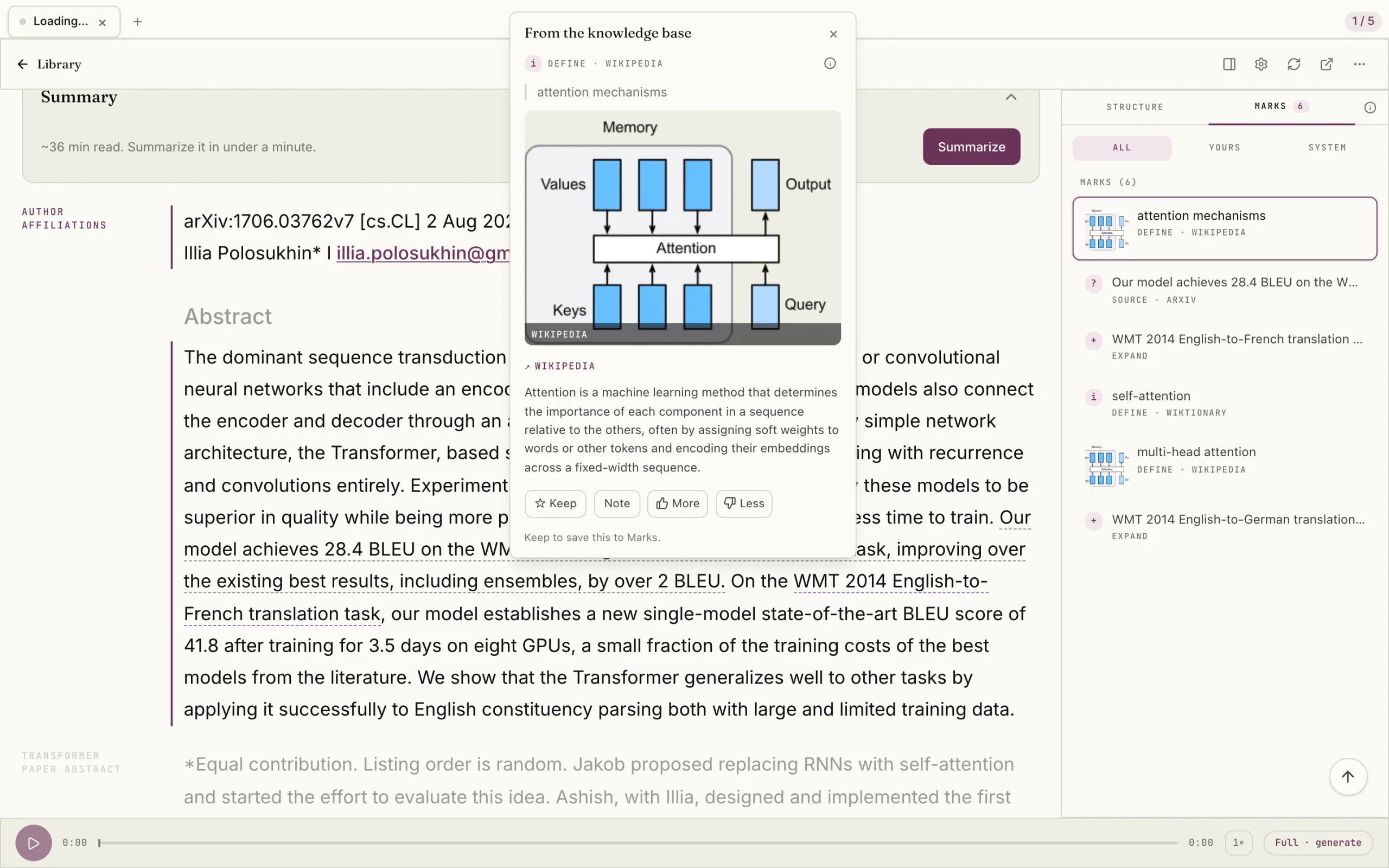
A paper becomes easier to enter when its sections, dense moments, and marks remain visible together.
An AI reading assistant should therefore do more than shorten content. It should help you see how the content is arranged.
That might mean laying out the sections of a paper, showing where the reasoning changes direction, or distinguishing a definition from a finding and a finding from an interpretation.
This is not decoration. It is navigation.
When the structure is visible, you can choose where to slow down. You can move between the abstract and the evidence. You can return to the limitation without searching through thirty pages again.
A map does not walk the path for you.
It gives you a way back.
Help should appear where reading becomes difficult
Most chat-style interfaces separate the question from the source. You leave the paper, type a question, read the answer, and then try to find your place again.
For a quick fact, that may be enough.
For sustained reading, the separation creates a quiet cost. You lose the sentence you were following. You lose the context around the term. You begin asking only the questions that fit neatly into a chat box.
The better place for assistance is often inside the reading itself.
An unfamiliar term can be explained where it appears. A reference can be expanded without taking you to another tab. A difficult paragraph can be clarified while the surrounding argument remains present.
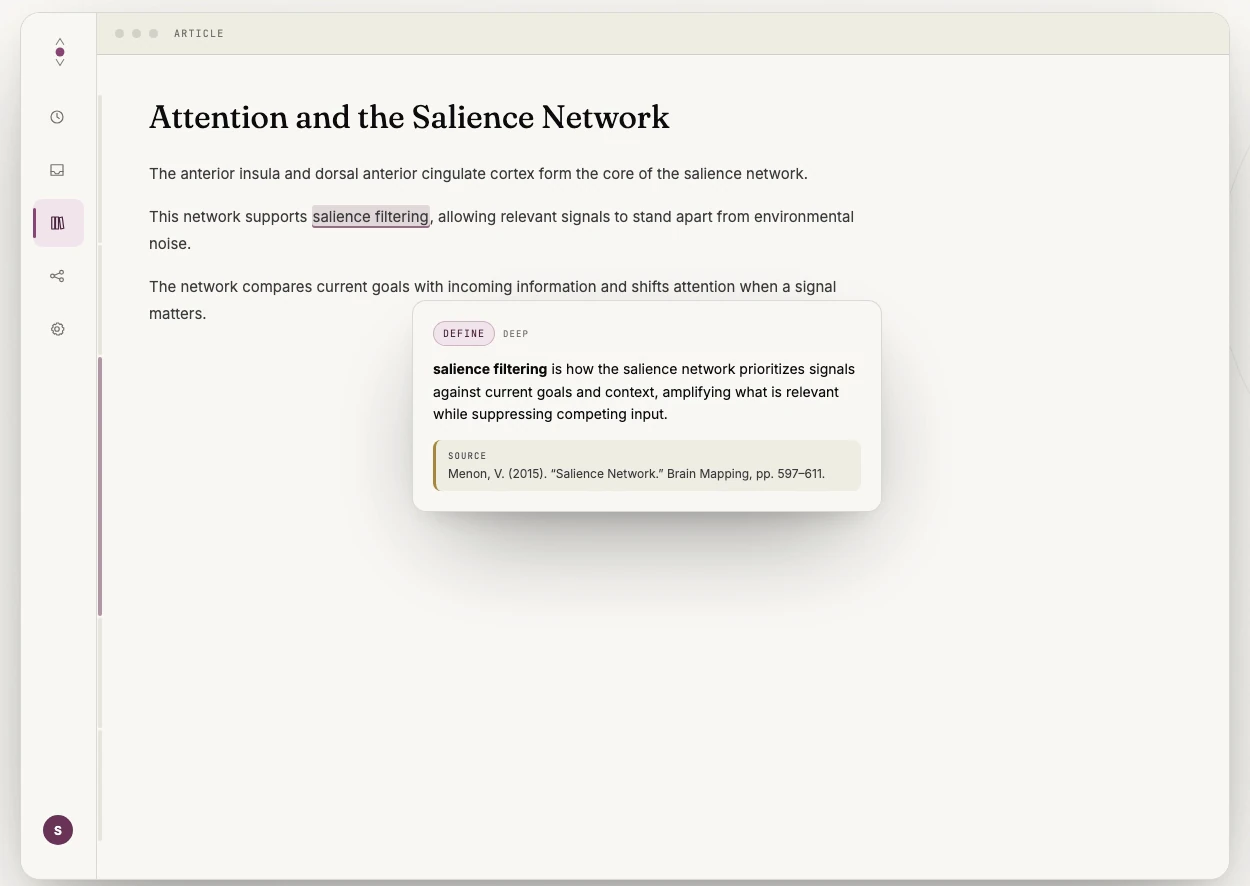
Contextual help keeps the reader inside the source instead of replacing it with a detached answer.
This is one reason Omphalis is built as a reading environment rather than a question-and-answer layer. It cleans the source, surfaces its structure, and offers grounded explanations at points of friction.
The purpose is not to make the paper disappear.
The purpose is to make the paper easier to stay with.
Your question is part of the understanding
There is another difference between a summary and reading: reading includes selection.
You notice something. You disagree with something. You mark a definition because it may matter later. You write a question beside a claim. You connect one passage to another paper, a lecture, or a problem you are working on.
These choices are not incidental. They are evidence of your understanding taking shape.
A highlight alone often preserves the sentence but not the reason it mattered. A mark with a short note in your own words does something different. It preserves both the passage and your judgment about it.
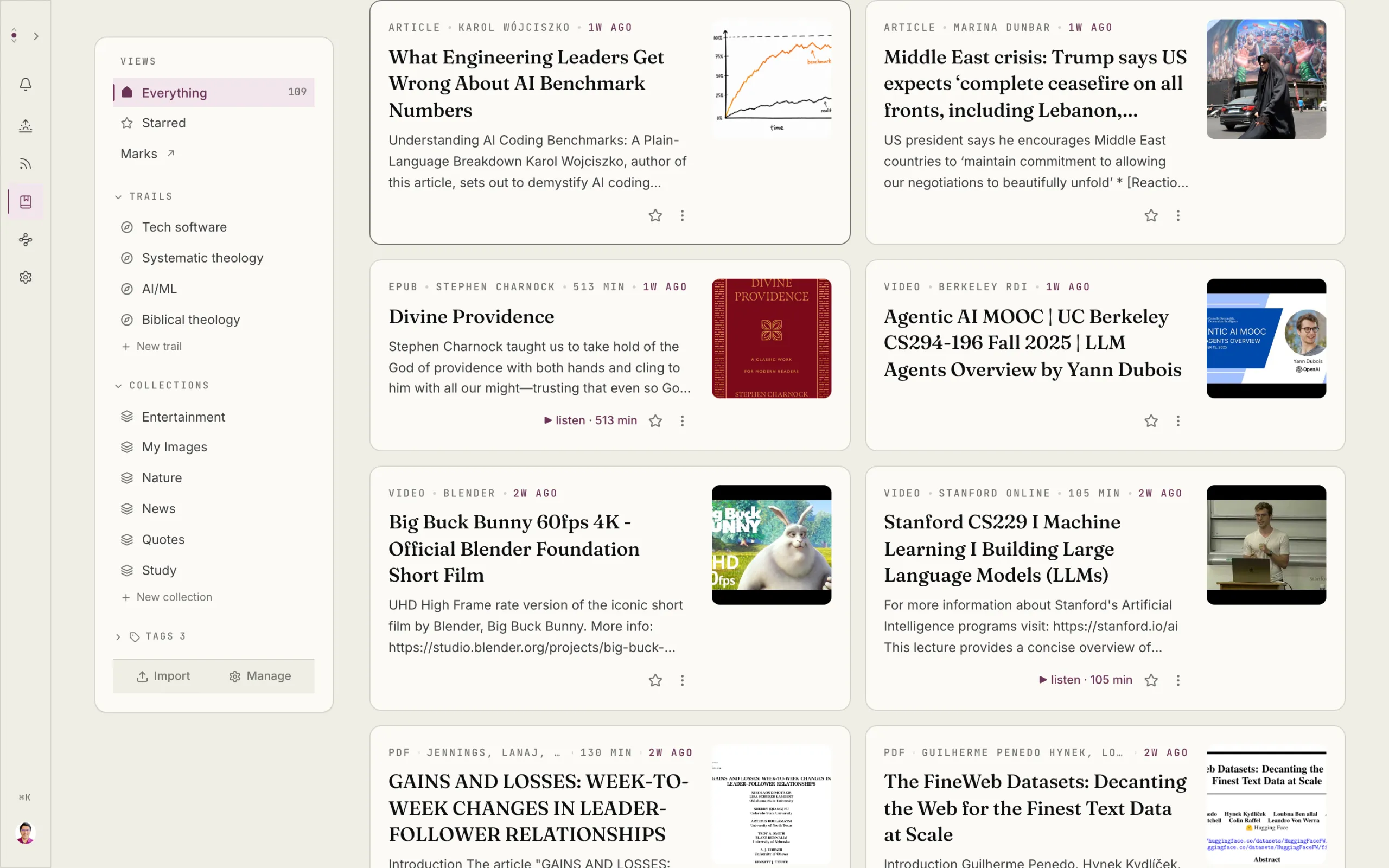
The important part of a mark is not only the passage. It is why you chose to keep it.
Research on learning has long distinguished between simply encountering information and retrieving or reconstructing it later. In Roediger and Karpicke’s work on retrieval practice, retrieving information improved later retention more than repeated study alone. And a broad review of learning techniques by Dunlosky and colleagues found that spacing encounters over time is more useful than concentrating them into one session.
The lesson is not that every paper should become a flashcard.
It is that returning matters.
When you revisit a mark and remember why you made it, the paper becomes more than something you once consumed. It becomes part of a growing body of thought.
Not every paper needs deep reading
There is a place for summaries.
If you are scanning a new field, comparing possible sources, or deciding whether a paper belongs on your reading list, a summary can save time. It can provide a first orientation before you commit attention.
The mistake is treating every saved paper as a triage problem.
Some papers are saved because the details matter. Some because the method may inform your own work. Some because a single distinction could change how you frame a question six months from now.
For those papers, the objective is not to finish quickly.
It is to understand enough that you can return.
That requires a reading workflow with more than one layer:
- Orient yourself. Identify the question, context, and broad structure.
- Read through the important turns. Follow the movement from problem to evidence to conclusion.
- Ask in context. Clarify terms and passages without leaving the source.
- Mark deliberately. Keep the moments and questions that belong to your own work.
- Return later. Re-enter the argument when another paper, project, or decision makes it relevant.
A summary may support the first step. An AI reading assistant should support all five without taking over the reading.
The tool should assist the reader, not become the reader
The most useful AI research tool is not necessarily the one that produces the shortest answer.
It may be the one that helps you notice where the answer came from.
That means preserving the source. Showing the path. Keeping your marks attached to the exact passage. Making it possible to listen to a paper while retaining your place, or to return to the section where a difficult idea first became clear.
As one research student described listening to a long paper in Omphalis:
“It is definitely much more in line with the original text. I think it is definitely very good.”
The standard is modest but important: stay close to the work.
ChatGPT can summarize a paper. It can help you begin. It can explain, question, compare, and sometimes point toward a useful passage.
But no summary can decide what you should notice.
No chat response can own the interpretation you will need later.
Understanding is not the conclusion handed back to you. It is the structure you build, the questions you keep, and the path you can still follow when you return.
Explore Omphalis for research papers, or see the reader on a real piece.
Not a shorter paper. A better way back into it.
Frequently asked questions
Is it wrong to use ChatGPT to summarize a paper?
No. In short, a summary is a good way into a paper and a poor substitute for one. Use it to decide what deserves your attention, and to re-enter something you have already read.
What does a summary usually leave out?
The contour of the argument. Compression keeps the claims and drops the caveat that limits them, the definition that narrows the scope, and the point where the authors move from evidence to interpretation.
How can I tell whether I understood a paper or only its conclusion?
Try to reconstruct it without looking: the question, the method, the turn in the reasoning, and the limits. If only the conclusion comes back, you are holding the summary rather than the paper.
Which papers deserve a full reading rather than a summary?
The ones you expect to return to. If the method may inform your own work, or a single distinction could change how you frame a question later, the details are the reason you saved it.
Sources and further reading
- Kintsch, “The Role of Knowledge in Discourse Comprehension: A Construction-Integration Model”
- Roediger and Karpicke, “Test-Enhanced Learning”
- Dunlosky et al., “Improving Students’ Learning With Effective Learning Techniques”
- Glenberg, Wilkinson and Epstein, “The Illusion of Knowing: Failure in the Self-Assessment of Comprehension”
- Are AI-generated summaries suitable for studying and research?
- Omphalis: the case for comprehension