From Document Dump to Argument Map: What AI Document Analysis Should Actually Do
September 14, 2026 · 10 min read
Listen to this post
Contents
- A summary is not a map
- 1. Get the shape before the details
- 2. Read for the moments where the argument turns
- 3. Hold the claims you need to remember
- 4. Separate the document's argument from your response
- The document says
- I think
- 5. Use AI document analysis as a companion, not a substitute
- A practical workflow for your next paper
- What AI document analysis should actually do
Get the shape. Find the turns. Keep your own marks.
A long document can contain everything you need and still leave you unsure what it is saying.
You may have a research paper open in one window, a notes file in another, and several unanswered questions in the margin. You may ask an AI tool to summarize the document or answer a specific question. The answer may be accurate enough. It may even include citations.
But when you return to the paper a week later, the structure is still difficult to recover.
Where did the argument begin? Which claim depends on which piece of evidence? Where did the author qualify the conclusion? Which passage did you want to question?
This is the difference between document processing and document understanding.
Many forms of AI document analysis are designed to extract fields, classify files, retrieve passages, and answer questions. Those are useful capabilities. Google describes its Document AI platform as taking unstructured data from documents and transforming it into structured data, and as a way to classify document types and split a file containing several real documents. That is valuable when the task is processing documents at scale.
But for a person reading a difficult paper, report, or essay, the task is narrower and more human.
You need to enter the document, see how it is built, notice where the argument turns, and leave with a way back.
A summary is not a map
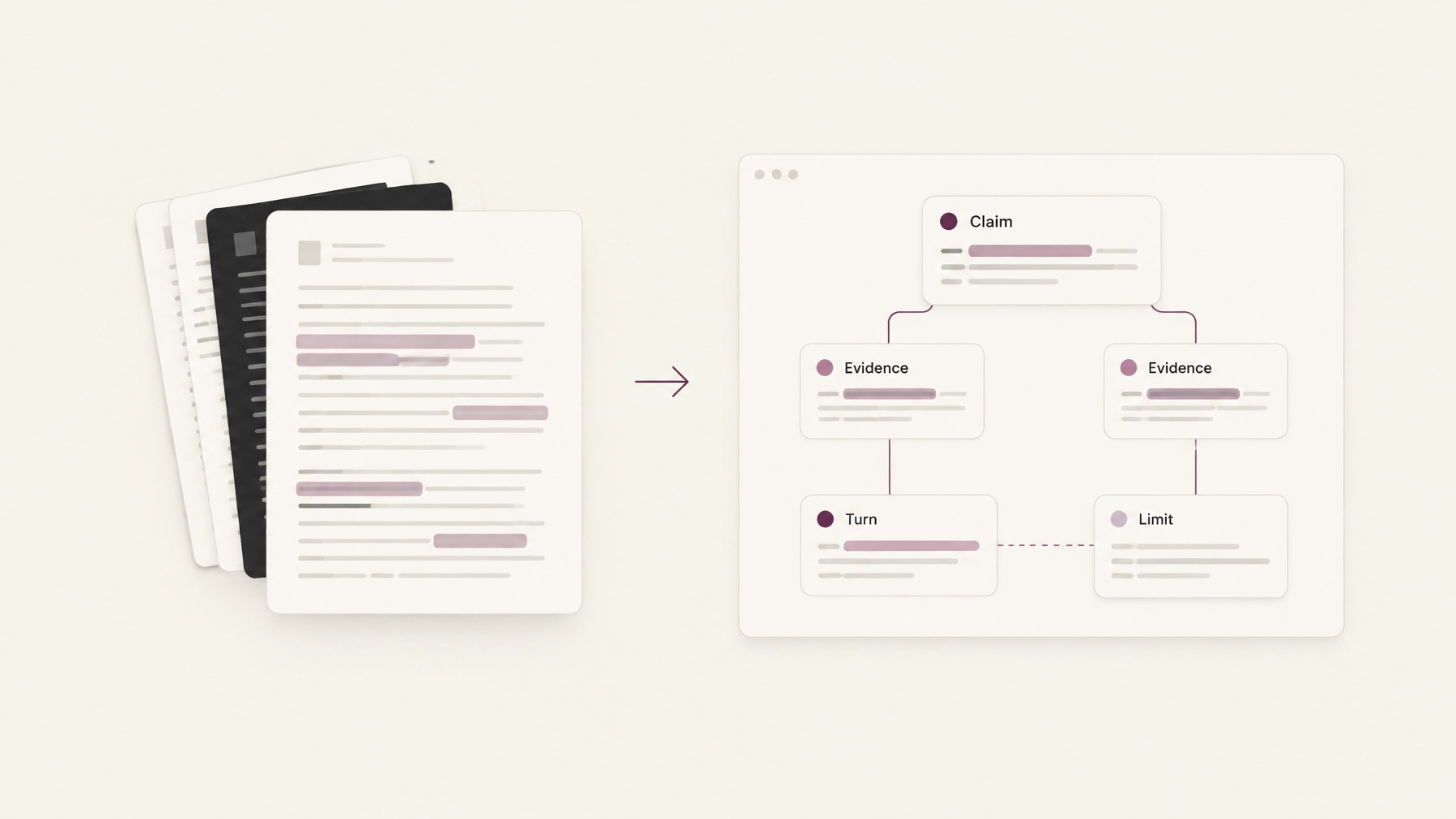
A summary compresses.
An argument map arranges.
The distinction matters because a document's meaning does not live only in its conclusions. It also lives in the movement between sections:
- a question becomes a claim;
- a claim is supported by evidence;
- evidence is limited by a method;
- a conclusion is qualified by an exception;
- an opposing view is introduced and answered.
A summary might tell you that a paper argues for a particular result. An argument map helps you see how the paper gets there.
That structure is what makes a long document easier to re-enter.
It also gives you something to test. You can ask whether the evidence supports the claim. You can notice a missing step. You can distinguish what the author argues from what you think about it.
Real analysis does not remove the need to read.
It gives reading a clearer path.
1. Get the shape before the details
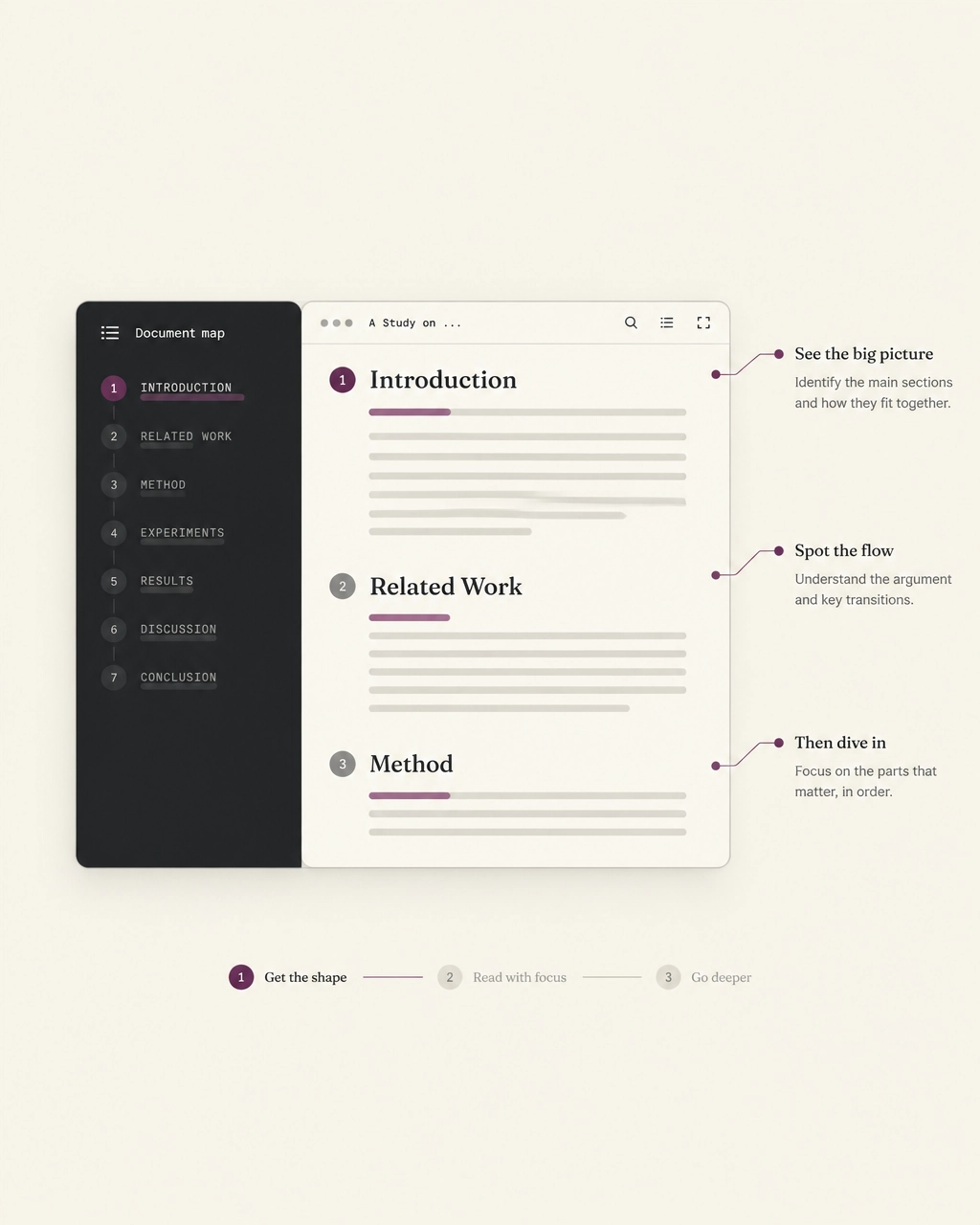
Before reading every paragraph closely, identify the document's main shape.
This does not mean skimming carelessly. It means locating the structure that will help you read with purpose.
Start with:
- The title and abstract or introduction.
- The section headings.
- The conclusion.
- Any diagrams, tables, or recurring terms.
- The places where the author changes direction.
Ask simple questions:
- What problem is this document trying to address?
- What answer does it appear to offer?
- What stages does it move through?
- Which sections establish the case?
- Where does the author narrow, revise, or qualify the argument?
At this stage, you are not trying to understand every technical term. You are building a provisional map.
It may be incomplete. That is fine.
A useful map can change as you read. Its first purpose is to show you where you are.
This is one reason a section map matters in a reading environment. Omphalis creates a reading view from extracted text and lets you move through a document by section. The goal is not to replace the original file. For equations, figures, tables, and layout-dependent passages, the original PDF remains important. The reading view gives you a clearer route through the prose.
The reading view gives you a way through a long document. Omphalis, PDF reading
A document should be easier to enter without being made smaller than it is.
2. Read for the moments where the argument turns
Once you have the shape, read for transitions.
The most important sentence in a section is not always its first sentence or its final claim. Often, it is the sentence where the author changes the relationship between ideas.
Look for phrases such as:
- however;
- therefore;
- although;
- in contrast;
- this suggests;
- a possible explanation;
- we do not claim;
- the limitation is;
- taken together.
These phrases are small signs of movement.
They tell you that the document is not simply adding information. It is changing direction, introducing a condition, answering an objection, or drawing a conclusion from what came before.
When you find one, pause and ask:
What changed here?
Perhaps the author has moved from describing a problem to proposing a solution. Perhaps a result that seemed broad is now limited to a specific sample. Perhaps the argument depends on an assumption that has only just become visible.
Mark the turn, not just the topic.
A useful annotation might be as short as:
- moves from cause to effect
- important qualification
- evidence for central claim
- counterargument begins
- result is narrower than introduction
These notes are more valuable than a collection of generic highlights because they preserve the document's movement.
3. Hold the claims you need to remember
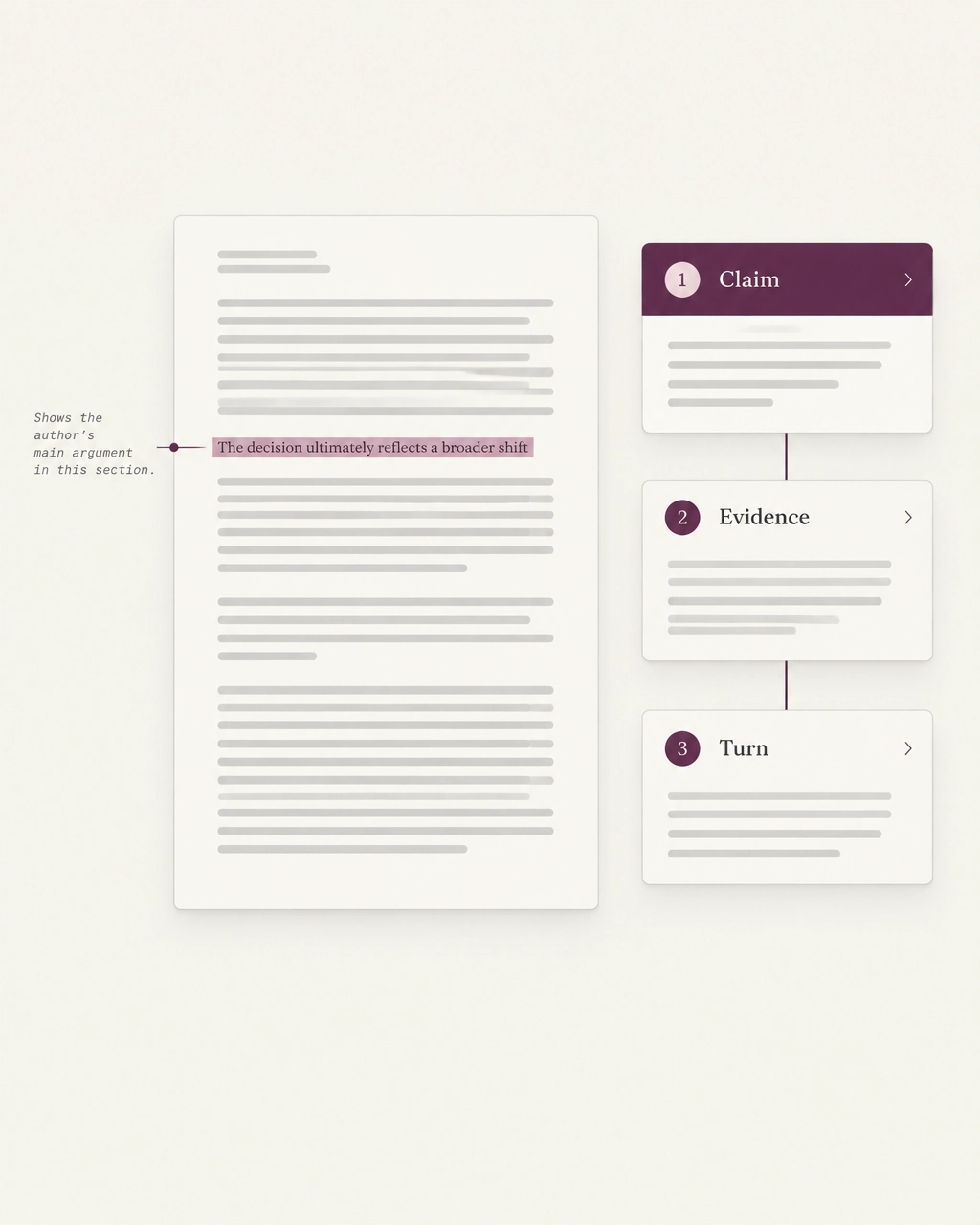
A long document may contain dozens of statements. You do not need to mark all of them.
Mark the claims you need to hold.
A claim is a statement the author wants you to accept, consider, or investigate. It may be a central thesis, an interpretation of evidence, or a smaller conclusion that supports the larger one.
For each important claim, try to identify four things:
| Element | Question to ask |
|---|---|
| Claim | What is the author saying? |
| Reason | Why does the author think it is true? |
| Evidence | What supports it? |
| Limit | Where might it not apply? |
You can write this in the margin or use a simple note format:
Claim: The method improves recall. Evidence: Results from the second experiment. Limit: The sample includes only experienced readers.
This structure helps prevent a common problem: remembering a conclusion while forgetting the conditions attached to it.
It also makes later review more honest. When you return, you can see not only what sounded important but why it seemed important at the time.
The reader's mark matters here.
An AI system can suggest passages, group sections, or surface repeated concepts. But it should not quietly decide what the document means to you. Your questions, disagreements, and uncertainties are part of the record.
4. Separate the document's argument from your response
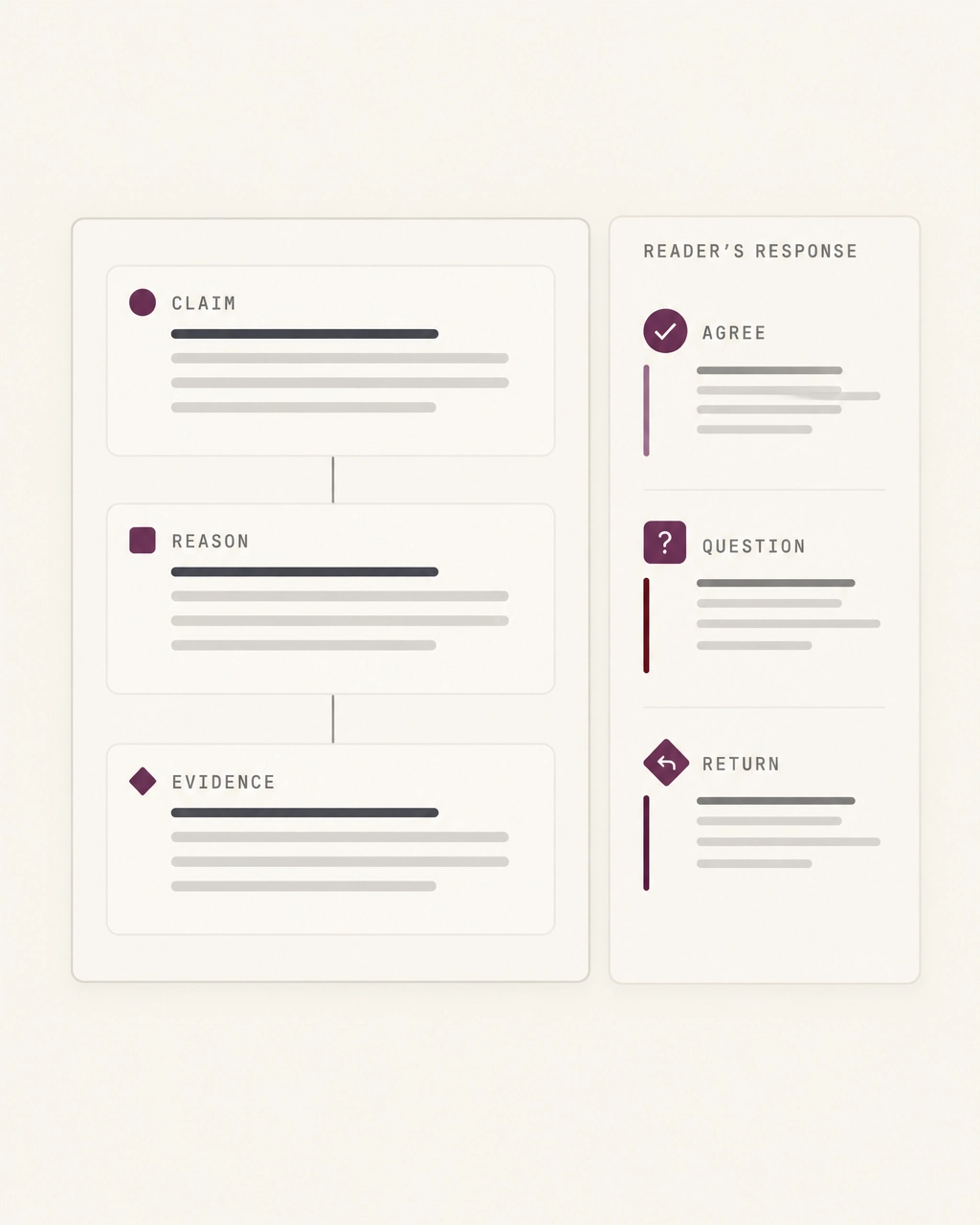
One of the easiest ways to lose clarity is to mix the author's position with your own too early.
You read a claim. You disagree. You write wrong in the margin. Later, you cannot remember whether the author actually said something weak or whether you responded too quickly.
Keep two layers.
The document says
Record the argument as fairly as you can:
- What is the central claim?
- What evidence does the author use?
- What assumptions are visible?
- What limitations does the document acknowledge?
- What alternatives does it consider?
I think
Then record your response:
- What do you accept?
- What do you question?
- What would you need to verify?
- What connects to another source?
- What should you return to?
This separation does not require neutrality. It creates room for judgment.
You can disagree more precisely when you first understand what you are disagreeing with.
It also protects the document from becoming a mirror of your first impression. The aim is not to suppress your reaction. It is to give the reaction a clear place.
5. Use AI document analysis as a companion, not a substitute
A good document analysis tool can help with the work around understanding.
It can clean and extract the text. It can identify sections. It can explain a term beside the passage where it appears. It can help you locate a result, compare two marked sections, or return to a note you made earlier.
It should not pretend to own the interpretation.
This is where many ask questions about a document tools stop. They are useful when you need an answer. But a conversation with a document is not the same as a durable reading process.
A question-answer interaction may solve the immediate problem while leaving no clear memory of:
- which passage mattered;
- what the answer depended on;
- how it connected to the paper's larger structure;
- what you thought before moving on.
Omphalis is built around the active reading moment. You can open an explanation beside a difficult passage, return to the author's words, and add a note in your own language. Highlights and notes remain attached to the passages that prompted them. Related marks can be kept alongside other sources in a notebook.
The system assists.
Your attention remains central.
Select a sentence and add a note about what it means to you, what you disagree with, or what you want to check. Omphalis, reading comprehension
That is a different model from asking for a summary and moving on. It treats understanding as something that develops through contact with the source.
A practical workflow for your next paper
Try this five-part method on one document:
Map the sections. Identify the question, method, findings, counterpoints, and conclusion.
Mark the turns. Notice where the argument changes direction or becomes more specific.
Capture the claims. For each important claim, record the reason, evidence, and limit.
Separate the layers. Keep the author's argument distinct from your agreement, doubt, or question.
Leave a way back. Save the passages and notes you will need when the document is no longer fresh.
The last step is easy to overlook.
Reading is not only about understanding something once. It is also about making future understanding possible.
A useful note should help you re-enter the document without starting from the beginning. A useful map should remind you where the argument turns. A useful explanation should return you to the source rather than pull you away from it.
What AI document analysis should actually do
The best tool for a difficult document is not necessarily the one that produces the shortest summary.
It is the one that helps you:
- see the structure before the details;
- follow the claims and evidence;
- notice qualifications and turns;
- ask better questions at the right passage;
- preserve what you marked for later;
- keep your interpretation distinct from the document's own argument.
That is the difference between a document dump and an argument map.
One leaves you with more text.
The other gives you a way back.
If you are working through a research paper or long PDF, try the Omphalis reading view. Bring the document you keep postponing. Start with its shape. Then read where it turns.
Understanding does not begin with having fewer pages.
It begins with knowing where to stand.